Sunday, April 25, 2010

Copyright Infringement and a Teachable Moment

I started blogging in the fall of 2006 because I wanted to introduce my students to blogging and felt I needed to be familiar with the ins and outs of the technology. I caught the blogging bug, found a niche I loved, and three and a half years later I'm still here.

For the most part, my blog is an outgrowth of my teaching and is a place where I attempt to share some of the things I am learning and working on with my students. It's also a place where I shine a spotlight on authors and highlight the ways in which their works might be used in the classroom. I try hard to follow the rules of Fair Use and copyright and thought I'd been responsible and done a fairly good job following them. Today I learned that I must do better.

An author wrote to me to let me know that I have infringed on his copyright by publishing an image of a poem I found online. After reading his message I decided to review basic copyright guidelines and make corrections where necessary. Some of you may be interested in revisiting these issues as well. For those of you who have questions about copyright and blogging, you may want to take a look at these helpful sites.

While I have removed the offending image and updated the post, I must make amends. If you've read this far I hope you'll do me one small favor. If there is an upside to this situation it is that I have learned about a new-t0-me site devoted to poetry. It is called Funny Poems for Children and is maintained by Patrick Winstanley. Please stop by and check out the wonderful poems and resources he has to offer.

Poetry Makers - Carmen Bernier-Grand

Several years ago while looking for some bilingual poetry for student teachers working in ESL classrooms with large numbers of Spanish-speaking students, I stumbled across the book Shake It, Morena!: And Other Folklore from Puerto Rico, compiled by Carmen Bernier-Grand and illustrated by Lulu Delacre. The book is filled with rhymes, riddles, songs, and stories. While the book was not exactly what I was looking for, I was so inspired by the author's note and what I found inside that it soon became a favorite. Here's an excerpt from the Author's Note.
Everybody has a culture, and we learn the most about that culture as a child. We don't have culture lessons. It's just that from the time we wake up in the morning until we go to bed at night, we experience bits and pieces of our culture—while we're eating, while at school, and especially while we're having fun. For what is culture if it isn't stories, games, holidays, food, music, crafts, traditions, religion, language?

. . . . .

It is my hope that educators can use this book to teach Spanish, math (Dos y Dos Son Cuatro), natural science (Puedo o No Puedo), social studies (Playground Passport), reading (The Legend of the Hummingbird), writing (Spelling Game), physical education (Shake It, Morena!).
And here is one of the songs from the book.

Waking Up Song

The parents sing:

Levántensen soldados
que las siete son,
y ahi viene el sargento
con su battalón.
Get up, you soldiers.
Seven o'clock is ringing,
And her come the sergeant,
Marching and singing.

The sleepy children answer:

Déjalos que vengan.
Déjalos venir.
Véte para la porra,
y déjanos dormir.
Let them all come.
Hear them at the door.
Just leave us alone.
Can't you hear us snore?

Children in Puerto Rico also wake up with the crow of roosters
and with the song of the reinitas, little birds with yellow chests.


Before we read more of Carmen's work, let's learn a bit about her.

***************
How did you get started writing poetry?
Carmen: My Marshall Cavendish editor asked me to write a biography of César Chávez. She wanted the text to have rhythm. The story was dictated to me from above, probably by César himself. It came in poetry format.

I hadn’t called myself a poet until reviewers began to say that I wrote free verse.

What got you hooked on children’s poetry?
Carmen: I grew up with a mother who was always reciting poems by Gustavo Adolfo Béquer and Rubén Darío: Margarita está linda la mar…”

What are the things you enjoy most about writing poetry for children/young adults?
Carmen: The best award is to have readers.

Who/what made you want to write?
Carmen: Looking back, I was born a writer. But since my sister kept saying that I was a liar, I decided to study math instead. In a way, she made me restart my writing life. I had to prove to her that there is a big difference between being a liar and being a writer. Today she’s proud of my writing and I love her more for it.

Have you had any formal poetry training? If not, how did you learn to write what you do?
Carmen: I read a lot of poetry.

Can describe your poetry writing process?
Carmen: Because I am writing biographies is verse, I research as much as I can from home, write a rough draft with the subject’s life details, polish it, read it aloud for rhythm, show it to my editor, revise accordingly. Then I visit places where my subject has lived. Back home, I revise again, polish, read aloud, polish, and finally send it to my editor--and the process begins again.

Do you have a favorite among all the poems/poetry books you have written?
Carmen: That’s a hard question to answer.

I care for César: ¡, Se Puede! Yes We Can (Illustrated by David Diaz) because César Chávez grabbed my heart with his goals.

I care for Frida: ¡Viva la vida! Long Live Life! (Illustrated by Frida Kahlo) because Frida was a strong woman and artist.

I care for Diego: Bigger Than Life (Illustrated by David Diaz) because I wanted I adore Diego Rivera’s murals and I needed to understand why he behaved the way he did.

Would you like to share the details of any new poetry project(s) that you’re working on?
Carmen: Sonia Sotomayor: Supreme Court Judge illustrated by Thomas Gonzalez (Marshall Cavendish, fall 2010)

Alicia Alonso: Prima Ballerina Assoluta illustrated by Raúl Colón (Marshall Cavendish, 2011)

I am working on a biography of Pablo Picasso.

Pop Quiz!
Your favorite dead poet?
Carmen: Rubén Darًío and Federico García Lorca among many others.

Your favorite place to write?
Carmen: The Sterling Writer Room at the Multnomah County Library in Portland, Oregon.

Favorite quote on writing/poetry?
Carmen: “Painting is poetry
and is always written in verse
with plastic rhymes, never in prose.” Pablo Picasso

Your nominee for the next Children’s Poet Laureate?
Carmen: Francisco X. Alarcón.

***************
Carmen followed the publication of Shake It, Morena! with César: ¡, Se Puede! Yes We Can, a biography written in a series of 19 free verse poems. The back matter in this book is extensive and includes a section of notes, a glossary, a short synopsis of Chávez's life, a brief chronology, the author's sources, and a collection of Chávez's quotes. It is one of the most comprehensive and moving biographies of the man I have ever read. What is different about this work is that it does not shy away from the difficulties and injustices he faced in his life. Instead, his life story is told head on, shining a spotlight on the good and bad times. Here is one of my favorite poems from the book.

Crooked Lines

"God has written in exceedingly
crooked lines."

What made César follow
Father McDonnell
from camp to camp
and Mass to Mass?

What made Father McDonnell
give César the teachings and prayers
of Saint Francis of Assisi:
"Lord, make me an instrument
of your peace"?

Why did a book about Saint Francis
mention Mahatma Gandhi,
a man of peace who won many battles
against injustices in India?

Why did César talk
to Father McDonnell
about his passion for peaceful change
and the leadership hidden deep
inside him?

What made Father McDonnell
send Fred Ross, from the
Community Service Organization,
to see César?

God's crooked lines.
The next biography Carmen tackled was Frida: ¡Viva la vida! Long Live Life!. In this book the poems are largely accompanied by the paintings of Frida Kahlo, though a few photographs of Frida are included. I knew nothing about Frida's personal life until I read this book. The 26 poems capture her strength in the face of adversity, her passion, and the poignant experiences that marked her life. Here is a poem describing an early event that shaped her life.

Hummingbird Wings

I am a wounded hummingbird
caged in my room for nine months
with polio, crippling polio.

Warm towels soaked in walnut water
ease the pain in my leg,
a thin, drying twig.

I hide in the walnut wardrobe,
put on a white sock,
another on top,
and another.
Is the right leg as fat as the other?

The cage opens.
Now I have wings.
As with César, the back matter in this book is also extensive and includes quotes from the letters and diary of Frida Kahlo, a short overview of Frida's life, a brief chronology, a glossary, the author's sources, and a section of notes.

After writing about Frida Kahlo, it makes a great deal of sense that Carmen's next work would be about Diego River. Diego: Bigger Than Life follows the form of the first two biographies and is another exceptionally well-researched volume about the artist. This one contains a whopping 34 poems. The emotion that resonates in these poems is a testament to how well Carmen writes. I'll have to admit that there was little I liked about the man after reading this, but the connection between his passionate, controversial life and art is unmistakable. Here's a poem that describes his art.
Brimming With Mexican Light

As naturally as I breathe,
I painted in grand scale the colors of Mexico—
clearer, richer, more full of light than colors in Europe.

As naturally as I speak,
I painted in grand scale the music of Mexico
in markets, crowds, festivals—
Burning of the Judases, the Dance of the Deer.

As naturally as I sweat,
I painted in grand scale the workers of Mexico
in fields, mines, streets—
Indians carrying bundles of calla lilies.

A million public walls
wouldn't be enough
to paint all the beauty of Mexico.
The Pura Belpré Award, which is presented to "a Latino/Latina writer and illustrator whose work best portrays, affirms, and celebrates the Latino cultural experience in an outstanding work of literature for children and youth," is one not unfamiliar to Carmen. Her biographies of Chavez, Kahlo, and Rivera were named Author Honor Books in 2006, 2008, and 2010 respectively.

If you haven't picked up Carmen's work yet, get thee to the nearest library or bookstore and check it out. You won't be disappointed.

To learn more about Carmen, check out these sites.
Many thanks to Carmen for participating in the Poetry Makers series.

All poems ©Carmen Bernier-Grand. All rights reserved.

Saturday, April 24, 2010

Your Chance to Win a Manuscript Critique

In honor of their blogiversary, the fine ladies behind the blog Teaching Authors are sponsoring a special giveaway of a manuscript critique of your choice. The lucky winner will be able to choose a critique of poetry, fiction picture book, nonfiction picture book, novel synopsis, or some other format. Since the manuscripts will be submitted via email, the giveaway is open to all readers (worldwide!) of Teaching Authors.

Be sure to read the rules and check out the full details of the critique giveaway.

Poetry Makers - Hope Anita Smith

Hope Anita Smith's first book for young readers, The Way a Door Closes, is a verse novel in which thirteen year old C.J. narrates the 34 poems that describe how his loving and close-knit family is affected when their father loses his job and eventually leaves home. It is heart-wrenching, deeply emotional, and perhaps one of the most authentic stories I've read about what it means to be part of a family during good times and bad. Here is the poem that gives the book its title.
The Way a Door Closes

When Grandmomma comes through a door
it closes quietly.
It is whispered shut
by the breath of God—
who acts as a doorman for
one of His good and faithful servants.
When my brother and I
go out the door,
it closes like a clap of thunder.
We are always in a hurry
to be somewhere.
My little sister closes the door
just so.
As if there were a prize for
getting it right.
My momma likes doors open.
It's her way of inviting the world in.
But last night
Daddy said,
"I'm going out,"
and he stood buttoning his coat
just so.
As if there were a prize
for getting it right.
Then he looked at each of us
a moment too long.
And when he went out the door
he held on to the knob.
The door closed with a
click.
I felt all the air leave the room
and we were vacuum-sealed inside.
I shook it off.
I told myself it was nothing
but
somewhere deep inside
I knew better.
I can tell a lot by
the way a door closes.
The Way a Door Closes won numerous awards, including the Coretta Scott King/John Steptoe New Talent Award, the Myra Cohn Livingston Award for Poetry, the Claudia Lewis Award for Poetry, and a Lee Bennett Hopkins Honor Award. It was also named to a number of best and notable book lists.

Before we read more of Hope's poetry, let's learn a bit about her.

***************
How did you get started writing poetry? What got you hooked on children’s poetry?
Hope: I started writing poetry when I was 8 years old. I loved the fact that each poem tells its own little story. I fell in love with children’s poetry when I took a poetry class with Myra Cohn Livingston. She was an amazing poet and a wonderful teacher.

What are the things you enjoy most about writing poetry for children/young adults?
Hope: The thing I enjoy most about writing poetry for children/young adults is just the joy of playing with words. I also respect the fact that children have a wealth of experiences to draw from. Their lives are just as complex as an adult’s life.

Who/what made you want to write?
Hope: I think my love of reading made me want to be a writer.

Have you had any formal poetry training? If not, how did you learn to write what you do?
Hope: I started writing poetry when I was 8 years old. Poetry was how I expressed myself. I can look back at all the poems I’ve written and tell you exactly what was going on in my life when I wrote them. I have had many years of practice. And we all know that if you practice, you can’t help but get better at what you’re doing.

Do you have a favorite among all the poems/poetry books you have written?
Hope: I have three favorites. I love each of my books for different reasons. In The Way A Door Closes and Keeping the Night Watch, CJ and his family found me and entrusted me with their story and Mother Poems is very personal. I lost my mother when I was twelve.

Would you like to share the details of any new poetry project(s) that you’re working on?
Hope: I am working on a novel. No poetry. I feel a little naked without it, but my editor, Christy Ottaviano at Henry Holt is always encouraging me to stretch. I did the illustrations for Mother Poems at her urging and I was pleasantly surprised.

Pop Quiz!
Your favorite dead poet?
Hope: Edna St. Vincent Millay.

Your favorite place to write?
Hope: In restaurants.

Favorite quote on writing/poetry?
Hope: Poetry: The best words in the best order. Samuel Taylor Coleridge.

Your nominee for the next Children’s Poet Laureate?
Hope: Paul Janeczko.

***************
Hope's book Keeping the Night Watch was published in 2008 and is the sequel to The Way a Door Closes. C.J. once again narrates narrates the 35 poems that describe how he and his family try to heal from their father's absence and subsequent return. The theme of this one is anger and forgiveness. How do you forgive someone when you can't get past the anger? What do you do when everyone else has let go and moved on? This is what C.J. wrestles with through most of the book. Here's a poem that describes C.J.'s anger.
If You Can't Stand the Heat . . .

I am mad.
I am the worst kind of mad.
I don't yell.
I don't slam doors.
I don't throw things.
I'm a pot with the lid on,
I keep all my mad inside.
I just let it stew.
I want Byron to be mad, too,
but he isn't.
Says he doesn't want to hold on to mad.
He takes the lid off his pot,
lets mad go.
Says he wants his family back.
Says he's glad Daddy's home.
I'm mad at Daddy,
but it feels like I'm mad at Byron, too.
We're two different kinds of pots,
Byron and me,
and when it comes to Daddy,
we can't cook together.
You can hear Hope read a few of the poems from Keeping the Night Watch at her web site. Just click on the media link at the bottom of the page.

Speaking of listening to Hope, I was charmed and learned quite a bit about her and her work by watching her "Writers Talk" interview. Produced by the Center for the Study and Teaching of Writing at The Ohio State University, "Writers Talk" interviews cover a variety of writing topics with an emphasis on how authors produce text and communicate in a variety of genres. This thirty minute interview is broken into the three segments below.


Hope's most recent book is Mother Poems (2009). This book takes readers on a roller coaster ride of emotion, introducing them to a young girl who clearly adores her mother, only to lose her much too soon. What follows is the story of her journey through the stages of grief and healing. The sense of loss and longing in this verse novel is overwhelming. I'll admit to crying at the end of each of Hope's first two books, but I had to read this one with a box of Kleenex at my side. In addition to the beauty of the poems, this volume is accompanied by illustrations of Hope's own making. The 20 torn paper collages are devoid of faces, but embody the connection between mother and daughter in the often overlapping images. Overall, this one packs an emotional punch. The subject matter alone should tell you that, but if you don't believe me, here's a finely wrought example.
Q and A

I never thought to ask my mother
what I was like when I was a baby.
Did I laugh a lot?
Was I fussy?
Did I have a favorite toy?
What was my first word?
When did I roll over? Crawl? Walk?
Did I ever like carrots?
Mothers give us our stories,
at least the beginning.
My mother left before she got a chance to
give me mine,
and I forgot to ask.
God should have made me smarter.
I am remembering less and less about my mother
and wanting to know more and more about me.
You can read a few more poems from the book and hear Hope talk about in this NPR interview.

I am so grateful that Hope made it here today and want to offer my heartfelt thanks to her for participating in the Poetry Makers series.

All poems © Hope Anita Smith. All rights reserved.

Friday, April 23, 2010

Poetry Friday - Tire Swing

I have always been a lover of swings and the act of flying through the air without a care in the world. As a child I had a swing set my father assembled from industrial pipes. It had two swings the afforded all kinds of pleasure, whether swinging in a traditional fashion, winding up and twisting and untwisting, or serving as a launching pad for dreams of the perfect aerial dismount. I also spent time on the knotted rope swing that hung in a tree over an obliging corn field.

I still swing today, and am grateful that I no longer need to push my son but rather can challenge him to see who the high flyer in the family really is!

Today I'm sharing a poem I found while preparing my Poetry Makers interview with Gene Fehler. He's the author of a teacher's guide entitled Let the Poems Begin!: A Poet's Guide to Writing Poetry. It is filled with practical teaching tips and suggestions for writing poetry and contains more than 100 original poems. Here's one of my favorites.
Tire Swing
by Gene Fehler

My brother Aaron swung me high and hard
Toward tops of trees, until I almost flew
Into the blue of sky above our yard.
I peaked, then roller-coasted down and through
My squeals that sprinkled on the distant ground.
I tilted, lurched, then fought to grab the rope
And stop my fall. The tire spun around
With wild abandon. I could only hope
That God or Aaron (either one would do)
Could soften up the oak tree's matchbox bark
Which planned a terrifying rendezvous
Somewhere within the tire's final arc.
I closed my eyes and never found out why
The oak tree stepped aside to let me by.

Poem ©Gene Fehler. All rights reserved.
The round up is being hosted by Anastasia Suen at Picture Book of the Day. Do stop by and take in all the terrific poetry being shared. Before you go, be sure to check out this week's poetry stretch results. Happy poetry Friday all!

Poetry Stretch Results - Shoes

The challenge this week was to write a poem about shoes. Here are the results.
Steven Withrow of Crackles of Speech shares a poem entitled Heels of Hermes.

Stu Pidasso of Mudville Musings shares a poem entitled Shoe Prince.

A Shoe Spiritual
by Jane Yolen

Click my heels.
Leap my soles.
Darn my heart--
My socks have holes.
Insteps dance.
Laces sing.
And I can make
The floorboards ring.

Tongues call out
To Peter’s gate.
I will not have
Too long to wait.
Click my heels,
Tap my toes.
Where these shoes go,
Heaven knows.

©2010 Jane Yolen, all rights reserved


Old Sneakers
by Kate Coombs of Book Aunt

When I opened the box
you were bright white,
gleaming like TV teeth.

Not anymore. Now
you look kind of gray,
like two old men—

your skin covered
with wrinkles and spots,
weathered leather.

Yeah, you remind me
of my grandfather's hugs,
good old sneakers.

--Kate Coombs, 2010, all rights reserved


Tap Shoe Jive
by Nicole Marie Schreiber

Clickety clap,
Tippity tap,
Hearing myself,
Go snappity snap.
Always moving,
Always grooving.
Rhythm and rhyme,
Steppin’ in time.


Julie Larios of The Drift Record shares this untitled poem.

Bernie loves
his Birkenstocks -
not the knock offs.
Only real.
Falls for a girl
in chic stilettos -
(red kid leather,
5-inch heel.)
Bernie woos her,
shoes and all,
(B. doesn't let a
stiletto stop him.)
Starts to like
the spiky things,
tries them on...
Girl is gone.


Riding Boots
by Amy Ludwig Vanderwater of The Poem Farm

We're riding boots.
We don't wear out.
We rarely touch the ground.
In the ring
On forest trails
We mostly hang around.
Riding rhythms of each horse
Walk
Trot
Canter
Gallop
Leather stirrups hold us in.
We feel our rider on our soles.
Who knew that feet could grin?

© Amy Ludwig VanDerwater


Elaine Magliaro of Wild Rose Reader shares a poem entitled Sole Song.

Jone of Deo Writer shares a poem and a photo.
It's not too late if you still want to play. Leave me a note about your poem and I'll add it to the list.

Poetry Makers - Michael J. Rosen

Michael J. Rosen came to my attention with the publication of his book Our Farm: Four Seasons with Five Kids on One Family’s Farm. It's not poetry, but considering he's published more than 75 books, I was pretty darned discouraged that it took me so long to find him.

There was poetry in Michael's publishing past, all books for adults, but that changed last year with the publication of The Cuckoo’s Haiku: and Other Birding Poems.

Before we read some of Michael's poetry, let's learn a bit about him.

***************
How did you get started writing poetry? What got you hooked on children’s poetry?
Michael: If you’ll indulge me in a long anecdote, I think I can get at the core impulse.

Several years ago, working as author-in-residence at an all-boys middle school, I finished lunch with the students while a teacher made announcements. He concluded by asking how the students wanted to spend their day between exams and Thanksgiving break. “Let’s do something special,” he urged, knowing the students would already be focused on vacation. “Want to come dressed as your favorite sports team?” he offered. The room exploded into cheers. Boys around me clapped each other on the back and slapped high-fives, shouting approval, calling the names of teams as though victory were suddenly at hand.

Amid that crowd of pre-teens, some thirty years more mature, accomplished, and confident, I was thinking: I don’t have a favorite sports team. I never did—not when I was their age, not in college, not now. I felt a shudder of exclusion and embarrassment as though the teacher had called on me particularly—particularly because I was known to be unprepared. I’ll just miss school on Favorite Sports Team Day, I thought to myself with an involuntary, but practiced, rationale.

I was considered popular, funny, smart, and plenty of other consoling adjectives in junior high school, but dread and anxiousness still plagued my adolescence. (Every kid finds some sort of dread and anxiousness, right? How else can adolescence do its job?) In gym class, team sports and cocky, loud-mouthed jocks made me feel marginal and mediocre. On the school grounds, kids we called, at the time, “hoods,” tormented me and the other obvious targets, which isn’t to suggest I didn’t construe it all personally. “Just ignore them,” adults would always advise, which really did ameliorate the situation: Instead of feeling like a chicken-shit loser I felt like a slightly more mature and aloof chicken-shit loser.

Indeed, I began to feel a precocious maturity, since most of what preoccupied the boys my age seemed to me ridiculous and crude. (And it was. As was the very expectation to go along with everyone else.) Yet this may be the point from which I began to dream of a world where the things I wanted to do, and could do well, would be the popular and enviable goals and attributes. I couldn’t entirely believe in a world that didn’t value and feature the traits and qualities that I identified as my own: being Jewish, for instance; being preoccupied with drawing pens and honors biology rather than RBIs and MVPs; being thought of as responsible and caring and empathic. Where was the world—and where were its occupants?—that held what I held dear?

Dreaming of alternatives, of course, is the root of making poetry and fiction. (Blessedly, libraries now brim with books—unlike when I was growing up—that lend commonality and credence to so many more experiences and backgrounds, to the broadest range of family groupings and cultures.) Being, or at least, feeling excluded often provokes introspection and self-consciousness; as well, it often provides an outsider’s ability to observe and assess.

All I needed to find was to find a form for such anxious and dreamy thoughts to fill.

What are the things you enjoy most about writing poetry for children/young adults?
Michael: The emphasis and need for form—rhyme and meter—are always welcome challenges. And the chance to create something I would have liked to have read as that kid I still imagine myself to be. I also relish the chance to use humor, which can be a serious way to understand ourselves in the world.

Who/what made you want to write?
Michael: I’ve had the gifts of working with several mentors in my life. That “being identified” is crucial. Someone to help you see the self that you haven’t yet the imagination to see yourself being. In high school, two of my English teachers offered both encouragement and opportunities. And, for almost 40 years, I’ve shared every inking, every inkling of work that I do with Mimi Chenfeld—by happy coincidence, one of the great early childhood educators in the nation was my neighbor growing up. Likewise, at writers’ conferences, I’ve met colleagues who value the same back-and-forth commiserating that I find indispensable to my own poetry.

Have you had any formal poetry training? If not, how did you learn to write what you do?
Michael: Along with the mentors, the general support of teachers in high school, I took one class in poetry in college (while I was studying pre-med). And I worked at Bread Loaf Writers’ Conference three years in a row before abandoning medical school to attend Columbia, where I received my MFA in poetry. But it was really though sharing poems with a few respected and indulgent friends, and through imitating writers I loved, that I came to share my own writing.

Can describe your poetry writing process?
Michael: I’ve always cherish one of W. H. Auden’s definitions of poetry: clear thinking about mixed feelings. Mixed, muddled feelings compose so much of my life—and I surmise, others’, too. Art can be clear thinking that returns us to those clouded sensations and emotions in hopes of some better comprehension, some small reparation.

Writing poetry for kids, I often have lighter motives! But the verse is always to cause a thickening of perception, as if to say, Not so fast there! Look again. Look harder…and while you’re at it, listen harder, think harder. I’m all for making poetry something very rich. If life is milk, then prose makes a luscious, thick cream of it—or a pudding, maybe, while poetry makes butter…or yogurt…or ice cream! (In other words, it’s that further attention and time that creates the unctuousness, the extra tartness, the over-the-top pleasure. I know I’m going to regret that metaphor!)

So the process? When I served as Literary Director at The Thurber House, we brought about 120 great writers to the center for workshops and readings. And I’d say nearly everyone answered that question in a different way. I think the object is to learn what makes writing both difficult and possible for you. Not just difficult. And not just possible. But that friction that makes for the best work.

This is a vague answer since I write in so many different ways, in different genres, for different ages. But in every case, I can say, I begin with something impressionistic or inchoate, and go through a very liberal, inclusive, gathering process that is mining (a term from Ruskin), and then a prolonged period of molding (also from Ruskin) in which form helps me undergo the compression and shaping that creates—it doesn’t simply carry—the very subject of the work. It’s the process of writing that reveals actual theme or subject matter. Said another way: I don’t look to writing to document my thoughts, but to help me conceive of those very cloudy thoughts—to help me present them in a clear, crystalline form.

Do you have a favorite among all the poems/poetry books you have written?
Michael: When kids ask me, “What’s your favorite book?” I can only reply, jokingly, “No, what YOUR favorite book of mine? My job is just to write them.” Maybe if all I wrote were narrative picture books, I’d have a means of comparing. But considering the range of work I’m drawn to do, I can’t chose one favorite among my apples and oranges, my pies and my cakes, and all the rest that’s in the cupboards, fridge, pantry…

Would you like to share the details of any new poetry project(s) that you’re working on?
Michael: I’m fortunate enough (or that ambitious, self-indulgent, or unfocused) to work on many things at once. Some people write from a passion for a given subject—say, nature, historical figures, or animals—and I do have a passion for some subjects, bug my governing, motivating passion is for writing itself: the pleasure of puzzling and piecing together than is the actual creating of poetry and stories.

At the moment, I’m writing poems about baseball, creatures that co-own the vegetable garden (with me), and odd body parts. How about that for a mixture?

Pop Quiz!
Your favorite dead poet?
Michael: I always love when I’m being introduced to a kindergarten class or an elementary school group by a well-meaning librarian or principal who says something such as, “Guess what boys and girls: Do you know who Michael J. Rosen is? That’s right! He’s a real, live poet…” I mean, talk about scary? Talk about a minimal qualification: at least I’m not unreal and dead? Yikes! Anyway, considering the fact that the entire canon of literature consists of dead folks, there are a lot of choices. And, to me, there’s no comparing what I love about, say, Elizabeth Bishop or Randall Jarrell, with Emily Dickinson or Homer. But just to suggest other dead folks I continue to reread, I’d say Robert Frost, Pablo Neruda, William Meredith, Marianne Moore, James Merrill…. Oh, and then there are those LIVE poets I love…!

Your favorite place to write?
Michael: With a portable computer, the sense of “favorite place” has changed into everywhere. I mean, it used to be that my writing life was anchored to one desk and chair. But now, even though I do spend a great deal of time in my home office/library, I like to write wherever I am. I think of it as a way of grounding myself wherever I am…motel room, friend’s house, vacation, outside on the deck.

Favorite quote on writing/poetry?
Michael: Poetry is the one means I have of slowing down the speed of life in hopes of understanding, not life, but my own reaction to it. A poem is my attempt at a prism that reveals the identifying colors of some unknown subject.

Your nominee for the next Children’s Poet Laureate?
Michael: Let’s see, since we can’t name ourselves (LOL), why not the prolifically energetic, irrepressible J. Patrick Lewis?

***************
Why birds and haiku? Here's what Michael had to say to Holly Richards, Zanesville Times Recorder journalist in the article Author opens haiku collection about feathered friends.
"Birding and writing poetry have been a part of my life for decades," he said by e-mail. "When I began writing haiku, rather than other forms that are more familiar, they sort of take over. So many observations suddenly had an opportunity to try to become a poem. My head percolated with alternative versions of poems. Haiku is a way of culling things from the stream of things that rush past the senses."
Looking much like a field journal, this beautifully written and constructed volume introduces readers to more than 20 common American birds. Grouped by season, each bird is afforded a double-page spread with a stunning watercolor illustration to accompany the haiku. Here are my favorite poems, one from each season. (Please note that the poems in the book are not titled. I have highlighted them this way only as a means of organization.)
Spring - American Crow

blooming apple tree
round and white as one peeled fruit
crow-seeds at its core


Summer - Pileated Woodpecker

woodpecker knock-knocks . . .
riddled with the same question
trees yawn, answering


Fall - Black-billed Cuckoo

the cuckoo's haiku
hidden like the chance of rain
its name, repeating


Winter - Dark-eyed Junco

phased like titled moons
half shadow, half reflection
juncos cross the snow
The book concludes with "Notes for Birdwatchers and Haiku Lovers," informational bits about each of the birds identified in the book. Here are the notes for the American Crow.
A roost of crows can number two million individuals. Since they're omnivores (eating most everything), they do no small amount of damage to orchards, fields, and crops--yet they also help farmers by eating destructive beetles and grasshoppers. Among the most clever, inquisitive, adaptive, easily trained, and aggressive birds, crows create complex family units, which may include fifteen family members with young from five different years.
The Cuckoo's Haiku was so well-received that it was nominated for both the 2010 Ohioana Book Award for Best Juvenile Book and the 2009 Cybils award for poetry. To see some of the illustrations and read more about the book, check out the review at Seven Impossible Things Before Breakfast.

I don't know about you, but I'm certainly hoping that Michael has more poetry for young people up his sleeve.

To learn more about Michael, check out these sites.
A hearty thanks to Michael for participating in the Poetry Makers series.

All poems ©Michael J. Rosen. All rights reserved.

Poetry Makers - April Halprin Wayland

I first read some of April Halprin Wayland's poetry in Myra Cohn Livingston's book I Am Writing a Poem About . . . A Game of Poetry. In it, Livingston wrote about three of the assignments she gave to the students in her Master class. For each of the three assignments readers will find a number of poems written by her students—students the likes of Kristine O'Connell George, Joan Bransfield Graham, Ann Whitford Paul, Alice Schertle, Janet Wong, and of course, April. One assignment was to write a poem in which the word rabbit appeared. Here's the poem April wrote.
As I turn my head
sideways, a dark rabbit hops
onto the full moon.
I later found poems of April's in the Lee Bennett Hopkins anthology My America: A Poetry Atlas of the United States. Here's one of them.
Cactus

"Don't dare come near,"
it says

with spike

with spear

with crossbow
poised to pierce . . .

beware!
But what really drew me to April's work was the "After Words" section of her verse novel Girl Coming in For a Landing. Here's how it begins.
A candle. That's what writing is for me. It lights up dark places in my life so that I can see them clearly. Writing poetry, usually late at night in my journal, is a way of sorting out emotions I can't express any other way.

Many of the poems in Girl Coming In for a Landing are from my journals. Some are the result of the kind of observation my poetry teacher, Myra Cohn Livingston, taught us. Don't just sit at your desk and try to remember what grass is like, she'd say. Go outside, look at it, smell it, feel it, lie down on it. Then write about grass.
I didn't need to read any further to know I'd found a kindred spirit. (And yes, I often read from the back of the book first!) Before we read more of April's poetry, let's learn a bit about her.

***************
How did you get started writing poetry? What got you hooked on children’s poetry?
April: Well…like so many writers, I have always been a journal-keeper. When I was seven I wrote about my allowance (50 cents a week) and how I spent it (on Pixy Sticks, of course—those striped paper straws filled with tangy colored sugar) and about our very stupid, very loving purebred cocker spaniel, Peanuts.

And when I was in middle school, I was a crazy night writer…typing poems about big life questions like the insanity of war, and how to be a better person…and also poems on important themes such as if Jordan Schwartz would ever kiss me (yes—in a spin-the-bottle game on my front lawn).
SPIN THE BOTTLE

spin the bottle
on my front lawn
my bare feet were freezing
so I’ve got socks on

spin the bottle
go, baby, go
I pray it stops in front of
divine Carlo

he takes me in his arms
and kisses me hard
I can’t believe it’s happening
in my front yard

© by April Halprin Wayland
from Girl Coming In for a Landing—A Novel in Poems (Knopf)

*****
I WONDER WHY

he stopped
in the middle

of kissing me passionately on the lips
to give my neck a nip.

Beth said he didn't move aside her coat
to kiss her throat

when her spin
stopped at him.

I wonder why
he kissed my lips / neck / lips? What did it signify?

Was it a whim?
Just a dumb spin-the-bottle turn to him?

Was my breath so bad
that he just had to take a break?

Did he think I was a flake?
Was it a hair?

Or--
did he care?

Was he just being polite?
Or did he really want to kiss
just me all night?

© by April Halprin Wayland
from Girl Coming In for a Landing—A Novel in Poems (Knopf)
After college, I realized that I loved picture books. Loved the duet of words and illustrations. I was hungry to learn all I could about how to create them. So I took classes in the UCLA Extension Writers Program in writing for children—every class was stellar.

I heard that Myra Cohn Livingston was teaching Writing Poetry for Children. All I knew about her was that she was a very, very important children’s poet. I thought that if I took her class in poetry, my picture book writing would become more poetic. I would understand how to use words in new ways.

Also, I had heard that she was old. I was afraid she might die, so I immediately signed up for her class. She didn’t die. She was a strict and uncompromising teacher—one of the best I’ve ever had. After taking her class several times, she invited me into her Master Class. There were only about twelve in her Master Class—what an honor!

I studied under Myra for twelve years. She—and the poets in her class—changed my writing and my life forever.

What are the things you enjoy most about writing poetry for children/young adults?
April: I love that I can close my eyes and swirl back to being five years old or ten or thirteen. I am playing make-believe, I am magic—and it’s my profession. How cool is that?

Who/what made you want to write?
April: My mother. Isn’t it always Mom? She and my father were in love with words, always words. Stressing the correct usage, helping me rewrite an essay, doubling over with laughter as she read Thurber and Dorothy Parker aloud to us each night.

Have you had any formal poetry training? If not, how did you learn to write what you do?
April: Yes—Myra was my bachelor’s degree, my master’s degree and my PhD in poetry.

Can describe your poetry writing process?
April: II learn by imitation. So sometimes I begin with a topic…like playing the violin, for example. First there’s that wild spill of words and thoughts—I just get them down. Memories of where I’ve played, of music lessons, of long hours practicing, and off-the-wall connections, too…no one’s going to read these notes but me.

Then I may page through books of poetry until I find just the right poem to imitate.

Here’s a step-by-step of my process:
  1. Think of a subject you’d like to write about.
  2. Write down everything you can remember about this topic—details, smells, incidents that comes to mind…invented words, crazy thought that comes to mind when you think of your topic…nothing is censured, nothing is off-limits.
  3. Choose one phrase or incident among all that you’ve written which fires you up.
  4. Find a poem you like and type it into a file.
  5. Now, using your subject, copy the poem’s structure, meter, use of sounds, and word choices.
  6. Read it aloud. (I often read my poems to Rosie, the world’s oldest dog.)
  7. Read it again. And again. Change what doesn’t work.
  8. Revel in it. Enjoy it. Do a happy poem dance.
  9. Share your poem with your friends and family.
And speaking of violins, I didn’t imitate anyone else’s poem when I wrote this, but I did do that mad brainstorming to get to this part of my musical life when I was a child:
TAKING VIOLIN AT SCHOOL

I open my case
tighten my bow
pluck a string to tune.
I love to listen to it chirp across the echoing room.

My friends are in class
reading about
a famous English king,
But I am training this wooden bird upon my arm to sing.

from Call Down the Moon: Poems of Music (McElderry, 1995), selected by Myra Cohn Livingston, reprinted by Cricket Magazine (April 1995)
also in Girl Coming In for a Landing—A Novel in Poems (Knopf, 2002) under the title, Taking Violin
Do you have a favorite among all the poems/poetry books you have written?
April: It’s always the most recent one, I think. This one is in Lee Bennett Hopkin’s just-published anthology, Sharing the Seasons: a Book of Poems, beautifully illustrated by David Diaz:
BUDDING SCHOLARS

Welcome, Flowers.
Write your name on a name tag.
Find a seat

Raise your leaf if you’ve taken a class here before.
Let’s go around the room.
Call out your colors.

I see someone’s petal has fallen—
please pick it up and put it in your desk
where it belongs.

Sprinklers at recess,
fertilizer for lunch,
and you may snack on the sun throughout the day.

Excuse me…
what’s that you have in your mouth?
A bee?

Did you
bring enough
for everyone?

© By April Halprin Wayland in Sharing the Seasons: A Book of Poems compiled by Lee Bennett Hopkins, illustrated by David Diaz (Margaret K. McElderry)
Would you like to share the details of any new poetry project(s) that you’re working on?
April: I won’t say much about my WIP novel-in-poems, because talking about things-just-being-born sometimes takes the energy out of them.

But I just sent off two picture books that I really love. I’m crossing my fingers!

One is about one man who spent his life creating a small oasis on the side of the Los Angeles River. I interviewed him before he died and have been writing this story and setting it aside for many years.

The other is a funny, very short manuscript based on what some friends of mine recently went through when they bought their first house.

I’m one of the poets who will be playing “Poetry Tag” for Poetry Month…one poet offers a poem, then tags another poet who must offer a poem that somehow connects to the last one. Tune into Professor Sylvia Vardell’s marvelous Poetry for Children blog.

And…I am planning to write a poem a day for Poetry Month—gulp! This is coordinated by the incredible Laura Evans of Teach Poetry K-12. The public-ness of this project is a bit concerning. We’ll see how it goes. You can follow along on my website. There will be a page in the Poetry section called Poetry Month.

Pop Quiz!
Your favorite dead poet?
April: Ogden Nash popped into my head first, so he wins (for today…ask me again tomorrow!) I was named for his poem, “Always Married an April Girl” (See my silly quiz for more information.)

I love his invented words, his humor, and I always loved his long poem, Custard the Dragon, which has been illustrated many times as a picture book.

Your favorite place to write?
April: Writing while eavesdropping on teen conversations at The Local Grind or melting into a couch at the Catalina Coffee Company. Or sitting on my green exercise ball in my bedroom office with my cats, Elsie and Snot. (I know. My husband named her…)

Favorite quote on writing/poetry?
April: There are so many! Today I have three:

“Yes, there is Nirvana; it is in leading your sheep to a green pasture,
and in putting your child to sleep, and in writing the last line of your poem.” ~ Kahlil Gibran (1883-1931) [Sand and Foam]

“Poetry is a place I set up where others can join me. I clear the brush, rake the leaves, drag in an old log, plant some violets. Readers may not see the same things I see there, or think the same things I was thinking when I wrote the poem, but they can sit next to me on the log and smell the violets.” ~ April Halprin Wayland

Or how about this one?
“Poetry is an extreme sport.” ~ graffiti seen in Paris, 2007

Your nominee for the next Children’s Poet Laureate?
April: Alice Shertle!

She is smart, deeply read, a fabulous teacher and a subtle, absurdly talented poet.

***************
Sheesh! April's done all my work for me by sharing so many poems. Since she didn't talk much about her accomplishments, let me do the honors. In case you've been living in a cave or under a rock you may not know that April's newest picture book, New Year at the Pier—A Rosh Hashanah Story, won the 2010 Sydney Taylor Book Award Gold Medal for Young Readers. This is an award for best Jewish picture book of the year. In 2003 her verse novel, Girl Coming In for a Landing, received a Lee Bennett Hopkins Honor Award for poetry. This book was also awarded the Myra Cohn Livingston Award for Poetry that same year.

I'm going to leave you with one of my favorite poems from Girl Coming In for a Landing.
Interesting . . .

When I send in my heart
—my poetry—
to a publisher,
it's called submitting.
To learn more about April, check out these sites.
Many, many thanks to April for participating in the Poetry Makers series.

All drawings and poems © April Halprin Wayland. All rights reserved.

Thursday, April 22, 2010

For Earth Day - A Thematic Book List on Trees

I started this list back in early March when the trees outside my office were still absurdly naked. I was waiting for winter to relinquish its grip and thinking about blooming trees made me happy. A LOT of time has passed since then and spring has taken center stage in all its glory.

Now that Earth Day is finally here, it seems like the perfect time to share some of my favorite titles on trees.

Poetry
Poetrees, written and illustrated by Douglas Florian - A treerific book of 18 poems about all manner of trees (coconut palm, baobab, paper birch) and tree parts (seeds, leaves, bark). Includes a glossatree.

Old Elm Speaks: Tree Poems, written by Kristine O'Connell George and illustrated by Kate Kiesler - This collection of 30 poems captures the beauty of trees in a range of settings and throughout the seasons. Nothing escapes George's notice in this volume, not even the materials of the beaver dam.

The Tremendous Tree Book, written by Barbara Brenner and May Garelick and illustrated by Fred Brenner - Tree history, tree facts, tree seeds, tree colors, tree treats and many other topics related to trees are covered in this simple introduction, written in rhyme and verse.

All About Trees
Tree (EYE KNOW), by DK Publishing - Written for younger readers but appropriate for all elementary grades, this title is PACKED with information and includes gatefold pages, cut outs to peer through, flaps to lift, and eye-catching photographs.

Trees (Field Guides), written and illustrated by Maria Angeles Julivert - Hands-down my favorite reference book on trees, this title has front endpapers on drawing trees and back endpapers on the tools needed to observe trees. In between readers will learn about the distinctive features of trees, from shape, bark, and leaves to flowers and fruits.

Are Trees Alive?, written by Debbie S. Miller and illustrated by Stacey Shuett - In the introduction the author explains how this book was inspired by her daughter asking the title question. When Miller answered yes, her daughter then asked "But how do they breathe; they don't have noses?" To answer the title question, Miller looks at the parts of trees and how they function to keep trees alive. The illustrations depict many different tree species. The back matter includes information about the trees pictured in the book.

Tell Me, Tree: All About Trees for Kids, written and illustrated by Gail Gibbons - Gibbons has written a fairly neat guidebook to trees. While this volume contains basic information about trees, what they look like inside, their parts, and more, the real interesting piece here is the section on identifying trees. Each tree is identified with a sketch of its overall shape, its leaves, and bark. Seventeen common species are identified. There are also instructions making a tree identification book.

Be a Friend to Trees, written by Patricia Lauber and illustrated by Holly Keller - This stage 2 book in the Let's-Read-and-Find-Out Science series explores the role of trees in the environment and the many uses of trees.

A Tree is a Plant, written by Clyde Robert Bulla and illustrated by Stacey Shuett - This stage 1 book in the Let's-Read-and-Find-Out Science series looks at how trees grow and change through the seasons.

Seasonal Trees and Life Cycles
A Tree for All Seasons, written by Robin Bernard - This title from the National Geographic Society has gorgeous photos that document the life of a maple tree through the seasons.

Sky Tree: Seeing Science Through Art, written and illustrated by Thomas Locker - Over a series of fourteen paintings, Locker presents the same tree changing with the seasons. The text is short and lyrical. Beneath each section of text is a question about the painting that accompanies it. The back of the book has a section on connecting art and science which addresses the questions posed about each painting from the perspective of both disciplines.

A Grand Old Tree, written and illustrated by Mary Newell Depalma - This is terrific book for young readers that tells the life cycle story of a dogwood tree. We see the tree (given a female persona) grow through the seasons and years as she flowers, bears fruit, has many children, and ultimately dies. The simple text and gorgeous illustrations make for a winning combination.

Red Leaf, Yellow Leaf, written and illustrated by Lois Ehlert - In simple text and vibrant illustrations, Ehlert tells the story of a sugar maple and the child who planted it.

Winter Trees, written by Carole Gerber and illustrated by Leslie Evans - In this book a child and his dog share a walk through a snowy woods while observing six different species of tree. Each double-page spread contains four lines of simple verse and block prints decorated with watercolor and collage. The book ends with a description of the different characteristics of the trees in winter.

Fire!: The Renewal of a Forest, written and illustrated by Celia Godkin - Are all forest fires bad? Godkin's book looks at fire as a natural force that keeps the forest healthy. Fires are often times as essential to forests as rain, releasing the mineral nutrients locked up in old trees. This is an essential book for looking life stages of an ecosystem and how life returns to a forest after a fire.

Trees as Habitats
One Small Place in a Tree, written by Barbara Brenner and illustrated by Tom Leonard - What happens to a tree once a bear sharpens her claws on the trunk? Readers find out as they follow the growth of a microhabitat in the tree as the claw marks cut the bark and begin a hole. Over time the space is inhabited by a variety of creatures.

The Gift of the Tree, written by Alvin Tresselt and illustrated by Henri Sorensen - This is another story of the life cycle of a tree. This one focuses on an oak tree that has stood in a forest for more than 100 years. It grows weaker over time as it is feasted upon by termites and ants. Fungus enters the heartwood and rot spreads inside the healthy bark. Branches fall during winter storms and finally a hurricane splits the trunk. However, animals still make a home in the fallen trunk.

Oak Tree, written and illustrated by Gordon Morrison - This one focuses on an oak tree and its inhabitants. Two levels of text, a story of the life cycle of the tree and short informational bits describing the parts of the tree and the animals living in it, make this one a splendid introduction to trees as habitats.

Tree of Life: The World of the African Baobab, written and illustrated by Barbara Bash - The life story of a baobab is told from the folklore of its planting (upside down by a hyena, which is why its branches look like gnarled roots), through its role as a home for many species in the savannah, to its death and the birth of a new tree.

The Sea, the Storm, and the Mangrove Tangle, written and illustrated by Lynne Cherry - When the propagule (seed) of a mangrove falls into the sea and finally comes to rest on the shore of a faraway lagoon, it takes root, sprouts and begins to grow. What follows is the story of that tree's life and the ecosystem that springs up around it.

Logs
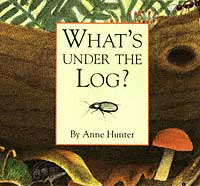
What's Under the Log?, written and illustrated by Anne Hunter - This little gem fits nicely in your hands and begins by asking the question in the title. Hunter then introduces readers to ten animals living beneath the log. The book ends with a short description of a tree's life cycle, reminding us that a rotting log not only provides a home for many creatures, but also returns important nutrients to the soil as it decays.

A Log's Life, written by Wendy Pfeffer and illustrated by Robin Brickman - An oak tree in the forest provides a home for many creatures. When the tree is felled during a storm it becomes a giant log and serves as a home for a whole host of new creatures. This one follows the log through several seasons until the rotting log becomes a mound of rich soil, and the perfect place for an acorn to take root and grow. (Take a closer look inside this book.)

People Who Planted Trees

Wangari's Trees of Peace: A True Story From Africa, written and illustrated by Jeanette Winter, is a biography of Mathaai told in clear, simple text and accompanied by vibrant acrylic illustrations. Readers see the landscape of Kenya change from barren to beautiful as a result of efforts by Wangari and the women who embraced her Green Belt Movement. It is a story full of hope and beauty. The author's note in the back provides more information about Wangari and the Green Belt Movement she started in 1977. (For more information, read my review.)

Planting the Trees of Kenya: The Story of Wangari Mathaai, written and illustrated by Claire Nivola, is a more detailed biography that is accompanied by intricate pen and watercolor illustrations. Nivola uses words and pictures to show Mathaai's connection with nature developed as a youth, and how this connection inspired her environmental practices as an adult. This one also includes an author's note with additional information on Wangari and her life.

Johnny Appleseed: The Legend and the Truth, written by Jane Yolen and illustrated by Jim Burke - Who was Johnny Appleseed? Legends and tall tales abound, but when it comes to separating fact from fiction, answers aren't always easy to find. Yolen explores the myth and brings some of that elusive truth to light. (For more information, read my review.)

Johnny Appleseed, written and illustrated by Steven Kellogg - The history and legend of Johnny Appleseed are told in this charming tale. The author's note at the end of the book attempts to clarify where history ends and legend begins. Also included is a map of Johnny Appleseed's life-long journey.

The Story of Johnny Appleseed, written and illustrated by Aliki - A very simple and kid-friendly text introducing readers to the life and legend of Johnny Appleseed.

The Man Who Planted Trees
, written by Jean Giono and illustrated by Michael McCurdy - This is the story of Elzéard Bouffier, a man who planted trees after seeing the land was dying for lack of trees. He planted hundreds of thousands of trees and slowly saw the community of humans and animals come back to life around him.

Fiction
Redwoods, written and illustrated by Jason Chin - When a boy finds a book about redwoods and begins to read, he soon finds himself in a redwood forest. I hate to categorize this one as fiction, but the story told through the illustrations is fantasy. The text, however, is informational with tons of facts about redwoods. (Perhaps we could call this faction!) For more information about the book, see the review at Seven Imp and check out the book's web site.

Cherry Tree, written by Ruskin Bond and illustrated by Allan Eitzen - On the way home from the bazaar a young girl eats all of the cherries in her possession. Her grandfather suggests she plant one of the pits. The seed sprouts and after surviving rain, munching animals and other mishaps, the tree blossoms some years later.

Aani and the Tree Huggers, written by Jeannine Atkins and illustrated by Venantius J. Pinto - Based on a true story, Aani wraps herself around a when the tree cutters come to her village to take them down. The importance of trees to the environment is not lost in the midst of this powerful story.

Someday a Tree, written by Eve Bunting and illustrated by Ronald Himler - When a family discovers the area around their favorite tree has been poisoned, they work with others in the community to try and save it. Despite their efforts, the tree dies. Don't worry though, the ending is hopeful as acorns are planted in healthy soil.

The Seasons of Arnold's Apple Tree, written and illustrated by Gail Gibbons - In this story, Arnold and his dog play in and around their apple tree throughout the year. In the spring they build a swing and smell the apple blossoms, in summer they build a tree house, in fall they rake leaves and pick apples, and in winter they build a fort.

Once There Was a Tree, written by Natalia Romanova and illustrated by Gennady Spirin - When a woodsman finds a broken tree, he saws it down so that only a stump remains. However, that stump still serves a purpose and is used by ants, a bear, a titmouse, a frog, an earwig and others.

Additional Resources
Here are a few resources to expand your thinking about trees and the many things they give us.

Have I missed one of your favorite tree books? If so, let me know so I can add it to the list. Anything but The Giving Tree (sorry, personal bias here!) will be added.