Tuesday, April 22, 2014

Science Poetry Pairings - Animal Homes

I love books about animals homes. I’m always amazed at the vast array of shapes, sizes, and locations they come in. Perhaps more impressive though, is how some of these homes are built and how animals manage to survive in some of the harsh environments they find themselves.

Today's book trio is about animal homes in all their varied forms.

Poetry Book
Nest, Nook, & Cranny, written by Susan Blackaby and illustrated by Jamie Hogan, is a collection of 22 poems that explore animals and the homes they make. Arranged by habitat (desert, grassland, shoreline, wetland, and woodland), the poems take an amazing range of forms, including villanelle, triolet, cinquain, sonnet, and more. Readers will find the poems informative and lyrical, the best combination of science and poetry. The book opens with these words in a section entitled "Before You Begin."
habitat - the natural home of an animal or plant 
The poems in this collection are loosely arranged by habitat, but you will find that coyotes, bats, and birds (to name a few) don't give a hoot about labels. Thanks to accommodations or adaptations or both, some creatures can live anyplace. Keep that in mind when the boundaries blur.
My favorite poem from the book reminds me of a creature I stumbled upon more than once as a child while traipsing through the woods and fields around my house.
A doe will pick a thicket
As a place to place her fawn,
Its speckled hide well hidden
In the dappled forest lawn.
A bed safe in the shadows—
Mossy cushion, leafy crest—
A doe will pick a thicket
As a place to make a nest.
Poem ©Susan Blackaby. All rights reserved.

The poems are beautifully accompanied by black-and-white drawings of creatures in their natural habitats. Back matter is extensive and includes a section describing the habitats used to organize the poems, as well as a section of author notes about each poem, the inspiration for them, and information about the forms.

Nonfiction Picture Book
Castles, Caves, and Honeycombs, written by Linda Ashman and illustrated by Lauren Stringer, is a quiet gem of a book. Written in rhyme and accompanied by vibrant acrylic illustrations, this book introduces many of the unique and interesting places that animals make their homes. It begins this way.
Many places make a home--
A heap of twigs.
A honeycomb.
A castle with a tower or two
An aerie with a bird's-eye view.
Can you name the animals introduced in the first few pages? As the text begins, readers find a family of beavers in their lodge, a swarm of bees protecting their honeycomb and its precious contents from a bear, two children playing in a play castle, and an eagle guarding the eaglets in its nest. The illustrations that accompany each line of the poem are bright and warm, depicting each animal in its home and often the habitat that home is found in.

In addition to the homes mentioned above, readers will learn that webs, sand dunes, cocoons, caves, warrens and many other places serve as homes for living things. One of my favorite parts of the text and illustrations shows "a hole beneath the floor." Can you guess what kind of animal might be living in your home? In this case it is a small mouse, munching on the remains of an apple core.

The book ends this way.
A home's a house, a den, a nest.
A place to play,
A place to rest.
A place to share,
A place to hug.
A home is someplace safe and snug.
Text ©Linda Ashman. All rights reserved.

This is an engaging text that will leave readers wanting to know more about the animals and their homes. 

And So They Build, written and illustrated by Bert Kitchen, introduces readers to 12 animal builders, from birds (4 species) to spiders, frogs, fish and more. Each double-page spread includes a full page illustration on the right, and two levels of text on the left. Rendered in watercolor and gouache, the images are highly detailed views of the animal(s) in action in their natural landscape. Only the illustration of cubiterme termite mounds lacks actual images of the builders. (Perhaps they are there but are too small to be seen). The text comes in two forms. First there is large print text that states in simple terms why the animals build and serves as an explanation for the illustration. Below, in smaller print, is a paragraph of information that explains in detail more about the builder and the structure. Here is an excerpt.
A tailorbird will be safer
if she hides her nest
and so she builds . . .
The tailorbird lives in southern China, India, and Southeast Asia, and the female usually nests in a garden or on cultivated land. She chooses one or two large, living leaves on a tree and draws their edges together, using her beak and feet. She makes small holes down the sides with sharp point of her beak. Then she twists spiders’ webs, bark, and plant fibers into threads and pushes them through the holes to hold the leaves together.
Text ©Bert Ktichen. All rights reserved.

The explanation goes on to describe how the stitches are fastened. The illustration shows the bird at work, literally sewing the leaves together. How this feat is accomplished by beak alone is simply amazing.

Anyone interested in animal homes will find much here to love. The illustrations alone are enough to recommend it, but the text provides enough information to arouse the curiosity of young naturalists and interest them in learning more.

Perfect Together
All three of these books beautifully describe a wide range of animal homes and shelters. They can be used across the elementary grades as a terrific source for thinking about where animals live, how they adapt to their environment, and just how ingenious they are.

For additional resources, consider these sites.

Monday, April 21, 2014

Science Poetry Pairings - African Animals

I believe I have more books on animals and nature than any other topic in my teaching library. As a science teacher, that probably doesn't surprise you. However, my love for animals started long before I began teaching. When I was young I tried to ensure I never missed an episode of Mutual of Omaha's Wild Kingdom. That show started a life-long fascination for animals of all types. However, it was a drive through Lion Country Safari in Loxahatchee, Florida in 1970 (I was nearly 5) that cemented a life-long fascination for African animals.

Today's book pairing showcases the amazing animals of the African continent.

Poetry Book
African Acrostics: A Word in Edgeways, written by Avis Harley with photographs by Deborah Noyes, is a collection of 18 acrostic poems, each accompanied by a gorgeous photograph of the animal described. Poems cover the crocodile, rhino, kudu, lion, hornbill, elephant, stork, zebra, giraffe, buffalo, ostrich, African wildcat, lioness, bonobo, impala, hippo, bat-eared fox, and leopard. 

Here's how the book opens.
ACROSTIC (uh-Kros-tik)

Welcome, all poets--both new
Or well versed. Non-rhymers or
Rhymers! Come,
Dive in headfirst!

Inviting all writers--
Now you're just the right age.

Explore the acrostic that rides
Down the page.
Get a word you
Enjoy and would like to define.
Write it down vertically
And fill in each line.
Your name is a very good way to begin.
Surprise yourself. Find that poem within!
The poems in this book are deftly created, with words spelled out vertically range from single words (herald, lying, poppet, outstanding) to phrases (wild stripes, cloud friends, fatherly advice, beauty in the beast). You'll find much more than simple acrostics here, with Harley including double acrostics, a quintuple acrostic (yes, that's FIVE words), and concrete acrostic. The patterns that exist within them never get in the way of the poem itself, and finding them is a bit of a surprise. 

Here's one of my favorite poems. 
A Croc Acrostic

Crackerjack-attacker
Reptile-in-my-dream
Old-mythmaker
Carnivore-supreme
Open-opportunist
Dragon-eye-agleam
Inner-grinner
Lizard-wizard
Enemy-extreme!
Poems © Avis Harley. All rights reserved.

Back matter includes More About Acrostics where Harley describes and provides examples of the types found in the book, Nature Notes on each animal, and A Note From the Photographer describing her experiences capturing photos of the scenes and animals in the book. 

Nonfiction Picture Book
African Critters, written by Robert Haas, is a first person account of his experiences photographing animals while on safari in different parts of Africa. After an introduction entitled Welcome to Africa, Haas writes about observing leopards, elephants, wild dogs, lions, scavengers (hyenas), the big grays (hippos and rhinos), itty bitty critters (Oxpecker bird, purple dragonfly, dung beetles), and cheetahs. Each chapter tells a true story about the location (Mala Mala, Okavango, Sabi Sand, and other places) and the animals observed there. The first person observation of the habitats and behavior of the animals is extraordinary. Also included are several small informational boxes in each chapter that provide additional information about the animals.

Here's an excerpt from the chapter The Scavengers of the Savanna (pp. 53-61).
     In the animal world, it is wrong to pin the label of "good guys" on certain critters and "bad guys" on other critters. Each type of animal must survive in its own way.
     For most meat-eaters, or carnivores, finding food is difficult and dangerous. It means capturing other critters who are usually able to escape and often willing to fight for their lives.
    Certain critters, known as "scavengers," will feed on the meat and bones left behind by other hunters. The best-known scavenger in all of Africa is the hyena. 
     After many safaris I had learned to respect the hyena as an animal with unique skills and a special role in the African wilderness. At first, I thought the hyena was simply a scavenger who would eat scraps from a fresh lion kill. But the hyena is also a fierce hunter who brings down prey after a chase that lasts for miles. And hyenas play an important role in their ecosystem. With a huge set of powerful jaws, they crush and eat even the largest bones left behind by lions and leopards. That way, they recycle food that others can't digest.
And here's an example of one of the informational boxes from this chapter.
Learning About Hyenas 
The largest type of hyena in Africa is known as the spotted hyena. Spotted hyena cubs are all black. The coat of an adult is thick and coarse with dark spots, and its muzzle is black. Female spotted hyena are larger than males, and the clan is usually led by a female. Even though clan members often hunt as a team, once their prey is brought down, each hyena fights for its share of the carcass.
Text © Robert Haas. All rights reserved.

Every chapter is packed with information about the animals and how they survive in the often harsh African wilderness. Back matter includes additional information on animals highlighted or mentioned in the chapters, an author's note on the photography and creation of altered and combined photos in the book, a glossary, extensive index, short list of references, and a nice list of books on animals by other National Geographic photographers.

Perfect Together
Harley's poems and Haas' observational stories offer an incredible introduction to the world of African animals. Begin with Harley's poems Moody Guy (rhino) and Sipping the Sunset (hippo). What kind of clues about them can you find in the acrostic words? Then read Haas' chapter on The Big Grays. Ask students what similarities and differences they found between the two descriptions of the animals, what surprised them, and the most interesting thing they learned. Continue on in this fashion, matching poems to the chapters in AFRICAN CRITTERS. When you're finished, consider making a class book on African animals.

For additional resources, consider these sites.
And just in case you're interested, here's a photo from our 1970 visit to Lion Country Safari.

Monday Poetry Stretch - Tritina

I've been working on a series of longer form poems recently, namely the villanelle and sestina. Whenever I get stuck on the sestina, I go back and work on the tritina. 

Helen Frost has a number of helpful worksheets on poetic form on her web site. She suggests starting with the tritina since the sestina is a more difficult form. This is an idea I have taken to heart.

Here are the nuts and bolts of the form.
10-line poem made of three, 3-line stanzas and a 1-line envoi

There is no rhyme scheme but rather an end word scheme. It is:
A
B
C

C
A
B

B
C
A

A, B, and C (all in the last line/envoi)
So, the challenge for the week is to write a tritina. Won't you join us? Please share a link to your poem or the poem itself in the comments.

Sunday, April 20, 2014

Science Poetry Pairings - Rain

I may have grown up where snow was the weather that was most talked about, but my favorite form of precipitation has always been the rain. In our old house in the city I used to love to sit outside on the porch swing when it rained and rock to the beat of the drops, and sometimes the thunder. William and I still like to play in the rain in the summer and jump in puddles in our bare feet. My favorite rain is quiet rain, early in the morning.

Today's book trio celebrates rain in all its wonder. 

Poetry Book
One Big Rain: Poems for a Rainy Days, compiled by Rita Gray and illustrated by Ryan O'Rourke, is a collection of 20 poems about rain through the seasons. Beginning with autumn, each section opens with a haiku about the season. Four additional poems follow. Gray includes eight haiku, two poems translated from other languages (Norwegian and Spanish), works by well-known poets like Robert Frost, Carl Sandburg, and Eve Merriam, as well as works by poets whose names may not be familiar to readers. The illustrations in muted browns, grays, blacks and greens beautifully capture the mood and subject of the poems.

The book opens with an introduction that describes rain through the seasons. The introduction closes with these thoughts.
A gentle rain can shower, sprinkle, drizzle, or mist. Powerful rains beat down in storms and downpours, fall in streams and sheets, or race, rush, and gush in torrents. Rain can play a pinging beat as it falls will-nilly from the sky: pitter-patter, plip-plop, drip-drop, plink-plink. And puddles are perfect to splish-splosh. Poets have captured the language and rhythm of the rain, creating images that stay with us throughout the year.
          As you read about the rain, in various poetic forms,
          Ripple in it, float in it, boat in it.
          Go on, get wet.
Text © Rita Gray. All rights reserved.

Following the introduction is a note about haiku translations. Adapted from a work by poet and translator William J. Higginson, the emphasis is not on counting syllables, but on finding the best rhythm for the haiku in the new language.

Here's the poem that opens the season of spring.
Haiku 
Rogetsu  
tree-frogs
calling . . . in the young leaves
a passing shower
And here's another poem from spring.
Little Snail 
Hilda Conkling 
I saw a little snail
Come down the garden walk.
He wagged his head this way . . . that way . . .
Like a clown in a circus.
He looked from side to side
As though he were from a different country.
I have always said he carries his house on his back . . .
To-day in the rain
I saw that it was his umbrella!
Here's a sample spread from the book. You can download this from the Charlesbridge site as a double-sided poster.

The small trim size may make this one go unnoticed, but don't pass it up. It's a lovely little book of poems.

Nonfiction Picture Books
This Is The Rain, written by Lola Schaefer and illustrated by Jane Wattenberg, is a picture book about the water cycle that uses the familiar cumulative pattern of "The House That Jack Built." Bold, vibrant photo-collages accompany the text. It begins this way.
This is the ocean,
blue and vast,
that holds the rainwater from the past.
Can you guess where this goes? Next comes the sun to warm the oceans, which eventually forms vapor that fills the clouds, which produce the rain that falls. Here's the text from the page on rain.
This is the rain,
falling all day,
that forms in clouds,
low and gray,
full of vapor, moist and light
made when sunshine,
hot and bright,
warms the ocean, blue and vast,
that holds the rainwater from the past.
Text © Lola Schaefer. All rights reserved.

After passing through all stages of the water cycle, Schaefer circles back to the rain falling "somewhere every day." The book ends with a short note about the water cycle on planet earth.

When Rain Falls, written by Melissa Stewart and illustrated by Constance Bergum, is a picture book that explains what happens to animals in different habitats when it rains. Each habitat section begins with the words "When rain falls ..." and goes on to describe how different animals respond. Stewart provides readers with glimpses of 22 different animals in a forest, field, wetland, and desert. The soft, watercolor illustrations are realistic and provide subtle details regarding each habitat.

Here's an excerpt from the section on a field.
When rain falls on a field . . . 
...plump little caterpillars crawl under leaves and cling to stems. Adult butterflies dangle from brightly colored heads. 
A raindrop knocks a ladybug off a slippery stem. The insect bounces into the air and then tumbles to the ground.  
A spider watches and waits as the rain beats down on its carefully built web.
Text © Melissa Stewart. All rights reserved.

The text is clear, concise, engaging, and easy to understand. Readers will learn much about how animals adapt to inclement weather.

Perfect Together
All three of these books explore rain in different forms. Whether studying weather or the water cycle (really, they should be taught together, but often aren't!) students can learn about what causes the rain and how people and animals react to the weather. In my classroom I'd start with Schaefer's book and look closely at the water cycle. Then I'd focus specifically on rain by reading a few poems and following up with Stewart's look at how animals respond to the rain.

For additional resources, consider these sites.

Saturday, April 19, 2014

Science Poetry Pairings - Forests

"The woods are lovely, dark, and deep," wrote the poet Robert Frost. I spent a lot of time in the woods as a kid, and still do today. When I lead science and outdoor education workshops I take teachers into the woods to look, listen, and learn. There is so much to discover by being still and observing closely.

Today's book pairing will invite and encourage readers to go into the woods and explore. 

Poetry Book
Forest Has a Song, written by Amy Ludwig VanDerwater and illustrated by Robbin Gourley, is a collection of 26 poems about the flora, fauna, and seasons of the forest. One time through will have readers puling on their boots and ready to take a slow, watchful walk through the woods. It opens with this poem.
Invitation
Today
I heard
a pinecone fall.
I smell
a spicy breeze.
I see
Forest
wildly waving
rows of
friendly trees.
I'm here. Come visit. Please?
One of my favorite forest activities to do with teachers is to take them to a site with decomposing logs and have them look over, under, and inside for signs of life. Amy has a poem just for that!
Home 
A rotten log is
home to bug
home to beetle
home to slug
home to chipmunk
home to bee
a lively living
hidden home
inside
a fallen tree.
Poems ©Amy Ludwig VanDerwater. All rights reserved.

One of my favorite poems in the book, Forest News, speaks of the stories that animal tracks tell when left in mud or snow. There are poems here about lichen and moss, as well as the owl, deer and woodpecker. For young and old alike, this is a lovely introduction to the forest.

Nonfiction Picture Books
Forest Explorer: A Life-Size Field Guide, written and photographed by Nic Bishop, is an oversized book that includes seven double-page photographic spreads of a North American deciduous forest in different seasons and different locations (forest floor, canopy, etc.). Designed as a guide to help students identify and learn about the creatures that live in the forest, more than 130 animals appear in these seven scenes.

Each habitat scene is shown life-size and is comprised of more than sixty different photographs that Bishop combined to create a single realistic illustration. (On the final page of the book he describes the meticulous work required to create the final products.) Animals in the scenes are shown engaged in the activities of daily life—hiding, feeding, hunting, waiting—and in different life stages.

Topics for the illustrations include:
  • Walking in Spring
  • The Leafy Understory
  • In the Treetops
  • Explore the Edge
  • After Dark
  • The Fall
  • Winter Survivors
Once readers have had a chance to study the illustrations, they turn the page to find detailed notes and a field guide to the animals and environment in the scene. Animals are named and identified in the narrative text by colored font. The text is engaging, understandable, and offers up interesting facts about the animals.

Bishop opens with a section on how to use the book. He also includes a section near the end entitled "Be a Forest Explorer," where he includes hints and projects for readers to explore a real forest on their own. He discusses finding a place to observe, keeping a journal, seasonal observation suggestions, forest safety, and more. Here's an excerpt.
March-April-May. Listen on warm damp evenings for wood frogs, spring peepers, and toads. Watch for the first spring wildflowers, then look for bumblebees and early butterflies feeding on them. Look for the first leaves to open. What trees do they belong to? See if you can find baby caterpillars and other insects that have just hatched. You may spot turkeys in forest clearings or hear woodpeckers drumming on tree trunks. Birds such as orioles, tanagers, grosbeaks, and wood thrushes may migrate to your forest from farther south at this time to start nesting.
Text ©Nic Bishop. All rights reserved.

The book ends with a picture index that will encourage readers to go back and look yet again at the illustrations.

Perfect Together
FOREST HAS A SONG and FOREST EXPLORER will complement one another nicely, whether a few poems are read before a related scene is shown and studied, or an illustration is shared first, followed by some related poems and then the informational text. Both of these books present strong observations of the life of the forest, albeit in different language.

For additional resources, consider these sites.

Friday, April 18, 2014

Poetry Friday - Take 2!

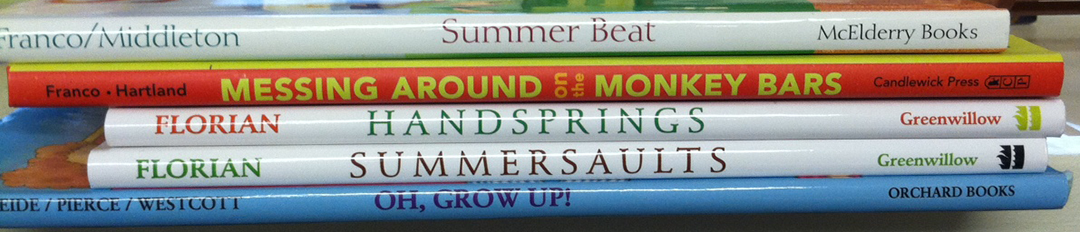
If you could see my office right now, you'd probably be shocked at how messy it is. I have piles of books EVERYWHERE. All the books I've been pulling for my National Poetry Month posts, the books on economics from class last week, and all my inter-library loan books are scattered about the floor! I guess it makes sense that out of this chaos came these book spine poems from my collection of poetry books.

Poem 1

Summer beat
Messing around the monkey bars
Handsprings
Summersaults
Oh, grow up!

(I so wish I had a book titled Never!)


 Poem 2

Toasting marshmallows
Keeping the night watch
Flicker flash
Fireflies at midnight
Sky magic

If you haven't been by already, be sure to check out all the wonderful poetic things being shared and collected today by Robyn Hood Black at Life on the Deckle Edge. Happy poetry Friday friends.

Science/English Poetry Pairings - Animal Collectives

I fell in love with words at a young age. Coupled with my love for science, I became enamored of the words to describe groups of animals and spent hours researching and memorizing the names.  When I turned turned twelve and my mother took me shopping for my birthday, I used money I'd saved to buy The Stranger by Billy Joel (vinyl!) and the book An Exaltation of Larks or The Venereal Game by James Lipton (yes, THAT James Lipton). I carried that book around for years, always entertained and intrigued by the contents.
While this topic may be more about etymology than science, young people are still interested in learning about the names given to animal groups. Today's book pairing can easily enhance and extend any study of the animal kingdom. 

Poetry Book
A Crossing of Zebras: Animal Packs in Poetry, written by Marjorie Maddox and illustrated by Philip Huber, is a collection of 14 poems that consider animal groups and how, perhaps, they came by those names. Why, for example, is a group of rattlesnakes called a rhumba? Here's Marjorie's poetic answer.
A Rhumba of Rattlesnakes

A rhumba of rattlesnakes knows how to shake
their long, slinky bodies and twist till daybreak.
They wobble their heads, give their hips a quick quake.
They jitterbug tails till their skeletons ache.

The rattle maracas and rat-tat on drums,
blow in tin trumpets, uncurl their tongues
to hiss a sweet song that invites you to come
a little bit closer. But you know to run

way over here and avoid the mistake
of dancing the rhumba with ten rattlesnakes.
While many of the poems in the collection rhyme, readers will also find free verse and poem for two voices. Here's my favorite of the lot. It is accompanied by an illustration of a rather alarmed scarecrow.
A Murder of Crows
Oh no, there they go, a murder of crows
throwing corncobs at the tattered scarecrow.
Though they never quite hit her, they flap to and fro,
cawing and jawing out names as they go.
They eat what's not theirs, then rush back for more,
ignoring her warnings, her pleas for reform.
No polite songsters here, well mannered with charm,
just fast flying hoodlums unfit for a farm.
Poems © Marjorie Maddox. All rights reserved.

The book features Philip’s lovely scratchboard illustrations with colored ink, depicting various animal packs. Back matter includes a note from the author explaining collective nouns and offering a list of books providing further information on the subject.

Nonfiction Picture Book
A Zeal of Zebras: An Alphabet of Collective Nouns, by Woop Studios, is a handsomely designed alphabet book that begins with "An Aurora of Polar Bears" and ends with the title collective, "A Zeal of Zebras." The folks at Woop Studios with responsibility for this project have impressive credentials. Two of the founders, Miraphora Mina and Eduardo Lima, spent a decade working as graphic designers on the Harry Potter franchise. In describing themselves they write, "United by a love of graphic design, words and images they founded Woop to bring a unique and exciting angle to the fascinating world of collective nouns." Unique, exciting, fascinating—their words pretty much sum up this book. The text is engaging and Woop's graphic designs are vibrant and fun, resembling in many ways vintage travel posters.

Each letter of the alphabet receives a double-page spread with a bit of informational text about the animal on the left side, with a gorgeous, full page graphically designed illustration on the right. Here's the text that accompanies one of my favorite entries.
A Galaxy of Starfish
Starfish, also known as sea
stars, are usually seen in
large numbers only when they
are washed up on beaches
after a storm. 
However, some starfish may
gather together when they
are ready to reproduce, using
environmental or chemical
signals to coordinate with
one another.
Text © Woop Studios. All rights reserved.

On their web site you can find many examples of the artwork, including more pieces than occur in the book. Stunning illustrations paired with interesting tidbits of information make this an unusual and outstanding entry in the alphabet book genre.

Perfect Together
During your next unit on animal study, consider extending it to include animal groups. Using Maddox's poems and Woop Studios illustrations and snippets of information as models, encourage students to create their own books or a class book on animal collectives. For example, while studying reptiles they can design pages for collectives of snakes, turtles, lizards, crocodiles, and more. Students can then create their own illustrations and write about the characteristics that are common to reptiles and unique to each order.

For additional resources, consider these sites.

Poetry Friday - By Messenger

I've shared poems by Amy Lowell before. This poem was first published in 1919 in a volume entitled Pictures of the Floating World. It is one of my favorite poems of all time.
By Messenger
by Amy Lowell 
One night
When there was a clear moon,
I sat down
To write a poem
About maple-trees.
But the dazzle of moonlight
In the ink
Blinded me,
And I could only write
What I remembered.
Therefore, on the wrapping of my poem
I have inscribed your name.
This poem and the book it was published in are in the public domain and have been digitized and made available by Google. You can read the entire volume simply by downloading a copy.


Do check out all the wonderful poetic things being shared and collected today by Robyn Hood Black at Life on the Deckle Edge. Happy poetry Friday friends.

Thursday, April 17, 2014

Science Poetry Pairings - Seasons

Every year from Kindergarten through second grade, my son came home with a picture he'd drawn of an apple tree seen through all four seasons. While I love the book that these were modeled on, I often found myself wishing that this activity was done at the end of the year as a culmination of months of studying the same schoolyard tree through the seasons. This isn't hard to do and teaches kids much about the skill of observation and keeping a nature journal. It's also a much better way to document the changing of the seasons. It may take longer to teach this way, but the benefits of long-term study are undeniable and vastly more interesting.

Today's book pairing offers an unusual, non-traditional and very clever look at our four seasons.

Poetry Book
Pumpkin Butterfly: Poems From the Other Side of Nature, written by Heidi Mordhorst and illustrated by Jenny Reynish, is a collection of 23 poems that begins with fall and cycles through the year's seasons, inviting readers to think about the signs of these seasons in new and extraordinary ways. Readers will be struck by the terribly clever metaphors as they find new ways to see and think about the world around them. Here's one of the poems that I particularly love.
Botanical Jazz

Quiet down, flower—
not so loud!

All this stretching your neck
and spreading your arms
bellowing your brassy yellow sass—

you’re breaking our eyedrums
trumpeting all that color and sun
blowing that blazing yellow jazz. . . .

Belt it out, flower—
we’ll join in!
As someone who uses poetry to teach science, I especially appreciate Mordhorst's gift for observation and her use of metaphor to help us see the everyday in new ways. Here's a terrific example of this.
Fireplace

It's only because of
the low December sun bearing
down along the street
that I notice
half a dozen fires without flame
smoldering among the roots of

a monumental oak where
leaves and fat acorns have pooled.
Their whispering columns of smoke
climb the trunk,
turning it into a risky thing:
a chimney made of wood.

I follow the white morning beams,
mingle my clouded breath with
the twisting wisps of smoke, and
warm my hands
over the burning of those
acorn coals, of that timber chimney.
Poems © Heidi Mordhorst. All rights reserved.

While these are ostensibly nature poems, they so keenly reflect the markers of each season that together they make this a perfect book for sharing during a study of the seasons.


Nonfiction Picture Book
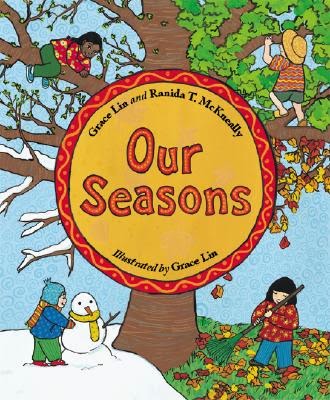
Our Seasons, written by Grace Lin and Ranida McKneally and illustrated by Grace Lin, is a beautiful combination of science and poetry that explores questions children often have about these seasons. Beginning with fall, each season is explored in three double-page spreads that include a haiku, related question, and the answer to that question.

Before the exploration of seasons begins, the book opens with this haiku and question-answer selection.
When the earth is cold
We long for the butterflies,
Yet in warmth we want snow.
Why do we have seasons? 
Did you know that the earth is titled as it revolves around the sun? If you drew an imaginary line through the earth's poles, this line (the axis) would be tilted at an angle, not straight up and down. The tilt of the axis never changes, so part of the year you are facing the sun more directly and part of the year you are not. Which season you experience depends on where you live and on the time of year.
Questions explored through the seasons include:
  • What makes the wind?
  • Why do leaves change color?
  • Why do I see my breath?
  • What is snow?
  • Why is there frost on the window?
  • Why do my cheeks turn red in the cold?
  • What makes a thunderstorm?
  • Why do bees like flowers?
  • Why do I sneeze?
  • Why is the air sticky?
  • Why do fireflies glow?
  • Why do I tan?
Text © Grace Lin and Ranida McKneally. All rights reserved.

The answers to each of these questions are written in a clear, understandable, and engaging manner. The book wraps up with the answer to the question, "Does everyone have four seasons?" Back matter includes a glossary of terms.

Perfect Together
While not a typical look at the seasons, Mordhorst's poetry will encourage students to look for signs of the seasons and imagine them in different ways. Pair this with Lin and McKneally's book to provide answers to often asked questions about the seasons and common events that occur in each.

For additional resources, consider these sites.
Finally, if you decide you want to try a year-long tree study, consider using this amazing book.

Sky Tree: Seeing Science Through Art, written by Thomas Locker and Candace Christiansen and illustrated by Thomas Locker, is a detailed look at one tree through a single year. The gorgeous oil paintings and lyrical text invite readers to look closely at the world around them. The author's note that opens the book reads:
I have spent most of my life learning to paint trees agains the ever changing sky. After all these years I still cannot look at a tree without being filled with a sense of wonder. 
Since I began collaborating with Candace Christiansen, who is a science teacher, I have become increasingly aware of the scientific approach to the natural world. I was amazed to discover that the more scientific facts I learned, the deeper my sense of wonder became. This realization led to the creation of Sky Tree
Sky Tree invites adults and children to experience the life of a tree and its relationship to the sky in several different ways. Through storytelling, art appreciation, and scientific exploration, Sky Tree attempts to reach both the heart and mind.
Back matter includes a section in which questions asked in the text are answered, linking science and art. 

Wednesday, April 16, 2014

Science Poetry Pairings - Bugs

First let me say that I hate the title of this post—bugs. The scientist in me really dislikes the use of the word bugs as a broad classification for arthropods and other "creepy crawly" creatures. Here's a rundown on the classification system and where these organisms are found.
Domain - Eukarya / Kingdom - Animal / Phylum - Arthropod

Arthropods are composed of five classes of organisms--arachnids, insects, crustaceans, centipedes, and millipedes. Now, hemiptera is an order of insects known as "true bugs." Included in this order are stink bugs, cicadas, aphids, water striders and more. I know this is really picky, but the classes of arthropods are pretty amazing, and I hate to see them all lumped together.

That said, bugs is the colloquial term for these critters, so I'll defer on this usage just for today's trio of books on BUGS!

*****
cicada ghosts

Haunted skins
cling
emptily
to the rough bark
of the hackberry
tree,
and farther up
where I can't
see,
ghosts are
buzzing
eerily:
zz-zz-zz-zz
zeeeeee!

The poem above is a perfect segue into the book Bugs: Poems About Creeping Things. The first thing you'll notice upon picking it up is the small trim size--perfect for the subject matter. The poems beg to be shared aloud, with a number of the selections (seven of them!) written for two voices. They are clever and witty and seem to share some inside jokes with young readers. Many of the situations are preposterous, making them all the more fun to consider. Here are two short poems.
spiderwebs

Web sparkle
on the lawn
like diamond
necklaces
at dawn.

Shiny droplets--
small oases--
beckon spiders
to their places.

Silently they
look and lurk.

Time now for
spider work.
Poems © David Harrison. All rights reserved.

Altogether you will find 40 short, rhyming poems in this volume that will delight children and adults alike.

Hey There, Stink Bug!, written by Leslie Bulion and illustrated by Leslie Evans, is a collection containing 19 poems, a helpful glossary of scientific terms, poetry notes that describe the form of the poems, and suggestions for additional resources. Here's a poem on the much maligned dung beetle.
Dung Beetle
by Leslie Bulion

Hard-working scarab
sculpts a tasty ball for grub
Beetle rock and roll
saves the world from dancing
knee-deep in elephant doo.
The terrific thing about the poems in this collection is that they are accompanied by factual information. Here's an excerpt about the dung beetle.
Dung beetles belong to a family of wide-bodied beetles called scarab beetles. Scarabs are often very colorful.

Dung beetles eat chunks of animal manure, called dung. Some dung beetles pat the dung into balls. They kick-roll the balls away and may even take them underground. Dung beetles are quite a clean-up crew!
And here's what you'll find in the poetry notes about this poem.
The tanka is a Japanese poem form even older than the haiku. It has five lines and no more than thirty-on syllables. Its ideas are usually from nature. Some of the words in a tanka can have more than one meaning in the poem. When you read a tanka, it can seem like two haiku poems—the middle line is part of each haiku.
Poem and Text © Leslie Bulion. All rights reserved.

Evans' watercolor-washed linoleum prints offer vibrant views of the insects, nicely complementing Bulion's poems and text.


Nonfiction Picture Book
Bugs Up Close, written by by Diane Swanson and photographed by Paul Davidson, is an oversized book with close-up photos of a wide range of insects in all their glory. After introducing and defining insects, Swanson turns to their features and behavior and highlights bodies, exoskeletons, spiracles, legs, wings, mouthparts, eyes, antennae, hair, signals, eggs, metamorphosis, colors, shapes, weapons, size, and success.

Here's how the book opens.
You are sitting under a tree when something tickles your toes. You brush it off, and the tiny critter crawls away through the grass. Then you notice a green bug hopping by and see yellow wings fluttering above your head.
Creeping, jumping, flying—little creatures seem to be everywhere. But not all of them are insects. The insects are the ones that have three main body sections. Most insects also have antennae, wings, and six legs (three on each side).
Text © Diane Swanson. All rights reserved.

Swanson has filled this book with fascinating bits about insects in a most accessible manner. Readers will find pronunciation for terms such as proboscis, spiracles and metamorphosis provided in parentheses. The text is concisely written and easy to comprehend. A table of contents, brief glossary, and index are also included. Paired with the incredible photographs supplied by Davidson, this book provides a thorough introduction to the world of insects.


Perfect Together
Pairing Harrison's more light-hearted look at bugs with Bulion's more serious is a good way to begin. From there I would consider the body parts and special features described in the poems and pair them with related text from BUGS UP CLOSE. Across these three titles there isn't much you can't learn or imaging about bugs!

For additional resources, consider these sites.
  • The Roach World site from Discovery Kids lets kids explore life through the eyes of a cockroach.
  • The Understanding Evolution web site has a comprehensive section on arthropods entitled The Arthropod Story.
  • At the University of Illinois you'll find a large collection of insect illustrations.
  • If you want to use live animals in your class, check out these resources on using stick insects in the classroom.
  • Kids can play a game called Monster Bugs at Scholastic's Magic School Bus site. Given a drawer full of bug parts, kids put them together to create bugs found in nature or new bugs of their own.
  • Orkin has some bug and insect games for kids.

Tuesday, April 15, 2014

Science Poetry Pairings - Butterflies

Over the last few years I've given a number of butterfly books to my son's teachers and other elementary teachers I work with. I love Eric Carle just as much as the next person, but there are many other books out there about caterpillars and butterflies!

Today's book trio reflects a few of the titles I love to share with teachers.

Poetry Book
The Monarch's Progress: Poems With Wings, written and illustrated by Avis Harley, is a collection of 18 poems about Monarch butterflies. Using a variety of poetic forms, including alphabet poems, acrostics, cinquains, haiku, limericks, sonnets and more, readers will learn a whole lot of science while enjoying these poems.

In the introduction, Avis explains why she chose specific forms for certain poems. Here's an excerpt from an acrostic poem.
Wintering Over
by Avis Harley

Amazing
Blazing
Clusters
Decorate
Entire
Forest
Groves.

Hanging
In
Jeweled
Kingdoms
...
One of my favorite poems from the book is this haiku.
Who can decorate
the walls of the world better
than a butterfly?
Poems ©Avis Harley. All rights reserved.

In the back matter is a section entitled Small Matters. In it readers will find additional information about the content of the poems and illustrations.

Nonfiction Picture Books
Monarch and Milkweed, written by Helen Frost and illustrated by Leonid Gore, follows the life cycle of the Monarch and the milkweed in parallel narratives that eventually draw closer together and combine before separating again at the end of the story.

The book begins by  focusing on the long journey the monarchs must make to arrive at the already thriving milkweed plants. As the plant begins to mature by blooming and then dropping those blooms to allow seeds to push through, the monarchs mate and fly, “From milkweed plant to milkweed plant, stopping on each to lay one shiny egg.” The description of the life cycles of both the milkweed plant and monarch butterfly continues from dying plant to floating and planted seeds and from caterpillar to chrysalis to butterflies respectively until the, “Milkweed’s first spring leaf unfurls,” and “Far to the south, in Mexico, Monarch rides the wind toward it.”

 Here's an excerpt of facing pages that shows the parallel narrative.
Milkweed's leaves, now full of holes,
turn yellow,
then brown.
Their edges curl, and they begin to fall. 
Monarch flies
from purple zinnia
to black-eyed Susan,
drinking nectar, getting ready.
As the days turn cool,
she turns south towards warmer air
to begin her longest journey.
Text ©Helen Frost. All rights reserved.

Frost and Gore do a marvelous job of clearly describing and illustrating the lives of these two distinct yet co-dependent organisms. Back matter includes includes an author's note with additional information about Monarchs and milkweed, as well as web sites for further information.

A Butterfly is Patient, written by Dianna Hutts Aston and illustrated by Sylvia Long, offers a sumptuous introduction to the world of butterflies. With poetic descriptions ("A butterfly is patient") that are accompanied by more detailed text and exquisitely detailed watercolor illustrations, the author and illustrator offer a unique look at these amazing creatures.

The book opens with a double-page spread of labeled illustrations of caterpillars, and closes with a similar double-page spread of the same caterpillars in butterfly form. Readers will want to examine these pages before they even get to the text!

Here's an excerpt.
A butterfly is helpful. 
Butterflies, like bees, help pollinate plants so that they can reproduce, or make seeds. As a butterfly flits from flower to flower, sipping nectar, tiny grains of pollen cling to its body, then fall away onto other flowers. Seeds are only produced when pollen is transferred between flowers of the same species. This is called pollination.
Text © Dianna Hutts Aston. All rights reserved.

“A butterfly is spectacular,” and so is this book. Using both lyrical text and clear and concise descriptions of butterfly life cycles, behavior, body structure, and more, this is a book readers will want to study for extended periods of time.

Perfect Together
Butterflies are a staple in the elementary curriculum when studying life cycles. All three of the books address this topic in varying ways. I hope you'll think about replacing some of your current titles with these more poetic, beautifully illustrated, yet scientifically accurate titles.

For additional resources, consider these sites.

Since I'm so fond of biography, consider adding this title to the mix.
Summer Birds: The Butterflies of Maria Merian, written by Margarita Engle and illustrated by Julie Paschkis, is based on the true story of how Merian secretly observed the life cycle of summer birds (a medieval name for butterflies) and documented it in her paintings. Focusing on her young life, this book shows readers how curiosity at a young age can lead to a lifelong pursuit.

Poets and artists must have a bit of scientist in them, as they must closely observe the world around them in order to share it from their unique perspective. Maria Merian was an artist and scientist who studied plants and animals in their natural habitat and then captured them in her art. Not only did she document the flora and fauna in her native Germany, but in 1699 she also traveled to South America where she studied and sketched plants and animals unlike any others she had seen.

Monday, April 14, 2014

Science Poetry Pairings - Extinction

I'm always a bit amazed and saddened when I visit a museum and see a stuffed dodo bird. I imagine that some day in the distant future, young and old alike may only be able to see the rhino, elephant, panda, and other such animals in zoos or museums, their species having long since died out in the wild.

Saving our planet means keeping the air, water, and land habitable for both humans and animals alike. As the human population continues to grow, life becomes more difficult for many species of animals.

Today's book pairing looks both at animals that can no longer be found on Earth, and those that are in danger of disappearing.

Poetry Book

Swan Song: Poems of Extinctionwritten by J. Patrick Lewis and illustrated by Christopher Wormell, is a collection of 20 poems that pay tribute to species that have disappeared since crossing paths with humankind. The book opens with these disturbing words.
More than ninety-nine percent of all species that have ever lived are now extinct.
. . .
On Earth, six animal species die every hour, many of the most recent due to climate change, habitat destruction, or human greed, carelessness or indifference.
A timeline runs across the bottom of the pages, with the poems ordered by when a species became extinct. You'll also find its scientific name and where it once lived. The first poem is to the aurochs, a species from which modern cattle descended that died out c. 1627. The last poem is to Miss Waldron's red Colobus monkey, a species that died out in 2000. In between you'll find familiar and unfamiliar animals, like the dodo and the blue buck.
The Arizona Jaguar

Description: Loner; nightfall eyes;
Coat of spots on spots (disguise);
Once the New World's largest cat;
Mountain, grassland habitat;
Fed on any kind of meat;
Stumbled down a one-way street;
Color of a jealous sun.
Status: Nowhere. Future: None.

Poem ©J. Patrick Lewis. All rights reserved.
The book concludes with a series of endnotes describing each animal in further detail.

Nonfiction Picture Book
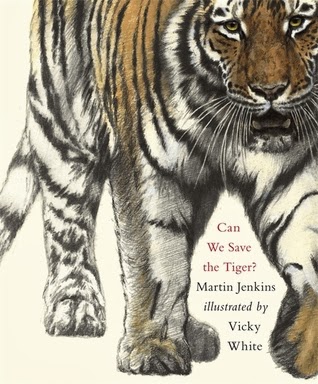
Can We Save the Tiger?, written by Martin Jenkins and illustrated by Vicky White, is an oversize volume with gorgeously detailed pencil sketches and a text that neither talks down to readers nor glosses over the difficult problems we humans have created. While Jenkins begins by discussing animals that are now extinct and why that is so, he goes on to discuss endangered species and once-threatened animals whose numbers are now on the rise.

Here's how the book opens.
The world's quite a big place,
you know. But it's not that big,
when you consider how much
there is to squeeze into it.
After all, it's home not just to billions of people, but
to the most amazing number of other kinds of living
things, too. And we're all jostling for space.
We humans have changed the world a lot over the
years, to make room for ourselves and to produce the
things we need.  We've turned forests into farmland,
dammed rivers, and built towns and cities to live in.
Some of the other animals and plants that we share
the Earth with have coped with the changes very
well.  But some haven't.
In fact, some have coped so badly that they're not here
anymore.
They're extinct.
Discussing endangered species is a complex issue, impacting not only the animals themselves, but the humans that live in close proximity to them. Saving animals, while noble, is not always a black and white issue. Jenkins tackles this head on in a conversational and understandable way. Here's how he addresses the issues facing humans and tigers.
Tigers are big and they are beautiful and they're fierce. And all this makes life difficult for them these days.
Because they're big, they need a lot of space. But the countries where they live, like India and Indonesia, have huge numbers of people in them too, all trying to make a living and needing to be fed.
And because they're beautiful, people have always hunted them for their skins. They also kill them for their bones and meat to use as medicines.
And because tigers are fierce, they don't mix very well with humans... 
So if you were a poor farmer trying to make a living with a couple of cows and a few goats, you might not be too happy if you found there was a hungry tiger living nearby.  And if you knew that someone might pay you more for a tiger skin and some bones than you earn in three whole months working in the fields, then you might find it very tempting to set a trap or two, even if you knew it was against the law.
Perhaps it's not too surprising that there aren't that many tigers left.
Text ©Martin Jenkins. All rights reserved.

Animals profiled include dodo, stellar sea cow, marsupial wolf, great auk, broad-faced potoroo, tiger, Asian elephant, sloth bear, African hunting dog, partula snail, quokka, mariana fruit dove, ground iguana, white-rumped vulture, sawfish, European crayfish, golden arrow poison frog, American bison, white rhinocerous, Antarctic fur seal, vicuna, kakapo, Rodrigues flying fox, whooping crane, Bermuda petrel, and polar bear. On the final page readers will find an illustration of Sander's slipper orchid, a plant that is protected because it is endangered. Back matter includes suggestions for further Web research and an index. 

Perfect Together
While Lewis' book focuses on extinct species, Jenkins' covers the range from extinct, to endangered, to making a comeback. Begin be reading some of the poems in SWAN SONG and discuss with students the reasons that these animals have become extinct. Follow this with Jenkins' book and see if some of these same reasons have contributed to the placement of animals on the endangered species list. These are difficult and sobering topics, so do ask students to think concretely about what they can do to help or make a difference.

For additional resources, consider these sites.
  • The Mammoth Extinction Game is an interdisciplinary science, math, and social studies lesson where students examine how the wooly mammoth became extinct about 11,000 years ago. First, they play a hands- on game with dice and graphing to understand how the mammoth population declined. Then, as a class, they use a system dynamics model to see what would happen to the population under varying conditions. 
  • The Scholastic Study Jams video on Population Growth describes how species become endangered and extinct.
  • Discovery Science has an article on Top 10 Extinct Species in which they describe 10 animal species no longer living.
  • The Oxford University Museum of Natural History site Learning Zone: Extinct and Endangered contains information on some of the extinct species pictured or on display at the museum.
  • National Geographic has a number of resources on the topic of De-Extinction: Bringing Extinct Species Back to Life.
  • The TEDx Event on DeExtinction, hosted by the National Geographic Society, presented a variety of speakers discussing the prospects of reviving extinct species and re-introducing them to the wild.  
Finally, I'll end today by recommending this video.


After watching, check out this LiveScience article entitled