Friday, April 25, 2014

Science Poetry Pairings - Camouflage

When I was young I often wished for clothing that resembled the woods around my home, largely because I wanted to win at hide and seek. I so wanted to be the last person found. Blending in with one's environment can come in handy, particularly when someone wants to make a meal of you. Camouflage is nature's way of hiding animals in plain sight. While those stripes may make a tiger stand out in his/her zoo home, they allow him/her to vanish in that stand of tall grass in the wild.

Whether it's zebra stripes, a body shaped like a stick, or fur that changes color with the seasons, today's book trio highlights the amazing adaptation of camouflage. 

Poetry Book
Where in the Wild?: Camouflaged Creatures Concealed ... and Revealed, written David Schwartz and Yael Schy with photographs by Dwight Kuhn, is a book filled with "eye-tricking photos, poems offering up clues, and information about the organism. The book begins with a brief introduction to camouflage and the book itself. Here is an excerpt.
Imagine that you are an animal in the wild trying to avoid a prowling predator. If it can't find you, it can't eat you.

Now imagine that you are the predator, silently hunting for prey. If you prey does not see you, you can catch it and eat it.
.
.
.
See if you can find the camouflaged animals photographed in their natural habitats. The poems will give you hints. When you think you have found a hidden animal--or if you give up!--open the flap to see "where in the wild" it really is. Then read on to find out more about these amazing animals and their vanishing acts.
What follows are examples of 10 clever uses of camouflage. On the left side of each spread is a poem describing the animal, and in some cases, its location. The outside of the gatefold on the right contains the picture that must be searched. Readers must be keen observes, as some of these animals are hard to find! In the corner of the gatefold is a small circle that says, "Lift to find me!" When the gatefold is opened, the image appears again, this time with everything grayed out except the animal in question. Often times, the appearance of the hidden animal is so startling that the reader must flip back to the original picture to search it out. In addition to the "answer" to photo puzzle, the inside of the gatefold also contains information on the animals subject.

The poems in the book come in a variety of forms, including haiku and concrete. Here is an example.
Speckled

speckled treasures lie
     bare upon the pebbled bank
          fragile life within
The photograph that accompanies it shows a rocky landscape. Can you guess what is hidden in plain sight?

There is another book that follow on the heels of this one, written in the same form and extending the ideas presented here. It is Where Else in the Wild? More Camouflaged Creatures Concealed...and Revealed. Both of these are great books for looking at animals in plain sight.

I'd be remiss if I didn't mention the amazing Ruth Heller here. She wrote a series of books that examined camouflage across the animal kingdom. Titles in this series include:
    All of Heller's books were written in verse. On the title page is this opening.
    If
    you take
    a careful look,
    you'll see
    how
    creatures
    in this book
    are
    CAMOUFLAGED
    and out
    of view—
    although
    they're
    right
    in
    front
    of
    you.
    Here's an excerpt from HOW TO HIDE A CROCODILE.
    This
    IGUANA
    and the
    tree
    bear a similarity....
    It he's
    hidden
    will depend
    on
    how well their colors blend.
    Each page shows the animal in full view, and then again camouflaged in its habitat.

    Nonfiction Picture Book
    Hide and Seek: Nature's Best Vanishing Acts, written by Andrea Helman with photographs by Gavriel Jecan, is a book organized by habitat that highlights the features of the location and describes how a handful of animals in each use camouflage to survive. What's interesting about this book is that readers won't find the answers to what they're looking for until they get to the back of the book! In a section entitled The Back Story, readers see a thumbnail version of the photograph with the animals circled. They will also find a bit more information about each animal photographed.

    Readers will find savanna/grasslands, sea, desert, Arctic, forest and mountains. Here's an excerpt from the mountains section.
    Elliot's Chameleon 
    Motionless, the colorful and crafty chameleon stays still, disappearing into tree bark in the Rwanda mountains. Its bulging eyes rotate in different directions, searching the turf for tasty treats. Aha! It focuses both eyes to judge the distance and position of an insect. Zap! The sticky-tipped tongue shoots out at 20 feet per second. Success! Chameleons are nature's quick change artists, exchanging one color for another to protect themselves from predators and become invisible prey.
    Readers will spend a great deal of time examining the photos in this one, and will learn about a wide range of animals while doing so.

    Perfect Together
    All three of these books, and really any other title about camouflage, are about what you can see. I love that the poems in Schwartz and Yael's book offer up clues to the animals hidden in the photos. I might start with a book by Heller to give students an opportunity to see how animals move from visible to hidden. This might offer clues to finding animals in actual photographs. Once you've had a chance to look these over, ask students to categorize the types of camouflage animals use. Then give them a paper butterfly to decorate and hide in the classroom. See how well they can hide their butterflies in plain sight!

    For additional resources, consider these sites.
    • Let your kids try this camouflage game, where they get to choose an animal and a background. Then they try different fur colors, shadings, and patterns to see which ones work best in different habitats.
    • The camouflage field book lets kids learn about animals hidden in different environments.
    • Seeing Through Camouflage is a game that asks kids to identify the four different types of camouflage and identify animals belonging to each one.
    • Hide & Seek Sea is an illustration that contains 22 animals. Once students find them all, they can click on the animals to see pictures and learn more about them.
    • Nature Works has a great article on deceptive coloration.

    Poetry Friday - Lines Written for Gene Kelly to Dance To

    Today I'm sharing an excerpt of the first stanzas from Lines Written for Gene Kelly to Dance To. You can find the entire poem in The Complete Poems of Carl Sandburg (pp. 704-705).

    Lines Written for Gene Kelly to Dance To
    by Carl Sandburg

    Spring is when the grass turns green and glad
    Spring is when the new grass comes up and says hey, hey, hey, hey.
    Be dizzy now and turn your head upside down and see how the world looks upside down
    Be dizzy now and turn a cartwheel and see the good earth through a cartwheel.

    Tell your feet the alphabet
    Tell your feet the multiplication table
    Tell your feet where to go, and watch ‘em go and come back

    Can you dance a question mark?
    Can you dance an exclamation mark?
    Can you dance a couple of commas?
    And bring it to a finish with a period?

    Can you dance like the wind is pushing you?
    Can you dance like you are pushing the wind?
    Can you dance like slow wooden heels?
    And then change to bright and singing silver heels.
    Such nice feet, such good feet.


    And since you've all probably seen Gene dancing in Singin' In The Rain, here's a video of him tap dancing on roller skates. It's one of my favorites, and yes, you can dance an exclamation mark!

    I do hope you'll take some time to check out all the wonderful poetic things being shared and collected today by Tabatha at The Opposite of Indifference . Happy poetry Friday friends.

    Thursday, April 24, 2014

    Science/Social Studies Poetry Pairings - Geography

    I have been teaching a course on integrating science and social studies for several years now. While I often get puzzled looks from folks when I try to explain the rationale behind this, the elementary teachers I work with recognize that this makes perfect sense. There is tremendous overlap between the science and social studies curriculum, particularly with respect to the topic of geography. 


    Today's book pairing will help readers look at the world through the eyes of both scientists and geographers.

    Poetry Book
    A World of Wonders: Geographic Travels in Verse and Rhyme, written by J. Patrick Lewis and illustrated by Alison Jay, is a collection of poems about explorers, places on the map (Sandwich Islands, Italy, Angel Falls, Mount Everest etc.), the globe itself (latitude v. longitude, equator and the poles), earth science topics (aurora borealis, San Andreas fault, stalactites v. stalagmites), and many other things. It opens with a poem entitled Places and Names: A Traveler's Guide, in which a number of cities and sites with interesting names are named. The poem concludes in this way.
    Thousands of spaces are places to be--
    Discover the World of GE-OG-RA-PHY!

    Travel by boat or by car or by plane
    To visit East Africa, Singapore, Spain.
    Go by yourself or invite a good friend,
    But traveling by poem is what I recommend.
    This is a wonderful book for introducing a mix of geography topics, as well as science topics like biomes, ecology and natural resources. Here's one of my favorite poems.
    The Arctic and Antarctica: Which is Colder? 
    The Arctic is water all covered with ice.
    Antarctica? Land (frozen paradise). 
    The Arctic is up; Antarctica's down—
    At least if you reckon from my side of town. 
    Nobody could live in the Arctic because
    It's freezing! (Except maybe Santa Claus?) 
    Antarctica is even chillier than that,
    According to the icicled thermostat. 
    Why? Because land becomes colder than water.
    (But penguins that live there don't want it much hotter.)
    Here's a short example of a science-oriented geography poem.
    How a Cave Will Behave 
    Take a look at these cone-like formations,
    And remember, wherever they're found,
    A stalactite drips down from the ceiling.
    A stalagmite grows up from the ground.
    Poems ©J. Patrick Lewis. All rights reserved.

    There are also a few poems that encourage readers to think about their impact on the earth. The last poem entitled Walk Lightly asks that we make the Earth our companion.

    Nonfiction Picture Book
    Hottest, Coldest, Highest, Deepest, written and illustrated by Steve Jenkins, is a book that examines extremes in the natural world, such as the highest mountain (based on elevation), longest river, place with the most extreme tides, the driest place on earth, and more. Here's how it begins.
    If you could visit any spot on earth, where would you go? What if you wanted to see some of the most amazing natural wonders in the world? 
    There are deserts that haven't seen rain in hundreds of years, and jungles where it pours almost every day. There are places so cold that even in the summer it's below freezing and spots where it's often hot enough to cook an egg on the ground. There are mountains many miles high and ocean trenches that are even deeper. You can find rivers thousands of miles long and waterfalls thousands of feet high.
    Jenkins grabs readers from the first page and makes them want to know about them. On every double-page spread that follows is a statement of fact, an inset map showing location, a bit of informational text, and some other graphic to help readers visualize and better understand the information. Here's an example.
    The world's highest waterfall is Angel Falls, in Venezuela. It is 3,212 feet high.
    This text is accompanied by a small map and globe with a red dot highlighting the falls. The facing page contains this statement.
    Angel Falls is more than seventeen times higher than Niagara Falls (180 feet), in New York State. Victoria Falls, in Zimbabwe, Africa, carries ore water than any other waterfall. It is 355 feet high.
    Text ©Steve Jenkins. All rights reserved.

    That's a lot of information packed into a few sentences. What ties all these ideas together is the final graphic that shows a height comparison of Angel Falls, Victoria Falls, Niagara Falls, and the Empire State Building. Placing these side-by-side shows just how high Angel Falls really is.

    Okay, time for a little quiz. Do you know...?
    • the name of the world’s most active volcano?
    • the height of the tides in the Bay of Fundy in Nova Scotia, Canada?
    • the depth of the deepest spot in the ocean?
    • the location of the hottest spot in the world?
    • the location of the oldest and deepest lake in the world?
    The answers to these questions and more can be found in Jenkins' handsomely illustrated book. There is no back matter in this volume, but the final page does include a world map that pinpoints the 12 locations described. 

    Perfect Together
    Both Lewis' poems and Jenkins' pages on extremes lend themselves to mapping activities. I highly recommend a permanent board (or a trifold if you lack space) with a world map in which students can place push pins or "markers" to identify locations studied. This works not only for these books, but also for places identified in current events and others books students read.

    I also recommend laminating the map or placing a layer of plastic over it so that students can label and color areas of the map. For example, Jenkins writes about the hottest spot on the planet. Lewis has a poem entitled 136ºF in the Shade that describes the hottest day ever recorded in history. Lewis also offers up a rhyming couplet describing the size of the Sahara Desert and a poem on the Mohave Desert. While reading these poems, students can research other deserts of the world and color all of them on the laminated map. From here they'll be able to draw some conclusions about the characteristics of deserts and the geographic features they share.

    Both of these books offer up a wealth of information that can and will keep students occupied over the course of the year. Just imagine what you can do if you devote one day a week to these kinds of geography/science activities.

    For additional resources, consider these sites.
    • The Missouri Botanical Gardens has a terrific site on biomes called What's It Like Where You Live?
    • Kids Do Ecology has a great site on world biomes.
    • The Geography4Kids site has lots of information on physical geography and earth science basics.
    • National Geographic has a fabulous set of resources on teaching geography.
    • Wikipedia has an interesting page on Extremes on Earth with lots of data.
    • Poetry of Place is a site that encourages the reading and writing of poetry in geography instruction and includes many fine examples of student work.
    • In the 2007 September/October issue of the Journal of Geography you will find an article by Joseph Kirman entitled Aesthetics in Geography: Ideas for Teaching Geography Using Poetry.

    Wednesday, April 23, 2014

    Science Poetry Pairings - The Human Body

    I enjoyed teaching about the human body when I was teaching middle school science. It's not always the easiest subject to share with kids, but it sure is interesting. Wherever possible I tried to make ideas concrete. For example, when I taught about blood I brought in three 2-liter bottles, two filled to the brim and one half-filled with red colored water. Then I handed them to a student to carry around. This represents about how much blood the average adult has in his/her body (~5 liters)!

    Unfortunately, the human body is not part of the science curriculum in Virginia. It is taught as part of the health and physical education curriculum. While my teacher friends in Virginia might not appreciate today's pairing, there are plenty of teachers in other states who teach about body systems.

    Today's book pair covers a wide range of ideas regarding the human body.

    Poetry Book
    The Blood-Hungry Spleen and Other Poems About Our Parts, written by Allan Wolf and illustrated by Greg Clarke, is a book of 35 poems that celebrates our gross, disgusting, fascinating, and amazing body parts and functions. It begins with a poem entitled "Our Amazing Body Language" and is followed by anatomically devoted sections with one or more poems. Sections (with number of poems in parentheses) include:
    • That's You All Over (1)
    • On the Face of It (7)
    • Parts that Bend (4)
    • A Bone (or Two) to Pick with You (2)
    • Belly Buttons and Bottoms (2)
    • The Circulation Department (3)
    • A Breath of Fresh Air (1)
    • Muscle Matters (2)
    • The Control Center (3)
    • The Ins and Outs of Eating (5)
    • Body Chemistry (1)
    • The Production Department (3)
    If you're a fan of Wallace Stevens, you'll be thrilled with the poem "Thirteen Ways of Looking at Your Knees and Elbows." No, seriously. Here's an excerpt.
    IV
    The knee wears a cap
    all year long,
    even in church.

    V
    If elbows did not bend
    you could not scratch
    your nose.

    VI
    If knees did not bend
    there would be no
    marriage proposals.

    VII
    Elbows and hair bows
    do not look alike

    VII
    When two knees meet
    they say, "I love you.
    I want you. I kneed you."
    The poems are funny and sometimes silly, but still ultimately impart some real knowledge about the part under consideration. Here's an excerpt from one of the bone poems.
    Bone Chart 
    Your bones hold you up like the frame of a house.
    Be you boy. Be you girl. Be you lion or mouse. 
    Your skull is a bone that encloses your brain.
    It holds up your hat, and it keeps out the rain. 
    Just under your skull is the trusty jawbone.
    It helps you to chew and to talk on the phone. 
    Your neck bones and back bones are called vertebrae.
    They help keep your spinal cord out of harm's way.
    ...
    Poems © Allan Wolf. All rights reserved.

    The illustrations are whimsical (many of the organs depicted have faces and arms and legs) and not necessarily anatomically correct, but they do convey the messages shared in the poems. For example, the illustration that accompanies the poem "Your Muscles Keep You Moving" depicts a sleeping girl with inset pictures of her heart and stomach sweating while running on treadmills.

    There is no back matter here, but it isn't really needed. Once Wolf has piqued his readers' interest, they'll be sure to look for more information on their own, especially after they've read a poem entitled "Spit" or "Consider the Anus."

    Nonfiction Picture Book
    50 Body Questions: A Book That Spills Its Guts, written by Tanya Lloyd Kyi and illustrated by Ross Kinnaird, is a question and answer book that tackles all kinds of topics related to the human body. Organized into 7 chapters, the book opens with an informative introduction ("Welcome to the Body Shop") and closes with a thoughtful conclusion ("High-Tech Humans").  In between the chapters are organized around related organs and systems.

    Here's an excerpt from the introduction.
    Blink. Your body just created thousands of cells. Snap. Thousands more! 
    Every single day, you make billions of new cells and get rid of just as many old ones. You couldn't possible flutter your eyelashes or snap your fingers as fast as those cells are produced. 
    Inside each microscopic building block is the exact same genetic information—a specific code that makes you unique. There are seven billion people in the world, but no one else has your code. Your cells create a body that's different from any other. Different . . . and yet similar.
    Every chapter begins with and ends with additional information about the topic. Chapters include: That Takes Guts, Blood Ties, Form and Function, Armed Invaders, Sense and Feeling, Gray Matters, and How Shocking!. Some of the questions readers will find answers to include:
    • Are there aliens inside you?
    • Is blood thicker than water?
    • Is your brain on a sugar high?
    • How is your spine like a racetrack?
    Text © Tanya Lloyd Kyi. All rights reserved.

    The illustrations are entertaining and the text is throughly engrossing (no pun intended). Readers of all ages will learn something new and find much to appreciate here. Back matter includes a helpful glossary, further reading, selected sources, and an extensive index.

    Perfect Together
    I can't imagine a more perfect match for Wolf's poems than the thoroughly asked and answered questions in Lloyd Kyi's book. Start with a poem and see what questions it leads you to explore!

    For additional resources, consider these sites.

    Tuesday, April 22, 2014

    Science Poetry Pairings - Animal Homes

    I love books about animals homes. I’m always amazed at the vast array of shapes, sizes, and locations they come in. Perhaps more impressive though, is how some of these homes are built and how animals manage to survive in some of the harsh environments they find themselves.

    Today's book trio is about animal homes in all their varied forms.

    Poetry Book
    Nest, Nook, & Cranny, written by Susan Blackaby and illustrated by Jamie Hogan, is a collection of 22 poems that explore animals and the homes they make. Arranged by habitat (desert, grassland, shoreline, wetland, and woodland), the poems take an amazing range of forms, including villanelle, triolet, cinquain, sonnet, and more. Readers will find the poems informative and lyrical, the best combination of science and poetry. The book opens with these words in a section entitled "Before You Begin."
    habitat - the natural home of an animal or plant 
    The poems in this collection are loosely arranged by habitat, but you will find that coyotes, bats, and birds (to name a few) don't give a hoot about labels. Thanks to accommodations or adaptations or both, some creatures can live anyplace. Keep that in mind when the boundaries blur.
    My favorite poem from the book reminds me of a creature I stumbled upon more than once as a child while traipsing through the woods and fields around my house.
    A doe will pick a thicket
    As a place to place her fawn,
    Its speckled hide well hidden
    In the dappled forest lawn.
    A bed safe in the shadows—
    Mossy cushion, leafy crest—
    A doe will pick a thicket
    As a place to make a nest.
    Poem ©Susan Blackaby. All rights reserved.

    The poems are beautifully accompanied by black-and-white drawings of creatures in their natural habitats. Back matter is extensive and includes a section describing the habitats used to organize the poems, as well as a section of author notes about each poem, the inspiration for them, and information about the forms.

    Nonfiction Picture Book
    Castles, Caves, and Honeycombs, written by Linda Ashman and illustrated by Lauren Stringer, is a quiet gem of a book. Written in rhyme and accompanied by vibrant acrylic illustrations, this book introduces many of the unique and interesting places that animals make their homes. It begins this way.
    Many places make a home--
    A heap of twigs.
    A honeycomb.
    A castle with a tower or two
    An aerie with a bird's-eye view.
    Can you name the animals introduced in the first few pages? As the text begins, readers find a family of beavers in their lodge, a swarm of bees protecting their honeycomb and its precious contents from a bear, two children playing in a play castle, and an eagle guarding the eaglets in its nest. The illustrations that accompany each line of the poem are bright and warm, depicting each animal in its home and often the habitat that home is found in.

    In addition to the homes mentioned above, readers will learn that webs, sand dunes, cocoons, caves, warrens and many other places serve as homes for living things. One of my favorite parts of the text and illustrations shows "a hole beneath the floor." Can you guess what kind of animal might be living in your home? In this case it is a small mouse, munching on the remains of an apple core.

    The book ends this way.
    A home's a house, a den, a nest.
    A place to play,
    A place to rest.
    A place to share,
    A place to hug.
    A home is someplace safe and snug.
    Text ©Linda Ashman. All rights reserved.

    This is an engaging text that will leave readers wanting to know more about the animals and their homes. 

    And So They Build, written and illustrated by Bert Kitchen, introduces readers to 12 animal builders, from birds (4 species) to spiders, frogs, fish and more. Each double-page spread includes a full page illustration on the right, and two levels of text on the left. Rendered in watercolor and gouache, the images are highly detailed views of the animal(s) in action in their natural landscape. Only the illustration of cubiterme termite mounds lacks actual images of the builders. (Perhaps they are there but are too small to be seen). The text comes in two forms. First there is large print text that states in simple terms why the animals build and serves as an explanation for the illustration. Below, in smaller print, is a paragraph of information that explains in detail more about the builder and the structure. Here is an excerpt.
    A tailorbird will be safer
    if she hides her nest
    and so she builds . . .
    The tailorbird lives in southern China, India, and Southeast Asia, and the female usually nests in a garden or on cultivated land. She chooses one or two large, living leaves on a tree and draws their edges together, using her beak and feet. She makes small holes down the sides with sharp point of her beak. Then she twists spiders’ webs, bark, and plant fibers into threads and pushes them through the holes to hold the leaves together.
    Text ©Bert Ktichen. All rights reserved.

    The explanation goes on to describe how the stitches are fastened. The illustration shows the bird at work, literally sewing the leaves together. How this feat is accomplished by beak alone is simply amazing.

    Anyone interested in animal homes will find much here to love. The illustrations alone are enough to recommend it, but the text provides enough information to arouse the curiosity of young naturalists and interest them in learning more.

    Perfect Together
    All three of these books beautifully describe a wide range of animal homes and shelters. They can be used across the elementary grades as a terrific source for thinking about where animals live, how they adapt to their environment, and just how ingenious they are.

    For additional resources, consider these sites.

    Monday, April 21, 2014

    Science Poetry Pairings - African Animals

    I believe I have more books on animals and nature than any other topic in my teaching library. As a science teacher, that probably doesn't surprise you. However, my love for animals started long before I began teaching. When I was young I tried to ensure I never missed an episode of Mutual of Omaha's Wild Kingdom. That show started a life-long fascination for animals of all types. However, it was a drive through Lion Country Safari in Loxahatchee, Florida in 1970 (I was nearly 5) that cemented a life-long fascination for African animals.

    Today's book pairing showcases the amazing animals of the African continent.

    Poetry Book
    African Acrostics: A Word in Edgeways, written by Avis Harley with photographs by Deborah Noyes, is a collection of 18 acrostic poems, each accompanied by a gorgeous photograph of the animal described. Poems cover the crocodile, rhino, kudu, lion, hornbill, elephant, stork, zebra, giraffe, buffalo, ostrich, African wildcat, lioness, bonobo, impala, hippo, bat-eared fox, and leopard. 

    Here's how the book opens.
    ACROSTIC (uh-Kros-tik)

    Welcome, all poets--both new
    Or well versed. Non-rhymers or
    Rhymers! Come,
    Dive in headfirst!

    Inviting all writers--
    Now you're just the right age.

    Explore the acrostic that rides
    Down the page.
    Get a word you
    Enjoy and would like to define.
    Write it down vertically
    And fill in each line.
    Your name is a very good way to begin.
    Surprise yourself. Find that poem within!
    The poems in this book are deftly created, with words spelled out vertically range from single words (herald, lying, poppet, outstanding) to phrases (wild stripes, cloud friends, fatherly advice, beauty in the beast). You'll find much more than simple acrostics here, with Harley including double acrostics, a quintuple acrostic (yes, that's FIVE words), and concrete acrostic. The patterns that exist within them never get in the way of the poem itself, and finding them is a bit of a surprise. 

    Here's one of my favorite poems. 
    A Croc Acrostic

    Crackerjack-attacker
    Reptile-in-my-dream
    Old-mythmaker
    Carnivore-supreme
    Open-opportunist
    Dragon-eye-agleam
    Inner-grinner
    Lizard-wizard
    Enemy-extreme!
    Poems © Avis Harley. All rights reserved.

    Back matter includes More About Acrostics where Harley describes and provides examples of the types found in the book, Nature Notes on each animal, and A Note From the Photographer describing her experiences capturing photos of the scenes and animals in the book. 

    Nonfiction Picture Book
    African Critters, written by Robert Haas, is a first person account of his experiences photographing animals while on safari in different parts of Africa. After an introduction entitled Welcome to Africa, Haas writes about observing leopards, elephants, wild dogs, lions, scavengers (hyenas), the big grays (hippos and rhinos), itty bitty critters (Oxpecker bird, purple dragonfly, dung beetles), and cheetahs. Each chapter tells a true story about the location (Mala Mala, Okavango, Sabi Sand, and other places) and the animals observed there. The first person observation of the habitats and behavior of the animals is extraordinary. Also included are several small informational boxes in each chapter that provide additional information about the animals.

    Here's an excerpt from the chapter The Scavengers of the Savanna (pp. 53-61).
         In the animal world, it is wrong to pin the label of "good guys" on certain critters and "bad guys" on other critters. Each type of animal must survive in its own way.
         For most meat-eaters, or carnivores, finding food is difficult and dangerous. It means capturing other critters who are usually able to escape and often willing to fight for their lives.
        Certain critters, known as "scavengers," will feed on the meat and bones left behind by other hunters. The best-known scavenger in all of Africa is the hyena. 
         After many safaris I had learned to respect the hyena as an animal with unique skills and a special role in the African wilderness. At first, I thought the hyena was simply a scavenger who would eat scraps from a fresh lion kill. But the hyena is also a fierce hunter who brings down prey after a chase that lasts for miles. And hyenas play an important role in their ecosystem. With a huge set of powerful jaws, they crush and eat even the largest bones left behind by lions and leopards. That way, they recycle food that others can't digest.
    And here's an example of one of the informational boxes from this chapter.
    Learning About Hyenas 
    The largest type of hyena in Africa is known as the spotted hyena. Spotted hyena cubs are all black. The coat of an adult is thick and coarse with dark spots, and its muzzle is black. Female spotted hyena are larger than males, and the clan is usually led by a female. Even though clan members often hunt as a team, once their prey is brought down, each hyena fights for its share of the carcass.
    Text © Robert Haas. All rights reserved.

    Every chapter is packed with information about the animals and how they survive in the often harsh African wilderness. Back matter includes additional information on animals highlighted or mentioned in the chapters, an author's note on the photography and creation of altered and combined photos in the book, a glossary, extensive index, short list of references, and a nice list of books on animals by other National Geographic photographers.

    Perfect Together
    Harley's poems and Haas' observational stories offer an incredible introduction to the world of African animals. Begin with Harley's poems Moody Guy (rhino) and Sipping the Sunset (hippo). What kind of clues about them can you find in the acrostic words? Then read Haas' chapter on The Big Grays. Ask students what similarities and differences they found between the two descriptions of the animals, what surprised them, and the most interesting thing they learned. Continue on in this fashion, matching poems to the chapters in AFRICAN CRITTERS. When you're finished, consider making a class book on African animals.

    For additional resources, consider these sites.
    And just in case you're interested, here's a photo from our 1970 visit to Lion Country Safari.

    Monday Poetry Stretch - Tritina

    I've been working on a series of longer form poems recently, namely the villanelle and sestina. Whenever I get stuck on the sestina, I go back and work on the tritina. 

    Helen Frost has a number of helpful worksheets on poetic form on her web site. She suggests starting with the tritina since the sestina is a more difficult form. This is an idea I have taken to heart.

    Here are the nuts and bolts of the form.
    10-line poem made of three, 3-line stanzas and a 1-line envoi

    There is no rhyme scheme but rather an end word scheme. It is:
    A
    B
    C

    C
    A
    B

    B
    C
    A

    A, B, and C (all in the last line/envoi)
    So, the challenge for the week is to write a tritina. Won't you join us? Please share a link to your poem or the poem itself in the comments.

    Sunday, April 20, 2014

    Science Poetry Pairings - Rain

    I may have grown up where snow was the weather that was most talked about, but my favorite form of precipitation has always been the rain. In our old house in the city I used to love to sit outside on the porch swing when it rained and rock to the beat of the drops, and sometimes the thunder. William and I still like to play in the rain in the summer and jump in puddles in our bare feet. My favorite rain is quiet rain, early in the morning.

    Today's book trio celebrates rain in all its wonder. 

    Poetry Book
    One Big Rain: Poems for a Rainy Days, compiled by Rita Gray and illustrated by Ryan O'Rourke, is a collection of 20 poems about rain through the seasons. Beginning with autumn, each section opens with a haiku about the season. Four additional poems follow. Gray includes eight haiku, two poems translated from other languages (Norwegian and Spanish), works by well-known poets like Robert Frost, Carl Sandburg, and Eve Merriam, as well as works by poets whose names may not be familiar to readers. The illustrations in muted browns, grays, blacks and greens beautifully capture the mood and subject of the poems.

    The book opens with an introduction that describes rain through the seasons. The introduction closes with these thoughts.
    A gentle rain can shower, sprinkle, drizzle, or mist. Powerful rains beat down in storms and downpours, fall in streams and sheets, or race, rush, and gush in torrents. Rain can play a pinging beat as it falls will-nilly from the sky: pitter-patter, plip-plop, drip-drop, plink-plink. And puddles are perfect to splish-splosh. Poets have captured the language and rhythm of the rain, creating images that stay with us throughout the year.
              As you read about the rain, in various poetic forms,
              Ripple in it, float in it, boat in it.
              Go on, get wet.
    Text © Rita Gray. All rights reserved.

    Following the introduction is a note about haiku translations. Adapted from a work by poet and translator William J. Higginson, the emphasis is not on counting syllables, but on finding the best rhythm for the haiku in the new language.

    Here's the poem that opens the season of spring.
    Haiku— 
    Rogetsu  
    tree-frogs
    calling . . . in the young leaves
    a passing shower
    And here's another poem from spring.
    Little Snail— 
    Hilda Conkling 
    I saw a little snail
    Come down the garden walk.
    He wagged his head this way . . . that way . . .
    Like a clown in a circus.
    He looked from side to side
    As though he were from a different country.
    I have always said he carries his house on his back . . .
    To-day in the rain
    I saw that it was his umbrella!
    Here's a sample spread from the book. You can download this from the Charlesbridge site as a double-sided poster.

    The small trim size may make this one go unnoticed, but don't pass it up. It's a lovely little book of poems.

    Nonfiction Picture Books
    This Is The Rain, written by Lola Schaefer and illustrated by Jane Wattenberg, is a picture book about the water cycle that uses the familiar cumulative pattern of "The House That Jack Built." Bold, vibrant photo-collages accompany the text. It begins this way.
    This is the ocean,
    blue and vast,
    that holds the rainwater from the past.
    Can you guess where this goes? Next comes the sun to warm the oceans, which eventually forms vapor that fills the clouds, which produce the rain that falls. Here's the text from the page on rain.
    This is the rain,
    falling all day,
    that forms in clouds,
    low and gray,
    full of vapor, moist and light
    made when sunshine,
    hot and bright,
    warms the ocean, blue and vast,
    that holds the rainwater from the past.
    Text © Lola Schaefer. All rights reserved.

    After passing through all stages of the water cycle, Schaefer circles back to the rain falling "somewhere every day." The book ends with a short note about the water cycle on planet earth.

    When Rain Falls, written by Melissa Stewart and illustrated by Constance Bergum, is a picture book that explains what happens to animals in different habitats when it rains. Each habitat section begins with the words "When rain falls ..." and goes on to describe how different animals respond. Stewart provides readers with glimpses of 22 different animals in a forest, field, wetland, and desert. The soft, watercolor illustrations are realistic and provide subtle details regarding each habitat.

    Here's an excerpt from the section on a field.
    When rain falls on a field . . . 
    ...plump little caterpillars crawl under leaves and cling to stems. Adult butterflies dangle from brightly colored heads. 
    A raindrop knocks a ladybug off a slippery stem. The insect bounces into the air and then tumbles to the ground.  
    A spider watches and waits as the rain beats down on its carefully built web.
    Text © Melissa Stewart. All rights reserved.

    The text is clear, concise, engaging, and easy to understand. Readers will learn much about how animals adapt to inclement weather.

    Perfect Together
    All three of these books explore rain in different forms. Whether studying weather or the water cycle (really, they should be taught together, but often aren't!) students can learn about what causes the rain and how people and animals react to the weather. In my classroom I'd start with Schaefer's book and look closely at the water cycle. Then I'd focus specifically on rain by reading a few poems and following up with Stewart's look at how animals respond to the rain.

    For additional resources, consider these sites.

    Saturday, April 19, 2014

    Science Poetry Pairings - Forests

    "The woods are lovely, dark, and deep," wrote the poet Robert Frost. I spent a lot of time in the woods as a kid, and still do today. When I lead science and outdoor education workshops I take teachers into the woods to look, listen, and learn. There is so much to discover by being still and observing closely.

    Today's book pairing will invite and encourage readers to go into the woods and explore. 

    Poetry Book
    Forest Has a Song, written by Amy Ludwig VanDerwater and illustrated by Robbin Gourley, is a collection of 26 poems about the flora, fauna, and seasons of the forest. One time through will have readers puling on their boots and ready to take a slow, watchful walk through the woods. It opens with this poem.
    Invitation
    Today
    I heard
    a pinecone fall.
    I smell
    a spicy breeze.
    I see
    Forest
    wildly waving
    rows of
    friendly trees.
    I'm here. Come visit. Please?
    One of my favorite forest activities to do with teachers is to take them to a site with decomposing logs and have them look over, under, and inside for signs of life. Amy has a poem just for that!
    Home 
    A rotten log is
    home to bug
    home to beetle
    home to slug
    home to chipmunk
    home to bee
    a lively living
    hidden home
    inside
    a fallen tree.
    Poems ©Amy Ludwig VanDerwater. All rights reserved.

    One of my favorite poems in the book, Forest News, speaks of the stories that animal tracks tell when left in mud or snow. There are poems here about lichen and moss, as well as the owl, deer and woodpecker. For young and old alike, this is a lovely introduction to the forest.

    Nonfiction Picture Books
    Forest Explorer: A Life-Size Field Guide, written and photographed by Nic Bishop, is an oversized book that includes seven double-page photographic spreads of a North American deciduous forest in different seasons and different locations (forest floor, canopy, etc.). Designed as a guide to help students identify and learn about the creatures that live in the forest, more than 130 animals appear in these seven scenes.

    Each habitat scene is shown life-size and is comprised of more than sixty different photographs that Bishop combined to create a single realistic illustration. (On the final page of the book he describes the meticulous work required to create the final products.) Animals in the scenes are shown engaged in the activities of daily life—hiding, feeding, hunting, waiting—and in different life stages.

    Topics for the illustrations include:
    • Walking in Spring
    • The Leafy Understory
    • In the Treetops
    • Explore the Edge
    • After Dark
    • The Fall
    • Winter Survivors
    Once readers have had a chance to study the illustrations, they turn the page to find detailed notes and a field guide to the animals and environment in the scene. Animals are named and identified in the narrative text by colored font. The text is engaging, understandable, and offers up interesting facts about the animals.

    Bishop opens with a section on how to use the book. He also includes a section near the end entitled "Be a Forest Explorer," where he includes hints and projects for readers to explore a real forest on their own. He discusses finding a place to observe, keeping a journal, seasonal observation suggestions, forest safety, and more. Here's an excerpt.
    March-April-May. Listen on warm damp evenings for wood frogs, spring peepers, and toads. Watch for the first spring wildflowers, then look for bumblebees and early butterflies feeding on them. Look for the first leaves to open. What trees do they belong to? See if you can find baby caterpillars and other insects that have just hatched. You may spot turkeys in forest clearings or hear woodpeckers drumming on tree trunks. Birds such as orioles, tanagers, grosbeaks, and wood thrushes may migrate to your forest from farther south at this time to start nesting.
    Text ©Nic Bishop. All rights reserved.

    The book ends with a picture index that will encourage readers to go back and look yet again at the illustrations.

    Perfect Together
    FOREST HAS A SONG and FOREST EXPLORER will complement one another nicely, whether a few poems are read before a related scene is shown and studied, or an illustration is shared first, followed by some related poems and then the informational text. Both of these books present strong observations of the life of the forest, albeit in different language.

    For additional resources, consider these sites.

    Friday, April 18, 2014

    Poetry Friday - Take 2!

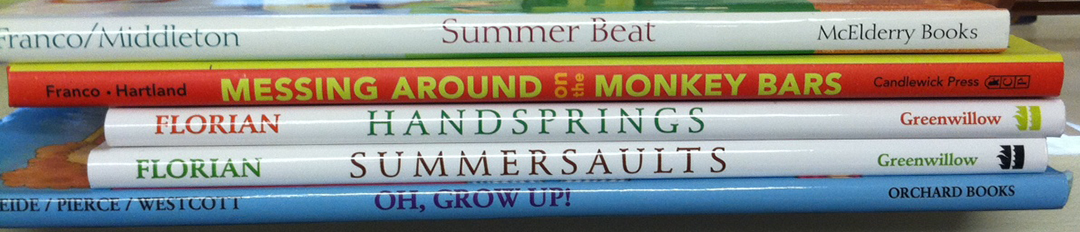
    If you could see my office right now, you'd probably be shocked at how messy it is. I have piles of books EVERYWHERE. All the books I've been pulling for my National Poetry Month posts, the books on economics from class last week, and all my inter-library loan books are scattered about the floor! I guess it makes sense that out of this chaos came these book spine poems from my collection of poetry books.

    Poem 1

    Summer beat
    Messing around the monkey bars
    Handsprings
    Summersaults
    Oh, grow up!

    (I so wish I had a book titled Never!)


     Poem 2

    Toasting marshmallows
    Keeping the night watch
    Flicker flash
    Fireflies at midnight
    Sky magic

    If you haven't been by already, be sure to check out all the wonderful poetic things being shared and collected today by Robyn Hood Black at Life on the Deckle Edge. Happy poetry Friday friends.

    Science/English Poetry Pairings - Animal Collectives

    I fell in love with words at a young age. Coupled with my love for science, I became enamored of the words to describe groups of animals and spent hours researching and memorizing the names.  When I turned turned twelve and my mother took me shopping for my birthday, I used money I'd saved to buy The Stranger by Billy Joel (vinyl!) and the book An Exaltation of Larks or The Venereal Game by James Lipton (yes, THAT James Lipton). I carried that book around for years, always entertained and intrigued by the contents.
    While this topic may be more about etymology than science, young people are still interested in learning about the names given to animal groups. Today's book pairing can easily enhance and extend any study of the animal kingdom. 

    Poetry Book
    A Crossing of Zebras: Animal Packs in Poetry, written by Marjorie Maddox and illustrated by Philip Huber, is a collection of 14 poems that consider animal groups and how, perhaps, they came by those names. Why, for example, is a group of rattlesnakes called a rhumba? Here's Marjorie's poetic answer.
    A Rhumba of Rattlesnakes

    A rhumba of rattlesnakes knows how to shake
    their long, slinky bodies and twist till daybreak.
    They wobble their heads, give their hips a quick quake.
    They jitterbug tails till their skeletons ache.

    The rattle maracas and rat-tat on drums,
    blow in tin trumpets, uncurl their tongues
    to hiss a sweet song that invites you to come
    a little bit closer. But you know to run

    way over here and avoid the mistake
    of dancing the rhumba with ten rattlesnakes.
    While many of the poems in the collection rhyme, readers will also find free verse and poem for two voices. Here's my favorite of the lot. It is accompanied by an illustration of a rather alarmed scarecrow.
    A Murder of Crows
    Oh no, there they go, a murder of crows
    throwing corncobs at the tattered scarecrow.
    Though they never quite hit her, they flap to and fro,
    cawing and jawing out names as they go.
    They eat what's not theirs, then rush back for more,
    ignoring her warnings, her pleas for reform.
    No polite songsters here, well mannered with charm,
    just fast flying hoodlums unfit for a farm.
    Poems © Marjorie Maddox. All rights reserved.

    The book features Philip’s lovely scratchboard illustrations with colored ink, depicting various animal packs. Back matter includes a note from the author explaining collective nouns and offering a list of books providing further information on the subject.

    Nonfiction Picture Book
    A Zeal of Zebras: An Alphabet of Collective Nouns, by Woop Studios, is a handsomely designed alphabet book that begins with "An Aurora of Polar Bears" and ends with the title collective, "A Zeal of Zebras." The folks at Woop Studios with responsibility for this project have impressive credentials. Two of the founders, Miraphora Mina and Eduardo Lima, spent a decade working as graphic designers on the Harry Potter franchise. In describing themselves they write, "United by a love of graphic design, words and images they founded Woop to bring a unique and exciting angle to the fascinating world of collective nouns." Unique, exciting, fascinating—their words pretty much sum up this book. The text is engaging and Woop's graphic designs are vibrant and fun, resembling in many ways vintage travel posters.

    Each letter of the alphabet receives a double-page spread with a bit of informational text about the animal on the left side, with a gorgeous, full page graphically designed illustration on the right. Here's the text that accompanies one of my favorite entries.
    A Galaxy of Starfish
    Starfish, also known as sea
    stars, are usually seen in
    large numbers only when they
    are washed up on beaches
    after a storm. 
    However, some starfish may
    gather together when they
    are ready to reproduce, using
    environmental or chemical
    signals to coordinate with
    one another.
    Text © Woop Studios. All rights reserved.

    On their web site you can find many examples of the artwork, including more pieces than occur in the book. Stunning illustrations paired with interesting tidbits of information make this an unusual and outstanding entry in the alphabet book genre.

    Perfect Together
    During your next unit on animal study, consider extending it to include animal groups. Using Maddox's poems and Woop Studios illustrations and snippets of information as models, encourage students to create their own books or a class book on animal collectives. For example, while studying reptiles they can design pages for collectives of snakes, turtles, lizards, crocodiles, and more. Students can then create their own illustrations and write about the characteristics that are common to reptiles and unique to each order.

    For additional resources, consider these sites.

    Poetry Friday - By Messenger

    I've shared poems by Amy Lowell before. This poem was first published in 1919 in a volume entitled Pictures of the Floating World. It is one of my favorite poems of all time.
    By Messenger
    by Amy Lowell 
    One night
    When there was a clear moon,
    I sat down
    To write a poem
    About maple-trees.
    But the dazzle of moonlight
    In the ink
    Blinded me,
    And I could only write
    What I remembered.
    Therefore, on the wrapping of my poem
    I have inscribed your name.
    This poem and the book it was published in are in the public domain and have been digitized and made available by Google. You can read the entire volume simply by downloading a copy.


    Do check out all the wonderful poetic things being shared and collected today by Robyn Hood Black at Life on the Deckle Edge. Happy poetry Friday friends.