Showing posts with label animals. Show all posts

Friday, April 18, 2014

Science/English Poetry Pairings - Animal Collectives

I fell in love with words at a young age. Coupled with my love for science, I became enamored of the words to describe groups of animals and spent hours researching and memorizing the names.  When I turned turned twelve and my mother took me shopping for my birthday, I used money I'd saved to buy The Stranger by Billy Joel (vinyl!) and the book An Exaltation of Larks or The Venereal Game by James Lipton (yes, THAT James Lipton). I carried that book around for years, always entertained and intrigued by the contents.
While this topic may be more about etymology than science, young people are still interested in learning about the names given to animal groups. Today's book pairing can easily enhance and extend any study of the animal kingdom. 

Poetry Book
A Crossing of Zebras: Animal Packs in Poetry, written by Marjorie Maddox and illustrated by Philip Huber, is a collection of 14 poems that consider animal groups and how, perhaps, they came by those names. Why, for example, is a group of rattlesnakes called a rhumba? Here's Marjorie's poetic answer.
A Rhumba of Rattlesnakes

A rhumba of rattlesnakes knows how to shake
their long, slinky bodies and twist till daybreak.
They wobble their heads, give their hips a quick quake.
They jitterbug tails till their skeletons ache.

The rattle maracas and rat-tat on drums,
blow in tin trumpets, uncurl their tongues
to hiss a sweet song that invites you to come
a little bit closer. But you know to run

way over here and avoid the mistake
of dancing the rhumba with ten rattlesnakes.
While many of the poems in the collection rhyme, readers will also find free verse and poem for two voices. Here's my favorite of the lot. It is accompanied by an illustration of a rather alarmed scarecrow.
A Murder of Crows
Oh no, there they go, a murder of crows
throwing corncobs at the tattered scarecrow.
Though they never quite hit her, they flap to and fro,
cawing and jawing out names as they go.
They eat what's not theirs, then rush back for more,
ignoring her warnings, her pleas for reform.
No polite songsters here, well mannered with charm,
just fast flying hoodlums unfit for a farm.
Poems © Marjorie Maddox. All rights reserved.

The book features Philip’s lovely scratchboard illustrations with colored ink, depicting various animal packs. Back matter includes a note from the author explaining collective nouns and offering a list of books providing further information on the subject.

Nonfiction Picture Book
A Zeal of Zebras: An Alphabet of Collective Nouns, by Woop Studios, is a handsomely designed alphabet book that begins with "An Aurora of Polar Bears" and ends with the title collective, "A Zeal of Zebras." The folks at Woop Studios with responsibility for this project have impressive credentials. Two of the founders, Miraphora Mina and Eduardo Lima, spent a decade working as graphic designers on the Harry Potter franchise. In describing themselves they write, "United by a love of graphic design, words and images they founded Woop to bring a unique and exciting angle to the fascinating world of collective nouns." Unique, exciting, fascinating—their words pretty much sum up this book. The text is engaging and Woop's graphic designs are vibrant and fun, resembling in many ways vintage travel posters.

Each letter of the alphabet receives a double-page spread with a bit of informational text about the animal on the left side, with a gorgeous, full page graphically designed illustration on the right. Here's the text that accompanies one of my favorite entries.
A Galaxy of Starfish
Starfish, also known as sea
stars, are usually seen in
large numbers only when they
are washed up on beaches
after a storm. 
However, some starfish may
gather together when they
are ready to reproduce, using
environmental or chemical
signals to coordinate with
one another.
Text © Woop Studios. All rights reserved.

On their web site you can find many examples of the artwork, including more pieces than occur in the book. Stunning illustrations paired with interesting tidbits of information make this an unusual and outstanding entry in the alphabet book genre.

Perfect Together
During your next unit on animal study, consider extending it to include animal groups. Using Maddox's poems and Woop Studios illustrations and snippets of information as models, encourage students to create their own books or a class book on animal collectives. For example, while studying reptiles they can design pages for collectives of snakes, turtles, lizards, crocodiles, and more. Students can then create their own illustrations and write about the characteristics that are common to reptiles and unique to each order.

For additional resources, consider these sites.

Monday, September 03, 2012

Nonfiction Monday - Bugs By the Numbers

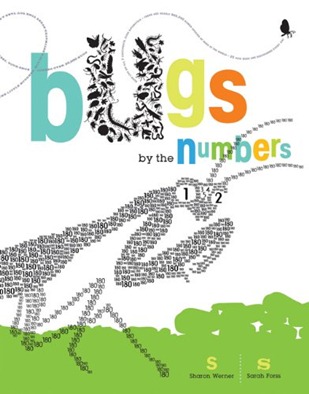
BUGS BY THE NUMBERS, written and illustrated by Sharon Werner and Sarah Forss, is a book I have a love/hate relationship with. Let's start with the stuff the "bugs" me (no pun intended) so that I can get on to the many things I love about it. Please bear with me while I put on my scientist hat.

First, I really dislike the use of the word bugs as a broad classification for arthropods and other "creepy crawly" creatures. Here's a rundown on the classification system and where these organisms are found.
Domain - Eukarya / Kingdom - Animal / Phylum - Arthropod

Arthropods are composed of five classes of organisms--arachnids, insects, crustaceans, centipedes, and millipedes. Now, hemiptera is an order of insects known as "true bugs." Included here are stink bugs, cicadas, aphids, water striders and more. 

The animals highlighted in this book are ant, butterfly, dobsonfly, fly, ladybug, spider, centipede, grasshopper, walking stick, leaf insect, scorpion, dragonfly, bee, mosquito, firefly, flea, cockroach, praying mantis, tick, bed bug, beetle, termite, and earthworm. All come from the phylum arthropod with the exception of the earthworm. This raises my second concern regarding the use of the word bug. Annelids are a phylum in the animal kingdom consisting largely of segmented worms. Earthworms fall within this phylum. They are not bugs in any sense of the word. I will admit that the term "worm" is used rather loosely and  is sometimes used to refer to certain forms of insect larvae (think mealworms, glowworms, inchworms, etc.). The authors do explain in the fine print on the earthworm page that all bugs evolved from earthworms. Even so, I find their inclusion here troubling. It's the one page that I skip while sharing this book with students.  

Now that I've had may little science rant, let's talk about the really amazing features of this book. When I read this book I begin by reading a bit from the jacket flap, as two brief rhyming stanzas do a terrific job introducing the contents of the book.
Each bug on these pages
Looks unique and rare,
Not like the insects
You see everywhere.

They're made up of numbers:
The ones that you count.
'Cause when you think bugs,
You think BIG amounts.
When you open the pages you'll find 23 different animals constructed from numbers of varying sizes and font faces. Many of the pages have fun flaps and flip-out sections. On every page there is a wealth of information on the animal, always highlighting in some way the numbers used to create it. For example, the ant is composed of 1s, 2s, and 3s, with each number comprising a different body segment (1s-head, 2s-thorax, 3s-abdomen). A fold-out flap of a leaf includes the number 3 and the fact that like other insects, ants have 3 body parts. When the flap is lifted up, 50 ants form the number 50. Beneath the number is this fact. "Ants can lift 50 times their own body weight. If you could do that, you'd be able to life a car." The fold-out flap on the bottom of the page looks like a pile of dirt. When it is folded down, a picture of ant tunnels beneath the ground is accompanied by the fact "An ant colony can reach 20 feet below ground. " In addition to these numbers and facts, readers learn that ants have 2 stomachs, that worker ants can take 250 short naps a day, and that queen ants can live for 30 years. As you can see, this one double-page spread is jam-packed with information. Nineteen of the animals in the book receive such extended treatment, with only four (dobsonfly, fly, tick and bedbug) garnering only a single page each.

My favorite page is the beetle page. While the graphic highlights the rhinocerous beetle, the bits of information along the bottom of the page describe a few standouts in the beetle family. Did you know that the fastest-running insect is the Australian Tiger Beetle? Or the that Goliath Beetle is the world's heaviest insect? Or that there are over 300,000 species of beetles on the planet? 

Want to know or see more? Check out the BUGS BY THE NUMBERS photostream on Flickr.

It's clear from the outset that Werner and Forss anticipated the kind of concern I raised about the use of the word bug. Here's an excerpt from the introductory page.
Now some smarties might notice
As the go through and look,
Not every creature is a bug in this book. 
Not all critters that fly or crawl  on the ground
Are technically bugs, but we both have found
Mos folks call them bugs, and since they do,
We figured, why not? We'd call them "bugs" too. 
Real bugs are insects, but not all insects are bugs
And spiders are neither (oh, please don't say, "Ugh").
So yes, the authors beg a bit of latitude in the beginning. I do think that if you use this in any kind of science context this needs to be explained and perhaps examined in a bit more depth.

Despite my concerns regarding the use of the word bug and the inclusion of the earthworm, I find the bulk of the book to be gorgeously constructed, highly engaging, and chock full of interesting tidbits. The kids in your classroom will be fighting over this one, so you may want more than one copy. RECOMMENDED.

Author/Illustrator:  Sharon Werner and Sarah Forss
Publisher: Blue Apple Books
Publication Date: April 2011
Pages: 56 pages
Grades: 3-8
ISBN: 978-1609050610
Source of Book: Copy borrowed from my local public library

P.S. - Did I mention that their new book, Alphasaurs and Other Prehistoric Types, comes out in October?

This review was written for Nonfiction Monday. Head on over to The Swimmer Writer and check out all the great posts highlighting nonfiction this week.

Wednesday, September 09, 2009

World Animal Day is Coming - Celebrating with Books (and More!)

October 4th is World Animal Day. The goals of this day are to:

  • Celebrate animal life in all its forms;
  • Celebrate humankind’s relationship with the animal kingdom;
  • Acknowledge the diverse roles that animals play in our lives – from being our companions, supporting and helping us, to bringing a sense of wonder into our lives; and
  • Acknowledge and be thankful for the way in which animals enrich our lives.
In the next few weeks I hope to launch a series of posts about ways in which you might celebrate this day with books and activities. To get things started, here are a few useful resources.

The Humane Society: Best Books - Since 1995 The Humane Society has recognized "an exceptional children's book with a humane focus on animals or the environment with the KIND Children's Book Award." The results for each year include best picture book, best chapter book and a number of honor books.

The Gryphon Press is a publisher dedicated to "picture books for children that explore the human-animal bond." You can learn more about their books here.

The Humane Society's Kind News has been published since 1983 for classroom use. In addition to resources for kids, you will find a series of lesson plans on responsible pet care.

Humane Education Children's Literature Index - The site Humane Education Teacher was created by Stephanie Bucalo as a way to combine her love of animals and children's literature. The index contains a lengthy list of books around themes including, but not limited to Animal Shelters, Animals Used for Entertainment, Farm Animals, Homeless Animals, Kindness, Loyalty, Wildlife Rescue and Rehabilitation, Wildlife, Sharing the World with, and much more.

Last fall I put together a list of books for kids who love animals. It's organized around the nonfiction works of Steve Jenkins, Sneed Collard III, Gail Gibbons, and Nic Bishop.

The Hennepin County Library has an annotated list of realistic stories about animals.

Saturday, February 28, 2009

The Dog and the Novel

I buy a lot of used (out of print) books through AbeBooks. Every so often they have articles and interviews on topics near and dear to my heart. Today you can find a piece entitled The Dog and the Novel: Loyal Companions. Here's an excerpt from the introduction.

Literature has long had a love affair with dogs. Granted, in January, an AbeBooks bestseller was Vicki Myron's Dewey, a tale about a library cat, but by and large, dogs in literature must outnumber their feline counterparts 10 to one.

. . .

And truth isn't a factor - fiction lovers can't get enough dog stories, either. From the small but brave Toto from L. Frank Baum's Wizard of Oz, to the courageous collie in Lassie Come-Home, authors and audiences are enchanted by the adventures of their furry, four-legged, canine subjects.

With that in mind, we spoke to Dr. Bryan Cummins, professor, collector, author and Ontario-based expert on dog books. He's been a bookseller with AbeBooks since March 1999, and kindly agreed to offer his insights into the world of dog books.

We've also compiled a list of some of the best-loved fictional dog books available, from collectible, to children's, to fiction for adults, to help you discover more about man's best friend.

It's a lovely little article that brought back some fond memories of some of my favorite stories. And yes, I'm proudly a member of team dog. (Sorry all you kidlit cat people!)

Wednesday, December 17, 2008

KIND Children's Book Award

While doing some research to follow-up on the post I wrote about great children's books about animals, I came across a new-to-me book award and list. It's really lovely, so I thought I would share it. Here's an excerpt from the introduction.

Story is a powerful tool for teaching humane concepts like compassion, responsibility, and respect. Good books provide context, create empathy, and give children characters to identify with, care about, and learn from. Stories can even inspire moral action and good citizenship.

Each year, Humane Society Youth recognizes an exceptional children's book with a humane focus on animals or the environment with the KIND Children's Book Award.

The 2008 winner was Before You Were Mine (2007), written by Maribeth Boelts and illustrated by David Walker.

Honor books for 2008 were:

For more information on these titles you should read the entire annotated list for 2008. You can also view the list of winners and honor books from previous years (1995-2007) for some outstanding choices.

In the meantime, perhaps we can try to predict some of the titles that will appear on the 2009 list. My suggestions include poetry, nonfiction and a picture book.

Will you play along with me? What was your favorite book published in 2008 with a "humane focus on animals or the environment"?

Saturday, November 22, 2008

Cybils Book Reviews - Two Heartwarming Tales of Survival

Two of the books on our list of nonfiction picture book nominees are stories of survival in the wake of Katrina. The fact that they both depict animals wins them big points in the kid appeal department.

Molly the Pony: A True Story, written by Pam Kaster, is the story of a small pony of the Americas (a cross between a Shetland and an Appaloosa) that opens with Molly being left alone in her barn to ride out hurricane Katrina. The pony survived on hay and puddles of water while she waited for someone to come for her. Two weeks after Katrina, she was found in her barn, the door having been blocked by a tree. Workers had to cut a hole in the side of the barn to get her out. Molly was taken to Ms. Kaye's farm until her owners could come and get her. Three months later, Molly became a permanent resident on Ms. Kaye's farm.

This, however, is only the beginning of the story. One day while Molly was napping in the pasture, a large Pit Bull ran into the pasture and bit her. Molly fell and kicked the dog, but it would not go away. The mauling left Molly with a badly damaged front leg.
At first the veterinarians thought they could not do anything to help Molly. Then they watched her closely for a few days. They were happy to see that she rested her healthy front leg by shifting her weight onto her back legs.

"Molly is a smart pony with a great attitude," said one veterinarian. "I think she could learn to walk with a prosthetic limb.* She knows how to take care of herself."

The veterinarians decided it would be best for Molly to go to the animal hospital at nearby Louisiana State University for the special surgery. They amputated* the injured leg below the knee and attached a stiff white cast. Molly stayed at the animal hospital for four days. Then Ms. Kay took her home.
The rest of the text follows Molly through her recovery and new role as an ambassador to children in hospitals and the elderly in retirement homes. Molly not brings smiles to the faces of all she meets, but she also leaves them behind, for the rubber hoof on the end of her prosthetic limb bears a smiley face.

The book uses photos of Molly to help tell the story. Challenging vocabulary words are printed in bold and marked with an asterisk. At the bottom of the page, readers find the words defined. An author's note at the end provides a bit more information about Molly, as well as resources to learn more about her story.

Just as Molly was left behind as families evacuated New Orleans before Katrina hit, so too were a dog and cat, both without tails, and both named Bobbi. Two Bobbies: A True Story of Hurricane Katrina, Friendship, and Survival, written Kirby Larson and Mary Nethery and illustrated by Jean Cassels, tells how these two friends survived the storm and the harrowing months that followed. It also tells of the national effort made to find them a permanent home.

When Katrina hit, Bobbi was tethered to a porch with a length of chain. Bob Cat stayed by her side. There they rode out the storm and waited for help. Even though many were rescued, no one came for the Two Bobbies. Bobbi finally broke loose, and with Bob Cat at her side, the two tried to make their way around the city. The amount of damage caused by the hurricane made it impossible for them to find a home. For months the two wandered the city, often chased by packs of hungry and homeless dogs. After a time, Bobbi's ribs began to show, and Bob Cat's markings began to fade.

Four months later, the Two Bobbies found their way to a construction site. A worker's dog rushed over to greet them. The worker, named Rich, saw how thin they were and began to feed them. However, after a week of caring for the two friends, his boss came to the job site and told him the strays had to go. Rich took the two to a temporary shelter run by the Best Friends Animal Society. When the Two Bobbies were placed in separate rooms, Bobbi howled all night long, and Bob Cat paced back and forth. It wasn't until the were placed in the same cage that they were happy.

It was at this point that workers in the shelter realized that Bob Cat was blind. All those months wandering homeless in the city, Bobbi had been keeping Bob Cat safe. The volunteers at the shelter began to look for their family, but they were never found. When it was time for the shelter to close its doors, the Two Bobbies still had no home. Desperate to find them a family, the volunteers arranged for the two friends to appeared on CNN.
The very next day, the Best Friends volunteers left New Orleans. One of them drove Bobbi and Bob Cat to the Best Friends Animal Sanctuary in Utah, where they would stay until a new family could be found. They were on their way west when the news came in.

Hundreds of people wanted to adopt them!
Yes, the story has a happy ending, and I dare you to keep a dry eye when you read it. I've read this a number of times with my son and every time he asks, "Mom, are you crying again?" ("Why yes son, your mother's a sap.") I wish I could find some word other than heartwarming, but it's absolutely the best one to describe this incredible tale. You'll not only feel good reading it, but also buying it, as the authors are donating a portion of their proceeds to the Best Friends Animal Sanctuary.

Book: Molly the Pony: A True Story
Author/Illustrator:
Pam Kaster
Publisher: Louisiana State University Press
Date Published:
2008
Pages:
36 pages
Grade:
K-4
ISBN:
978-0807133200
Source of Book: Interlibrary loan (Thank you Sweet Briar College!)

Book: Two Bobbies: A True Story of Hurrican Katrina, Friendship, and Survival
Authors:
Kirby Larson and Mary Nethery
Illustrator:
Jean Cassels
Publisher: Walker Books for Young Readers
Date Published:
2008
Pages:
32 pages
Grade:
K-4
ISBN:
978-0802797544
Source of Book: Copy received from publisher for Cybils consideration.

Friday, August 31, 2007

Those Amazing Animals!

Studying animal adaptations is a part of the elementary science curriculum in VA in both second and third grade. Students study hibernation, migration, camouflage and more. One of the things that kids find most fascinating (teachers too!) are the interesting and outrageous way some animals take the art of adaptation to the extreme. The books listed below are wonderful resources for examining the many ways animals adapt to their environments.
  • What Do You Do With a Tail Like This? written by Robin Page and illustrated by Steve Jenkins - Beautifully illustrated with cut paper collage, this book explores the amazing things animals can do with their eyes, ears, noses, mouth, feet and tails.
  • What Do You Do When Someone Wants to Eat You? by Steve Jenkins - This book, also illustrated with Jenkins' signature cut paper collages, describes how various animals, including an octopus, a bombadier beetle, a puff adder, and a gliding frog, escape danger.
  • Exploding Ants: Amazing Facts About How Animals Adapt by Joanne Settle - Who can resist a book with chapter titles like fooled ya, invasion of the body snatchers, and sucking blood? Learn about frogs that use their eyeballs to help swallow their food, caterpillars that look like animal droppings, worms that live in a dog's nose mucus, and many other approaches to survival.
  • Picture Window Books has two terrific nonfiction series. The first, called Animal Wise, was awarded a Distinguished Achievement Award from the Association of Educational Publishers. Written by Patricia Stockland and published in 2005, this series includes the following titles:
    • Pointy, Long, or Round: A Book About Animal Shapes
    • Red Eyes or Blue Feathers: A Book About Animal Colors
    • Sand, Leaf, or Coral Reef: A Book About Animal Habitats
    • Strange Dances and Long Flights: A Book About Animal Behaviors
    • Stripes, Spots, or Diamonds: A Book About Animal Patterns
    • Swing, Slither, or Swim: A Book About Animal Movement

    The second is called Animal Extremes. Written by Michael Dahl and published in 2006, this series includes the following titles:
    • Cold, Colder, Coldest: Animals That Adapt to Cold Weather
    • Deep, Deeper, Deepest: Animals That Go to Great Depths
    • Fast, Faster, Fastest: Animals That Move at Great Speeds
    • High, Higher, Highest: Animals That Go to Great Heights
    • Hot, Hotter, Hottest: Animals That Adapt to Great Heat
    • Old, Older, Oldest: Animals That Live Long Lives

  • Claws, Coats and Camouflage by Susan Goodman - Using photographs and questions to get kids thinking scientifically, this informative text looks at all the different adaptations animals use to adapt to their surroundings, stay safe, get food, and reproduce.
  • Fur, Feathers and Flippers: How Animals Live Where They Do by Patricia Lauber - This photo-essay explores the seas of Antarctica, the grasslands of East Africa, the forests of New England, the desert of the southwestern U.S., and the tundra of the Far North while showing how animals adapt to living in these places.
The books on this list provide a good introduction to a myriad of adaptations. Since the topics of migration, hibernation and camouflage are topics unto themselves, they will be tackled in later posts.

Wednesday, June 13, 2007

In Anticipation of Father's Day - Animal Dads

With Father's Day just around the corner, I thought this would be an appropriate time to celebrate Dads -- animal dads. Yes, believe it or not, there are many animal species where dad takes more than a passing interest in his offspring. Some of these amazing animal dads even show up in books for kids. Here are a few that might interest you.
  • Animal Dads written by Sneed B. Collard III, illustrated by Steve Jenkins - Okay, you know I'm a sucker for the work of Steve Jenkins. This book is no exception. The collages are fantastic and help to highlight animal dads that actually take on caregiver responsibilities in the wild. Included you will find the Emperor penguin, gorilla, wolves, Nile crocodile and more.
  • Mister Seahorse by Eric Carle - In this tribute to animal dads of the sea, readers meet Mr. Seahorse, who has just taken over the duty of caring for the eggs deposited in his pouch. As he moves through the sea, he meets five other fish fathers, a stickleback, tilapia, Kurtus nurseryfish, pipefish and bullhead catfish, all of whom help with prenatal care.
  • Just Us Two: Poems About Animal Dads by Joyce Sidman - I love the poetry of Joyce Sidman. This wonderful volume of appealing poems highlights such animal dads as the poison arrow frog, ostrich, and giant water bug.
  • Animal Fathers by Russell Freedman - Okay, my copy is old and worn (published in 1976), but this is a really terrific volume that discusses the child care behavior of fifteen animal fathers including the Downy Woodpecker, House Wren, White-handed Gibbon, Common Marmoset, and others. You may be able to find a copy in your local library.
You can also find some interesting resources for this topic at the following web sites.

Saturday, April 28, 2007

Poetry Saturday - Animal Families

William and I have been reading about animal families, so I was inspired to write this silly little poem. Enjoy!
A Family For You

Consider your life in
a warren or scurry

If your kin were a pride
would you need ever worry?

Are you suited to
tower or ambush or band?

Would play in a shrewdness
get way out of hand?

Imagine your clan is
a bloat or a pod

Would home in a prickle
be frighteningly odd?

Picture
a cackle
a richness
a gaze

In which of these groups could you
spend your days?

So
CHOOSE
while you can
and make it
fast
too

Because the Zookeeper
is coming for
YOU!
Thumbs up to you if you can name the animal groups. For a hint or two, visit this zoo page!