
by Kwame Alexander

by Skila Brown

by Deanna Caswell

by Julie Fogliano

by Nikki Grimes

by Irene Latham

by Laura Shovan
You can view all the Cybils finalists here. Happy New Year and happy reading.




 The finalists for the 2011 Cybils are in! This year there was a new category (Book Apps) and as usual, many wonderful titles up for review.
  At the Sea Floor Café: Odd Ocean Critter Poems, written by Leslie Bulion and illustrated by Leslie Evans, is a collection that contains 18 poems, a helpful glossary of scientific terms, poetry notes that describe the form of the poems, and suggestions for additional resources. Did you know that Bulion has a graduate degree in oceanography? That means you'll find poetry and science--a perfect pairing in my opinion--that are nicely matched in this collection.
 Walk Like a NutThe poems in this collection are accompanied by factual information. Here's the text about the coconut octopus.
This octopus walks backwards on two arms,
And wraps the other six around its top.
It ambles free of predatory harms,
And thus avoids become shark-chewed slop.
It winds six tentacles around its top,
Pretending to be flotsam sharks ignore,
And treads away from trouble, flippy flop,
Instead of being chomped to guts and gore--
A coconut that strolls across the ocean floor.
Poem © Leslie Bulion. All rights reserved.
The coconut octopus wraps six of its arms around its head and walks backwards on its other two arms. This movement makes the octopus look like a coconut drifting across the shallow sea floor near Indonesia. Predators hunting for an eight-tentacled snack pass on by.This is just the type of book I enjoying sharing with my preservice teachers. The blending of poetry and informational text makes this a good choice for teachers attempting to to integrate children's literature into the content areas.


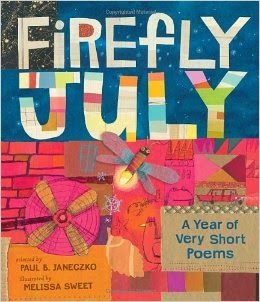
 It's that time of year again. On October 1st, the Cybils open for nominations. This year I'm moving out of nonfiction picture books and into poetry. I know I will miss nonfiction, but am looking forward to examining this year's crop of poetry in more depth. I am particularly excited about the amazing folks I get to serve with. Here's the scoop on the poetry category.
Our esteemed organizer: Kelly Fineman of Writing and Ruminating.
Panelists (Round 1)

 Duel! Burr and Hamilton's Deadly War of Words
 Nic Bishop Frogs
 A River of Words: The Story of William Carlos Williams
 Wanda Gág: The Girl Who Lived to Draw
 Wangari's Trees of Peace: A True Story from Africa
1. Where Does It Belong?That's all for now. I still have more book reviews to post, so don't forget to come back and look for them in the new year.
The organizers for all the categories worked behind the scenes as nominations rolled in to determine the eligibility of titles and to ensure proper placement of books. This required a lot of hard work and some intense discussion. In some cases, where a book belongs isn't evident until a panelist sees it first hand. One of our books was moved to fiction picture books because the note in the back of the book explained the book was "based on a true story." The cataloging information just wasn't enough go on when deciding where to place the book.
2. Is It Nonfiction?
During the nomination stage, a few titles were moved to the fiction picture book category. While they were clearly "informational" books, they weren't strictly nonfiction. I tend to think of these books as "faction"--a nice blend of fact and fiction. One example of this was Boycott Blues: How Rosa Parks Inspired a Nation, written by by Andrea Davis Pinkney and illustrated by Brian Pinkney. Narrated by a guitar-playing hound dog, it's a beautiful, blues-inspired account of the Montgomery bus boycott. Another example can be found in Fartiste, written by Kathleen Krull and illustrated by Paul Brewer. This biography of Joseph Pujol, a Frenchman who built a stage career using fart effects, reads on the cover, "an explosively funny, mostly true story." It's unfortunate this disclaimer appears so boldly from the outset, as it seems designed only to let readers know that the title relies on fact as well as legend in telling Pujol's life story.
There are always so many titles in the category of fiction picture books that I fear some of these more "information-oriented" books may get lost in milieu of more traditional stories.
3. First Person Narratives?
I was surprised by the number of titles that used first person in the writing. In some cases, the author included extensive notes that lent veracity to their use. However, in other cases there was no such information. How then, is a reader to take this information? Keep Your Eye on the Kid: The Early Years of Buster Keaton, written and illustrated by Catherine Brighton, is a fantastic biography of Keaton's early years, but it is written entirely in the first person. The author's note provides sources for further reading, as well as some Keaton films that are currently available on DVD, but she never explains the first person use.
4. Common Themes
Biographies abounded in the list of nominees this year. At least 25 titles were accounts of important events in the lives of historical figures or works that recounted a large portion of their life stories. Two very different biographies on Nobel Peace Prize winner Wangari Mathaai were included in this number. In addition to these, one title provided a biographical look at the Statue of Liberty!
Always popular, books about animals made a strong showing. Two of these animal titles were inspired by events following hurricane Katrina. There were also 2 books about bears, 2 about frogs, and 2 about ocean life.
I found it interesting that a number of the nominees contained photographic illustrations. These tended to be books on science (animal) topics.
5. Publisher Participation
Nearly one third of the nominated titles in our category were not sent to the panelists. (One panelist informed us that two titles arrived on her doorstep yesterday!) Fortunately, most of use were able to wrangle books through local libraries or interlibrary loan. In the end, there were only 2 books we never saw. I must say that I'm a bit puzzled by the lack of participation. Members of our panel highlighted nominees on their blogs. The titles got face-time at the Cybils site and even more publicity from the Cybils widget. Based on the strength of many of these titles, I purchased some for my own collection. I also took books into local schools and read them with kids. While there I made recommendations to classroom teachers and school librarians.
The positive press generated by the Cybils should not be underestimated. I'm not sure how we get more publishers to participate, but I would think that this kind of free advertising is worth giving away a book or two.
 In spring of 2007, I wrote a thematic book list on seeds and growing things. When I update the list, Flip, Float, Fly!: Seeds on the Move, written by JoAnn Early Macken and illustrated by Pam Paparone, will most certainly be added.
Take a breath and blow
on a fuzzy dandelion. Whee!
One puff sends seeds soaring.
Like small, soft feathers,
they parachute up in the sky.
Maple seeds whirl and twirl in a breeze.I can't do justice to the font and form of the text here. It is simply lovely. Each illustration that accompanies the text covers a full double-page spread. Readers learn about specific plants and how their seeds are spread, from tumbleweeds (why did it never occur to me that this was how they disperse their seeds?) to coconuts. In some instances, a "microscope view" (round circle containing a close-up image) shows the fruit, flower and leaves of the plant described. The illustrations are soft, quiet and beautiful. Even the picture of a bat "passing" seeds (after it has feasted on a fig) is charming.
FLIP, flutter, float!
The wind lifts them up and off of the tree.
Away they fly like shiny green helicopters,
spinning and spinning.
People plant seedsThe next double-page spread serves as an illustrated glossary, depicting and defining seedpod, fruit, seed, shoot, sprout, seedling, nut, flower, leaves, stem and roots. The final page of the text includes a few notes about seeds.
in gardens and flowerpots.
They tend the seedlings and watch them grow.
Sprouts! Shoots! Leaves and roots!
Flowers bloom and new seeds form,
beginning the cycle again.


The books in the Explorers series take young readers back in time to share explorations that had a major impact on people’s view of the world. Kids will investigate why and how the explorers made their journeys and learn about animals they discovered along the way. They’ll find out how some animals affected the outcome of the journey, helping explorers find their way, causing key events to happen, or helping the explorers survive. Young readers will also learn that, because of the explorers’ journeys, animals were introduced to places they’d never lived before, sometimes with dramatic results.
Would you believe that, once, worms inspired people to explore the world? In fifteenth-century Europe, silk made from the thread of silkworms was more valuable than gold. Silk and silkworms could only be found in the areas now known as China and Japan, and finding the fastest sea route between these areas and Europe could make an explorer very rich. Christopher Columbus was determined to find that route. In 1492, he set off with three ships, and while he did find land, it wasn't what he expected. Neither were the animals he found along the way.Readers learn about the Silk Road and the quest to find an easier route to the silk and spice trade. It took more than eight years for Columbus to sell his plan. The description of the ships includes information about cats and rats, both of which were common shipmates, as well as "bugs in the grub." The fleet set sail on August 3, 1492. They had problems early on and landed in the Canary Islands before they set sail again. They entered the Sargasso Sea in mid-September. The wealth of animals they spotted led them to believe they were close to land, but this was not the case. Finally, in mid-October, they spotted land.
Christopher Columbus leapt out of his boat ahead of all the others and waded onto the beach. There he dropped to his knees and gave thanks for a safe voyage. He named the new land San Salvador and claimed it for Spain. Neither Columbus nor the Spanish rulers cared that a group of people Columbus came to call the Tainos (TI-nohz) had already settled on the island and called it Guanahani (Gwah-nah-hah-KNEE).The author makes no bones abut Columbus' actions towards the natives and states that "Columbus ordered his men to capture six of the natives. In his logbook he described them as strong, healthy, smart, and likely to be good slaves." Columbus sailed through the islands of the Caribbean for two months before departing in on Christmas Eve in 1492. Around midnight, the Santa Maria struck a coral reef and began to sink. Columbus was forced to join the crew of the Niña and left the crew of the Santa Maria behind to found a colony on the island he named Española. On January 6, the Pinta and Niña finally reunited to sail home, but it was a difficult journey. Both ships finally returned to the Spanish port of Palos on March 15, 1493. In April of 1493, Columbus went to meet the King and Queen and show them all he had brought back from the Caribbean, including the Taino captives, gold, and animals.
ANIMALS SANK THE SHIPI found there was less of an emphasis on animals in the volume on Robert Scott. This book seemed to focus more on Scott and the men who made the trek with him. Here is how this one begins.
Coral reefs are really large groups of animals called coral polyps. Each coral polyp produces a hard skeleton around itself, forming a little cup it can hide inside. Neighboring coral polyps link their skeletons together. When they die their skeletons become the foundation on which new coral polyps build. Slowly, the coral colony becomes big enough to form a reef.
Imagine a place that is so far away from where most people live that for ages no one knew it existed. It can be reached only during the summer because in the winter it is surrounded by ice and it's dark nearly all the time. Much of the land is also covered in ice year-round, and the weather is among the fiercest in the world. This place is Antarctica (ant-ARK-ti-kuh).Throughout this book, "boxes" resembling index cards provide information about the exploration, animals, and important findings. Since these explorations took place in the early twentieth century, there are photographs to accompany the illustrations.
Since it's such a long journey to get to Antarctica and conditions there are so unpleasant, why did Robert Falcon Scott go there twice? You may be surprised to learn that animals had a lot to do with why he went and also played a major role in what happened while Scott was there.

People have giggled about it, snickered about it, whispered about it (shhh) for hundreds of years. They've made jokes; they've teased. They've been too embarrassed to talk about it out loud, even though they have a pretty good idea what's under there.And ends:
What is it? What is so funny about underwear?
Will underwear still be funny in the future? Maybe it always will be. There's just something about it. Is it because underwear is usually hidden? Because it's the layer between being dressed and undressed? Because it's colorful, silly, skimpy, or just because it's . . . under there?In between, a skillfully written, engaging text, accompanied by clever, cartoon-style illustrations describes the evolution of underwear from early days to the present. There is much to learn and enjoy here. The illustrations are downright funny. While much of the humor may escape young readers, adults will enjoy every bit of it. For example, one illustration shows shows a woman catapulting into a hoop skirt, while the opposite page shows women fully dressed and parachuting to the floor instead of taking the staircase. Another illustration shows a group of men, women and children dressed in "union suits," skating on a pond. Below them, a bull chases a family dressed in red union suits out of a field. There is also a wonderful illustration of a soldier parachuting out of the sky with what appears to be a nylon stocking.
Can you say it in a whisper? Can you say it out loud? Can you say it without a smile?
"I see London,
I see France,
I see Laura's under ____?"
Instead of going into a landfill, the used clothing may be sold at a Goodwill store, or sold to a recycling company that converts it back into cotton fibers to be used in new ways, such as stuffing for dolls. Used clothes are also shipped in large bales to countries such as Zambia in Africa.The book ends with a timeline on the history of underwear, and includes a list of books and web sites where readers can get additional information.
Book: Underwear: What We Wear Under There
Author: Ruth Freeman Swain
Illustrator: John O'Brien
Publisher: Holiday House
Date Published: 2008
Pages: 32 pages
Grade: 3-8
ISBN: 978-0823419203
Source of Book: Interlibrary loan (Thank you Alexandria library!)


