The blog of a teacher educator discussing math, science, poetry, children's literature, and issues related to teaching children and their future teachers.
I've been a fan of spiders for ages, long before I became a faculty member at the only college in the country with a spider mascot. As a classroom teacher I had a tarantula in my classroom and often shared spider-related humor with my students. A particular favorite was this Calvin and Hobbes strip.
If you can't quite make out the text, here's what Calvin opines.
Like delicate lace, so the threads intertwine, Oh, gossamer web of wondrous design! Such beauty and grace wild nature produces …
UGHH, look at the spider suck out that bug’s juices!
While many folks focus on the "yuck factor," spiders are truly fascinating creatures. Leslie Bulion has fully captured how amazing they are in both verse and prose in Spi-ku: A Clutter of Short Verse on Eight Legs. Add in the incredible illustrations by Robert Meganck and you have a masterpiece that even arachnophobes will love.
Bulion is a master of informational texts that marry engaging, kid-friendly poetry with science. I wish her books had been around 33 years ago when I settled into my first classroom, eager to put science books in kids hands that would neither put them to sleep with their didactic approach to content, nor turn them away with the complexity of the writing. Not only were truly exceptional nonfiction science books hard to find back then, but poetry was almost nonexistent. As someone who encourages teachers to integrate poetry and children's literature into content area instruction, Leslie's books are a gift.
Let's start this review by exploring from the back. My students know how much I love back matter. It's one of the components that I believe separates good nonfiction texts from great ones. The back matter in Spi-ku consists of a glossary of 24 terms, notes on poetics forms, spider identification that includes common and scientific names (genus and species) for the 53 spiders illustrated so carefully by Meganck, ideas for going on a spider hunt, an annotated bibliography with resources for further study, the author's acknowledgements (yes, she consulted with experts!), a double-page spread showing spiders' relative sizes, and a page of close-up illustrations of the spiders that appear on the cover. Phew! See what I mean about back matter? This information adds a welcome layer of depth to the text.
While many of the poems in the text use Japanese or Japanese-inspired forms, such as haiku, tanka, dodoitsu, and cinquain, there are other forms, including limerick, double dactyl, free verse, concrete, and many more. The first poem, "Araneae All Around" provides a nice introduction to the humble spider and the volume. The poems are all accompanied by illustrations of spiders, their silks, and webs. I found myself constantly flipping between the pages and the spider identification in the back to try and determine exactly what spiders I was looking at. After the introductory poem, Bulion introduces arachnids, or the class of invertebrates that spiders belong to.
(Click to enlarge.)
I adore the word play in using mite in this poem. This is the kind of thing that students will remember. I know this one turn of phrase is a great way to remember at least one other type of organism found in the arachnid class. As pictured above, each double-page spread includes one or more verses and a block of informational text. The spiders highlighted in the text blocks appear in boldface to make them stand out. The information unfolds in a thoughtfully organized fashion, taking readers on a journey that has them learning about spider silk, spider movement, how they catch and eat their meals, their webs, how some spiders capture prey without the use of a web or snare, how spiders fool both prey and predators, spider senses, and so much more.
I learned as much from the poems in the book as I did the nonfiction excerpts. The 3 different spreads on spider enemies all include poems for two voices and are particularly engaging when read aloud. The text ends with a final poem entitled "Appreciate Araneae!" After learning so much about them, it's hard not to appreciate all they contribute to "Our Spiderful World," which just so happens to be the heading for the last block of nonfiction text. (Go ahead, see for yourself!)
(Click to enlarge.)
There is so much to love in this volume. I encourage all you folks who are fearful or disdainful of spiders to be brave and take a peak. I guarantee that by the end of it, even the biggest spider-haters will be converts.
For all you teachers out there, Leslie has developed a particularly useful Educator's Guide. Don't miss it!
Thanks to PeachTree for sending me a copy of the book and including me on the blog tour. You can check out the other stops this week to learn more.
You can learn more about Robert Meganck and his art on his web site. (Turns out, he's my neighbor here in Virginia. Hi Robert!) You can also find him on social media at:
On this last day of April, it's fitting that I share this poem by Phillis Levin.
End of April
Under a cherry tree
I found a robin’s egg,
broken, but not shattered.
I had been thinking of you,
and was kneeling in the grass
among fallen blossoms
when I saw it: a blue scrap,
a delicate toy, as light
as confetti
It didn’t seem real,
but nature will do such things
from time to time.
I looked inside:
it was glistening, hollow,
a perfect shell
except for the missing crown,
which made it possible
to look inside.
What had been there
is gone now
and lives in my heart
where, periodically,
it opens up its wings,
tearing me apart.
I've enjoyed exploring different poets and poems this month. Thanks for following along. And remember, just because National Poetry Month is ending, doesn't mean the daily reading of poetry has to end.
I'm so thrilled to have served as a Cybils first round judge in the poetry category this fall. I'm very excited to share the list we are sending forward to the round 2 judges.
When I was young and learned my father served in the Naval Air Corps during WWII, I became a voracious reader of anything and everything about the war, including the Holocaust, Pearl Harbor, Jackie Robinson, Rosie the Riveter, the WACs, and more. What I didn't find were stories about the Tuskegee Airmen. My young self would have been as thrilled as I am today with the release of an amazing poetry collection entitled You Can Fly: The Tuskegee Airmen, written by Carole Boston Weatherford and illustrated by Jeffery Boston Weatherford.
You Can Fly: The Tuskegee Airmen is a collaboration between award-winning children’s book author Carole Boston Weatherford and her son, debut illustrator Jeffery Boston Weatherford. They have woven poems and scratchboard illustrations into a history in verse inspired as much by World War II newsreels as by modern day graphic novels. The project was nearly ten years in the making. With starred reviews in Kirkus and Publisher’s Weekly, the book for middle grades is off to a flying start.
Here the mother-son/author-illustrator team interview each other.
Carole:When did you first hear about the Tuskegee Airmen?
Jeffery: I first heard about them when I was a young boy. We took family trips to the Smithsonian Air and Space Museum in Washington and to Tuskegee Institute, Alabama where we toured exhibits about the Tuskegee University’s founder Booker T. Washington, botanist George Washington Carver and the Tuskegee Airmen. I always had dreams of flight.
Jeffery: Why did you want to write this book? Carole: I first learned of the Tuskegee Airmen in a magazine article in the 1980s. I was so moved by their story that I saved the magazine. My literary mission is to mine the past for family stories, fading traditions and forgotten struggles. The Airmen’s saga is historically and politically significant. As a children’s literature professor, I knew of at least one historical fiction picture book and of several informational books about the Tuskegee Airmen. I felt that the story would lend itself well to a poetic treatment.
Carole: Tell us about your family’s military ties?
Jeffery: My great great great grandfather Isaac Copper fought in the U.S. Colored Troops during the Civil War. He was one of 17 veterans who founded the town of Unionville on Maryland’s Eastern Shore. My mother’s father Joseph Boston Jr. served in World War II. He was a technical sergeant in the Army Corps of Engineers in New Guinea and the Philippines. My grandmother still has his uniform and medals.
Jeffery: Which poem was most challenging to write?
Carole: “Operation Prove Them Wrong” was by far the toughest to write. It was like plotting scenes for a war movie. I had to boil down Operation Corkscrew and Operation Diadem to a few lines that captured the battles. It might have been easier if I were gamer like you or at least a World War II buff.
Carole: You were a serious gamer growing up. Did your background as a gamer influence how you illustrated the battle scenes?
Jeffery: Yes, absolutely. I had lots of residual visual references from battles across galaxies.
Jeffery: What is your favorite illustration from the book?
Carole: I like the one opposite the poem “Routines.” It shows a dogfight in which one plane gets bombed and explodes. The explosion is quite animated, like something out of a comic book. I almost want to add an action bubble: Boom! Carole: Describe your creative process. Jeffery: For inspiration, I viewed documentary photographs from the Library of Congress and National Archives collections. While researching picture references, I had some dreams of meeting Tuskegee Airmen. I also watched the movie Red Tails. For each illustration, I drew a graphite study to layout the composition. Once that was completed and approved by the publisher, I refined the image and transferred it to scratchboard. I used various nibs for different effects.
Jeffery with Airman portrait
Jeffery: What do you want readers to take away from the book?
Carole: I want them to be inspired by the courage and determination of the Tuskegee Airmen. I want them to understand that the sky is no limit if they are willing to prepare themselves, practice and persevere. The book aims to lift the ceiling off of young people’s dreams.
P-51 Mustangs flying in formation over Ramitelli, Italy.
The poems in this volume are moving, vivid, and packed with information. The poem in the Epilogue describes the race barrier breaking moments that came after the Tuskegee Airmen paved the way for integration of the U.S. military. The backmatter includes an author's note, timeline, and extensive list of additional resources and primary sources.
My thanks to Carole and Jeffery for sharing their conversation and their work. You Can Fly: The Tuskegee Airmen was released on May 3rd and is available now. Don't miss it!
I was saddened to hear of the death of Francisco Alarcón last week. I had the pleasure of interviewing him for one of my National Poetry Month series on Poetry Makers. If you don't know him or his work, his obituary contains some lovely thoughts.
Reading Rockets conducted a nice interview with him. It is below.
Finally, I thought this might be a good time to share again his Poetry Makers interview. This was originally posted April 3, 2010.
*****
Several years ago while looking for some bilingual poetry for a student teacher, I stumbled across the book Iguanas in the Snow and Other Winter Poems / Iguanas en la nieve: y otros poemas de invierno, written by Francisco Alarcón and illustrated by Maya Christina Gonzalez. The vibrant art on the cover reeled me in, and once I was inside the magic of the poems enchanted me. Here's one I suggested she use with her ESL students, all recent immigrants, all Spanish-speaking.
Ode to Buena Vista Bilingual School
here Spanish
goes to school
with English
uno-dos-tres
is as easy as one-two-three
here children
of all races write
beautiful poems
in English
and Spanish
even in spirals
and following
the beat of teacher
Felipe's clave
here children
learn to sing
with their hearts
Oda a la Escuela Bilingüe de Buena Vista
aqui el español
va a la escuela
con el inglés
uno-dos-tres
es tan fácil como one-two-three
aqui niños de todas
las razas escriben
bellos poemas
tanto en inglés
como en español
hasta en espiral
y siguiendo
la clave del
maestro Felipe
aqui los niños
aprenden a cantar
con el corazón
Before moving on to Francisco's interview, take a few minutes to listen to him talk about his family and read some of his poems.
***************
How did you get started writing poetry? What got you hooked on children’s poetry?
Francisco: I started to write poems when I was around 13 years. I was in Guadalajara, Mexico, and I wanted to put down in writing my grandmother’s songs she used to sing. I thought the songs were part of the oral tradition but when I found out they were her own compositions that she had never written down, I decided to transcribe them. Since I don’t have a very good memory, I would make up for a line or two that were missing in the traditional ballads that usually have stanzas of four verses each.
I published my first book of bilingual poems for grown-ups in 1985. Later I became aware that there were almost no books of bilingual poems children written by any Latino poet in the United States, and so I wrote and published my first book of bilingual poems for children in 1997, “Laughing Tomatoes and Other Spring Poems” (Children’s Book Press). I published three additional books to complete the “Magical Cycle of the Four Seasons” of the year. I wrote a book of bilingual poems for children about dreams. “Poems to Dream Together” (Lee & Low Books, 2005). My latest book, “Animal Poems of the Iguazú / Animalario del Iguazú” (Children’s Book Press, 2008) is a celebration of a natural wonder of the world.
What are the things you enjoy most about writing poetry for children/young adults?
Francisco: I write poetry for children in the same way I write poems for grow-ups. My signature poetics is that “less is really more,” that is to say, that few words in a poem can express a great deal and some times better than long texts. I believe that poems can only be complete when they are read by readers or are heard by listeners. My poems demand readers and listeners who are “accomplices” of the author and can make sense of my poems that I believe are incomplete without the participation of readers and listeners. This is why I enjoy immensely reading aloud my bilingual poems to children during school visits or during poetry presentations in public libraries or community centers.
In the past, I used to present my poems together with slide shows, but last year, at the urging of the organizers of “Words Take Wing,” an annual literary presentation of children sponsored by the School of Education and that takes place at the Mondavi Performing Arts Center at the University of California, Davis, I began doing power point presentations in which my poems are projected to a screen together with visual images from my children’s books. I did this for the first time at a morning presentation at the Mondavi Center together with artist Maya Christina Gonzalez, the illustrator of five of my children’s book.
There were about 1,000 children and teachers in the audience in one of the largest performance theaters in Northern in California. It was a smashing great success and as a direct result, I was invited to visit about 20 schools in the surrounding areas in the following months. I see this as an integral part of the poetic process that starts with my solitary writing of the poems, then includes the edition and publication of the books of poems with artwork by inspired artists and designers, and finally extends to the actual presentation of the poems to children, their families and teachers, and the public in general. This process brings lots of joy and satisfaction to me as a poet and educator.
Who/what made you want to write?
Francisco:I began writing poems as a way to retrieve family memories, first by writing down the songs composed by my paternal grandmother in Guadalajara, Mexico, and then, by giving testimony of my family and personal experiences. After I do presentations of my poems to children, I usually ask children if they have any questions or comments, and often I receive some very insightful comments or questions from children, like the one I received at “El Festival del Libro” on March 14, 2010, in Sacramento.
A nine-year old girl commented that she noticed that all the poems I had read were in some way connected to my own life. I told her that I appreciated very much her insightful comment, and that yes, for me, poetry is an extension of my own life; that my poems are direct reflections of life and reality that I find fascinating, mesmerizing, and magical; that although I celebrate the imagination of other poets and writers, my poetry is a celebration of our surrounding reality, than more than being fictitious, my poetry is above all a testimony of life.
I told the audience that I have thinking about my work as a poet of the past 30 years; that I have come to the conclusion that maybe the main reason why I have never used periods in my poems is that in reality all my poems are really part of a single very long poem that is my life; that a big final period will mark my tombstone. And then I read the following poem that I include here:
Life Poem
not a single
period in all
of my poems--
my life
is really
the one poem
I've been
writing all
these years
--one single
long sentence
with no periods--
the day
I pass away
will mark
the last
and only
period
of all
my life
poem
Poema Vida
ni un solo
punto en todos
mis poemas--
mi vida
es de veras
el único poema
que he estado
escribiendo todos
estos años
--una sola
larga oración
sin puntos--
el día
que muera
marcará
el único
punto
final
de todo
mi poema
vida
Have you had any formal poetry training? If not, how did you learn to write what you do?
Francisco: I had the privilege of having excellent education opportunities in my lifetime. I was a scholarship student that attended El Instituto de Ciencias, an elitist high school run by the Jesuits in Guadalajara, Mexico. Since I was in the Dean’s List, I was given the keys to a wonderful literary library of more than 3,000 books that was at my personal disposal. This library was a paradise for a teenager interested in devouring books.
Then after I moved to California and went to college, I took many solid courses on Latin American and Spanish literature and got a BA in Spanish and History from California State University, Long Beach. For five years I undertook graduate studies at Stanford University, in the Department of Spanish and Portuguese. I consider Fernando Alegría, a Chilean poet and novelist who was the cultural attaché in the Chilean Embassy during the Allende government, and a professor at Stanford, one of my literary mentors. When I was a Fulbright scholar in Mexico, I met and became a very close friend of Elías Nandino, who at 80 years old was a survivor of generation of Mexican writers known as “Los Contemporáneos.” Elías Nandino became my mentor in poetry and life.
While attending Stanford, I moved and lived in the Mission District in San Francisco, California, and met and collaborated with many great poets and writers like Juan Felipe Herrera, Lorna Dee Cervantes, José Antonio Burciaga, Lucha Corpi, Jack Hirschman, Alejandro Murguía, among others.
Being faculty to some intensive poetry workshops like “Art of the Wild” organized by Jack Hicks, professor fo UC Davis, in Squaw Valley near Lake Tahoe in California, taught a great deal about poetry. I had the chance to interact with Gary Snyder, who is one of the main teachers of poetry of my generation. Above all I have to say that life is the teacher, mentor, inspiration, and main theme of my poetry.
Can describe your poetry writing process? Francisco: I am always very puzzled by poets who say that they write poetry every day at a certain time. I have never been able to do so. I write poems really in a fit of passion. I can go on days and months without writing anything and then suddenly poems come rushing to me unexpectedly. I have learned to leave everything aside and become a medium for the poems. Whole collections of poems have come to me in a matter of few days. Most of the bilingual poems my latest book, “Animal Poems of the Iguazú / Animalario del Iguazú.” came to me while I was visiting the Iguazú National Park in Northern Argentina. So, I can say the poems were written in situ.
For some unknown reason, I write most of poems by hand on yellow lined paper blocks. Maybe I see myself as a secretary taking dictation for a poetic brief instead of a legal one. I am so old fashioned; I still use cursive handwriting; for me, the movement and cadence of writing by hand are very inspirational and conducive to poetry.
Do you have a favorite among all the poems/poetry books you have written? Francisco: This is very difficult question to ask to poet like me. It’s like asking a father about his favorite son or daughter. I celebrate each poem of every poetry book as being unique and part of a large book that I have been writing all my life. For me poetry somehow escapes the realm of the possible. I read some of my poems I wrote decades ago as if I had written them yesterday, and others that I wrote recently I read them as if someone else had written them; they keep surprising me.
Would you like to share the details of any new poetry project(s) that you’re working on?
Francisco: I have been working on two books of poems for children. The first one is collection of bilingual poems about the Mesoamerican origin of Chocolate. I have submitted the manuscript to several published and I have been told by editors that although they loved my poems they found that the subject matter, chocolate, is really a taboo subject for children’s books, because chocolate supposedly makes people obese. But my poems deal with the indigenous origins of chocolate and not about the sugar that was later added to chocolate. I sent the manuscript to a university press that is still considering it. I know that when my book of chocolate poems comes out it will do really well among children, educators, critics, and the public in general.
The second book is a collection of poems about Aztec calendar. I have titled this unpublished book, “Tonalamatl: Book of Days / Libro de los días.” This is a trilingual collection that includes short poems for the 20 days in the Aztec calendar in Spanish, English, and Nahuatl, the language of the Aztecs. The poems in Nahuatl are translations done by Natalio Hernández, one of the most distinguished Mexican poets who write in Nahuatl in Mexico. This book is directed toward middle school children and young readers and is a groundbreaking literary project because it will be the first time that a picture book will be published in English, Spanish, and Nahuatl in the United States. I am in the process of looking for a publisher.
Pop Quiz! Your favorite dead poet?
Francisco:In English, two of my favorite poets are E. E. Cummings and Langston Hughes. In Spanish, I would say Federico García Lorca and Pablo Neruda.
Your favorite place to write? Francisco: I don’t have a particular place for writing. I have written many of my poems on my kitchen table and on small notebooks as I walk around or right after I wake up in the morning, also in the middle of night still on my bed.
Favorite quote on writing/poetry? Francisco: "The earth laughs in flowers" by E. E. Cumming. I once wrote a poem that resembles this quote:
SPRINGTIME
hills are starting
to crack a green
smile once again
Your nominee for the next Children’s Poet Laureate? Francisco:I would nominate Pat Mora, who has published so many beautiful children’s books.
***************
Francisco has done such a wonderful job describing his art that I can't add much more. I wish I had thought to ask if he composes in Spanish, English, or both. I'm not sure it matters, but to someone who is sadly monolingual, I am intrigued by those who can "think" in a second language. And frankly, I struggle to write decent poetry in my native language, so reading Francisco's work fills me with even more admiration and wonder knowing he's working in two languages.
It's that time of year again. On October 1st the Cybils open for nominations. I am excited about serving again this year in the first round of judging with an AMAZING group of folks. Here's the scoop on the poetry category.
Our esteemed organizer: Jone Rush MacCulloch of Check It Out
I know we'll have a slew of terrific books to review and report on, with the outcome being a small group of outstanding finalists that will give those round two judges a whole lot to talk about. Last year I racked up $31 in library fines for keeping my books a wee bit too long. Let's hope I'm much better about returning books this year.
I can't wait to get started. Three cheers for the Cybils!
This month the poetry seven have been focused on writing a pantoum using the words certainties and flight. They will debut on May 1st. YIKES! Mine is not even close to written yet because I'm still tossing around ideas. Here's the work I did yesterday as I sat in two different meetings. This is not surprising, as words and poems seem to emerge in the most inconsiderate of moments.
Here's what I scribbled during the morning meeting.
When I got back to the office, I dumped my ideas into a form, playing a bit with the lines.
Unsure of the this idea, I tried something new at my second meeting.
The ideas I'm working with are fledgling birds (ducks!) and leaving rural life. I'm not sure if either one will work, but we will find out next week!
This morning I am celebrating the range of diverse books (authors, illustrators, and subjects) and poetry present in the youth media award winners announced at the American Library Association (ALA) Midwinter Meeting in Chicago.
It was hard keeping quiet about this amazing list of books. Here's what the round 1 judges, a lovely group of women to work with, chose to send along to the round 2 judges.
Brown Girl Dreaming is many things in one rich collection – memoir, history, biography – and lyrical, exquisite poetry. Events of the author’s personal and family history provide the framework for a series of individual poems. Woven throughout are key events of the Civil Rights journey and also personal effects of racism and discrimination. In this beautiful and powerful tapestry of verse, one hears the poignant reflections of Jacqueline Woodson, one of today’s finest writers, who kept on dreaming through tough times and good times and who keeps on writing in mesmerizing verse.
written by Irene Latham and illustrated by Anna Wadham
Dear Wandering Wildebeest’s poetry bounces with the impala and peeps like the meerkat. With childlike illustrations by Anna Wadham, Irene Latham takes us on a journey to the water hole of the African grasslands. Each poem is accompanied with factual information that will inform even the oldest readers.
To All the Beasts who Enter Here, there is word play with “Saw-scaled viper/ rubs, shrugs,/ sizzzzzzzzzzzzzzzzzzzzzles,” form experiments in Triptych for a Thirsty Giraffe, humor with “Dung Beetle lays eggs/ in elephant poop,” and even danger, “Siren-howls/ foul the air./ Vultures stick to task.” Children and adults alike will love the language and learning that wanders in this book along with the animals of the watering hole.
written by Paul B. Janeczko and illustrated by Melissa Sweet
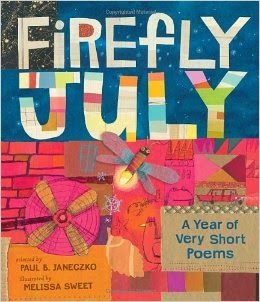
Prolific anthologist Paul B. Janeczko brings the old and the new together in Firefly July: A Year of Very Short Poems. The collection of 36 poems contains poems by classic poets such as Emily Dickinson and Robert Frost. Intermingled with these are poems by well known children’s poets including J. Patrick Lewis and X. J. Kennedy. Firefly July takes readers through the seasons beginning in spring and ending with winter. The poems take readers to different locations as well. Both city and country settings appear in the poems. As the subtitle states, the poems are short, but the images they evoke are almost tangible. Melissa Sweet’s mixed media illustrations are colorful, playful, imaginative, and whimsical. They draw readers into the poems. Firefly July is a stellar collection that will likely be a family favorite for years to come.
Inspired by his twins, Muth wrote a haiku book that doesn’t followe the often used three line, 5-7-5 syllable form. This made this title a stand out among other haiku books.
Readers take a seasonal journey from summer through spring by Koo the panda. (Thus the pun in the title: Hi Koo!) Beginning with a simple observation about the wind: /found!/ in my Coat pocket a missing button/ the wind’s surprise, to the last haiku: becoming quiet/ Zero sound/ only breath/ Muth offers to young readers a new way to experience haiku.The watercolor and ink drawings complement the text. The subtle alphabet theme adds another dimension to the book.
The author’s note at the book’s beginning sets the tone: “…haiku is like an instant captured in words–using sensory images. At its best, a haiku embodies a moment of emotion that reminds us that our own human nature is not separate from all of nature.”
This book of poetry will help readers to slow down to appreciate the small moments of nature and daily happenings.
Blurb written by Jone Rush MacCulloch, Check It Out
written by Bob Raczka and illustrated by Chuck Groenink
Who knew that among his many talents, Santa was an expert at writing haiku? In this collection of 25 poems using the 5-7-5 format, Raczka brings us Santa’s many observations, some about his job: “Wishes blowing in/from my overfilled mailbox–/December’s first storm” and others about the weather, the time of year, and Christmas preparations: “Clouds of reindeer breath/in the barn, steam rising from/my hot chocolate”. A fun read all at once, or one per day in anticipation of Christmas, some of the haiku work for winter in general as well: “Just after moonrise/I meet my tall, skinny twin–/’Good evening, shadow.'”
Voices from the March is a historical novel in verse that focuses specifically on the momentous march on Washington, D.C. on August 28, 1963, where Dr. Martin Luther King, Jr. gave his landmark “I Have a Dream” speech. Six fictional characters (young and old, black and white) tell their tales on this historic day in cycles of linked poems alongside the perspectives of historic figures and other march participants for a rich tapestry of multiple points of view. It’s been 50 years since the signing of the Civil Rights Act in 1964, when discrimination on the basis of race, color, religion, sex, or national origin became against the law. In this powerful work, Lewis and Lyon tackle issues of racial and social justice in 70 lyrical poems that reflect the perspectives of young people and adults struggling with taking action for positive change in peaceful ways. In addition, extensive and helpful back matter includes a guide to the fictional and historical voices, bibliography, index, and list of websites and related books.
In a series of free verse poems in English and Spanish, our most precious natural resource takes center stage. Water rolls, rises, slithers, hums, twists, plunges, slumbers and moves across the Earth in varied forms and places. Mora’s three-line poems are filled with imagery and emotion. “Water rises/ into soft fog,/ weaves down the street, strokes and old cat.” (In Spanish: “El agua sube/ formando suave neblina/ que ondula pro la calle, acacia a un gate viejo.”) The lyrical movement of water described in verse is accompanied by Meilo So’s gorgeous mixed-media illustrations highlighting 16 landscapes from Iceland, to China, to Mexico, the United States and more. Back matter includes an author’s note and information about the images in the book. A joyous, bilingual celebration, this collection brings water to life.
If you are interested in more poems on civil rights heroes, check out When Thunder Comes: Poems for Civil Rights Leaders by J. Patrick Lewis. It includes an introductory sonnet and seventeen poems about both women and men who stood up against injustice of every kind. This is how the book begins.
Last year my plans for National Poetry Month were put on hold by an unexpected death in the family. It was the first time I'd missed celebrating in several years of blogging. I'd like to say I have something elaborate planned this year, but I'll be traveling during two different weeks to conferences so I have scaled back a bit.
This year my theme is Poetry A-Z. For the first 26 days of the month I'll be highlighting poetic forms, specific poems, books of poetry, and poets according to letter. For the last 4 days I've created a set of "acrostic" themed posts with some additional thoughts on poetry.
I know I haven't been around much, but I do hope you'll join me.
I'm writing the syllabus for my science class right now and am finding a great deal of inspiration in this quote from Lois Lowry.
A sense of wonder comes built in with every child. Powers of absorption greater than the most up-to-date Pampers are part of youth's standard equipment.
This comes from a piece Lowry wrote in response to calls for censorship of THE GIVER and is called Trusting the Reader. You can find it in the Kerlan Collection's Censorship Portfolio. (Scroll down the page to the author's response section for the link to the pdf.)
While Lowry was talking about readers in this piece, it most certainly applies to the teaching and learning of science. That curiosity about the world around us is one of things teachers need to kindle and encourage. Too often it's what is quashed by the lack of time afforded to science and the emphasis on teaching to the test. It is hard to find balance, but I'm convinced it can be done.
This sense of wonder and the ability to look closely and see beyond the surface of things is not unique to science and the work of scientists. It is also the work of the poet. Poets not only see deeply, but they see uniquely and encourage us to view the world from a different perspective. For example, I've never seen numbers the same way since reading this poem.
Cardinal Ideograms by May Swenson
0 A mouth. Can blow or breathe,
be a funnel, or Hello.
1 A grass blade or cut.
2 A question seated. And a proud
bird’s neck.
3 Shallow mitten for a two-fingered hand.
4 Three-cornered hut
on one stilt. Sometimes built
so the roof gapes.
See what I mean about seeing the world through a different lens? In the hands of a skilled poet, poetry can astound. And therein lies another connection to science. When kids embrace science (play, discover, and do, NOT memorize), it too has the power to amaze.
This year I had the pleasure of serving as a judge for the Lee Bennett Hopkins Poetry Award. After months of reading, the committee of judges met virtually to discuss our top choices. The authors have been contacted, so we've been given the go-ahead to share the news. I am pleased to announce this year's choices.
I know everyone is writing about ALA midwinter and all the awards announced yesterday. Have you taken stock of the poetry on the list? Here's a recap from a poetry perspective.
Coretta Scott King Book Awards - Author Honors The Great Migration: Journey to the North, written by Eloise Greenfield and illustrated by Jan Spivey Gilchrist Never Forgotten, written by Patricia C. McKissack and illustrated by Leo and Diane Dillon
Pura Belpré Author Award Winner AND William C. Morris Finalist Under the Mesquite, written by Guadalupe Garcia McCall