Friday, September 18, 2015

Say Hello to Poetry, Cybils Style!

It's that time of year again. On October 1st the Cybils open for nominations. I am excited about serving again this year in the first round of judging with an AMAZING group of folks. Here's the scoop on the poetry category.

Our esteemed organizer: Jone Rush MacCulloch of Check It Out

Round 1
Round 2
I know we'll have a slew of terrific books to review and report on, with the outcome being a small group of outstanding finalists that will give those round two judges a whole lot to talk about. Last year I racked up $31 in library fines for keeping my books a wee bit too long. Let's hope I'm much better about returning books this year.

I can't wait to get started. Three cheers for the Cybils!

Monday, September 14, 2015

Constitution Day is Thursday, September 17th

In the summer of 1787, the Constitutional Convention met in Philadelphia to write a new plan of government for our nation. The Constitution was approved by the Convention and signed on September 17th of the same year. Once signed it was sent to the states for ratification.

In 2005, a federal law established September 17th as Constitution Day. Here are some books and additional resources to help you celebrate the law of the land in your home or classroom. Please note that these are largely focused on the elementary level.

Books

The United States Constitution: A Graphic Adaptation, written by Jonathan Hennessey and illustrated by Aaron McConnell - This graphic text provides an illustrated journey through the articles and amendments of the Constitution. Text and illustrations provide clear explanations and historical background.

Shh! We're Writing the Constitution, written by Jean Fritz and illustrated by Tomie dePaola - This book provides a highly readable account of the Constitutional Convention by describing what the framers were doing and how they did it. Readers will find the text of the Constitution, as well as several pages of explanatory notes.

We The Kids, illustrated by David Catrow - Drawing on his strengths as a political cartoonist, Catrow uses a group of friends and a backyard camping trip to make the Preamble to the Constitution understandable for readers by pairing the text with illustrations that help define phrases like insure domestic tranquilitycommon defense, and our posterity. For example, the illustration for "establish Justice" shows a dog wearing a helmet and standing guard while the kids play inside the tent.

A More Perfect Union: The Story of Our Constitution, written by Betsy Maestro and illustrated by Giulio Maestro - This book provides an overview of the Constitution, beginning with the initial decision to hold the convention and ending with the adoption of the Bill of Rights. The focus of the text is really on the basic decisions about the organization of the government which resulted in the Great Compromise. Also included is a final section that provides a list of the signers, chronology of events and dates, and simple summaries of the Articles and amendments.

If You Were There When They Signed the Constitution, written by Elizabeth Levy and illustrated by Joan Holub - Like other books in the If You Were There series, this one is organized around a series of questions. It begins with What is the Constitution? and then moves on to a bit of history (the war, the Declaration, the Articles of Confederation) in order to lay the foundation for understanding the document. This one answers many questions about who was involved, why certain choices were made, and how the process worked.

Picture Window Books publishes a series entitled American Symbols. In it you will find these books written by Norman Pearl and illustrated by Matthew Skeens:
  • The U.S. Constitution - This book begins with James Madison introducing himself and asking the question "What is the U.S. Constitution?" What follows are a series of spreads with information about the framers and how they worked together, the document itself and the branches of government.
  • The Bill of Rights - In this book James Madison looks at the Bill of Rights and explores how it came to be.

Constitution Translated for Kids, written by Cathy Travis - Written at a 5th grade level, this book provides the entire text of the Constitution accompanied by a kid-friendly translation. In addition to the side-by-side translation, readers will find a timeline of events leading up to the writing of the Constitution, a glossary, information on Constitutional compromises, a bibliography and more.

Sites for Kids

Additional Web-Based Resources

Last But Not Least ... Schoolhouse Rock!

Monday Poetry Stretch - Ubi Sunt

My son started high school last week and with it, his first foray into learning another language. He came home on Friday with a list of vocabulary words to memorize for a quiz on Tuesday. When I realized one of his words was ubi (he's taking Latin), I knew exactly what the form for this week's challenge would be.

Ubi sunt (Latin for  “where are?”) is a verse form traditionally used in Old English poetry. In the Ubi-sunt poetic form, a narrator asks a series of questions that tend to take the form “Where are the ____ of yesterday?” or “Where has the _____gone?”

Here is how The Poetry Foundation defines the form.
A number of medieval European poems begin with this Latin phrase meaning “Where are they?” By posing a series of questions about the fate of the strong, beautiful, or virtuous, these poems meditate on the transitory nature of life and the inevitability of death. The phrase can now refer to any poetry that treats these themes. 
You can learn more about this form at Wikipedia. You can find helpful advice for writing an ubi sunt poem at How to Write a Ubi-Sunt Poem (Synonym) and How to Write a Ubi Sunt Poem (Seattle PI).

I hope you'll join me this week in writing a poem in the form of ubi sunt. Please share a link to your poem or the poem itself in the comments.

Friday, September 11, 2015

Poetry Friday - September Twelfth

In memory ...
Image from the National Park Service

September Twelfth, 2001
by X.J. Kennedy

Two caught on film who hurtle
from the eighty-second floor,
choosing between a fireball
and to jump holding hands,

aren't us. I wake beside you,

Read the poem in its entirety.


If you are interested in 9-11 poetry, see The Response of American Poets to 9-11: A Provisional Report at the Michigan Quarterly Review. You'll also find a helpful Web Guide to the Poetry of 9-11 from the Library of Congress.

I'd like to end today with this poem by Billy Collins.

I do hope you'll take some time to check out all things poetry being shared and collected today by Robyn Hood Black at Life on the Deckle Edge. Happy poetry Friday friends! 

Monday, September 07, 2015

Monday Poetry Stretch - Etheree

The next form for the Poetry Seven year-long writing project is the etheree. Since I've promised myself I won't wait until the last minute this time around, I'm posting the form now as a reminder to get to work! 

An etheree is a poem of ten lines in which each line contains one more syllable than the last. Beginning with one syllable and ending with ten, this unrhymed form is named for its creator, 20th century American poet Etheree Taylor Armstrong.

Variant forms of the etheree include the reverse form, which begins with 10 syllables and ends with one. The double etheree is twenty lines, moving from one syllable to 10, and then from 10 back to one. (I suppose a double etheree could also move from 10 syllables to one, and then from one back to 10.)

You can learn more about the etheree at The Poets Garret and Shadow Poetry.

I hope you'll join me this week in writing an etheree. Please share a link to your poem or the poem itself in the comments.

Saturday, September 05, 2015

Found Poem - A Process Post

After reading my poetry sisters' posts yesterday, I wanted to revisit my poems, rethink the form, and play a bit more. While doing this, I thought I would share a bit about process.

I had a hard time finding source material for this project. I looked over travel brochures, the newspaper, appliance manuals, picture books, and more. It wasn't until I was looking for a dinner recipe that it struck me I might be able to use a recipe. Unlike my mother's old Good Housekeeping cookbook (a wedding gift circa 1952), today's cookbooks contain more than just recipes. They often contain a bit of insight, family history, tales of cooking exploits, and more. When I read Jamie Oliver's recipe for Monkfish Wrapped In Banana Leaves With Ginger, Cilantro, Chile, And Coconut Milk, I knew I had a text to work with.

The first thing I did was copy and paste the recipe into Word and justify the text. Here's the intro and directions from the original piece. When I realized I wouldn't be using the ingredients in my word choices, I took that section out. (It occurs to me now that I may have cheated a bit in doing this. Oh well ...)
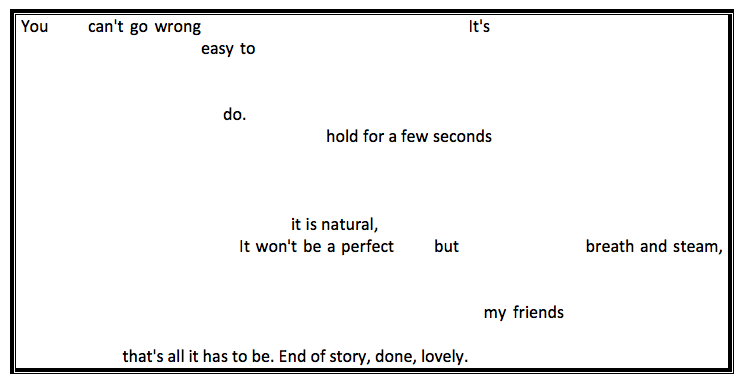
You just can't go wrong with this combination of flavours. It's open to all white-fleshed fish. Banana leaves are very easy to buy from Asian or Latino markets. Get nice big ones to wrap your fish up in. Failing banana leaves, you can use vine leaves, which you can get in the supermarkets, somewhat smaller, but no less tasty for that. If you really can't get hold of any leaves then kitchen foil will do.
To make the banana leaves more pliable, hold for a few seconds over a gas flame. Leaving aside the fish and herb sticks, pound the rest of the ingredients in a pestle and mortar to make a thick paste and spoon a little onto each banana leaf. Place the fish on top and then spoon the rest of the paste on the top. Bringing the sides in and spiking it with a rosemary sprig or bay leaf stick to secure it. This will look lovely and it is natural, but I have been known to use a clothes peg or string to hold it all together. It won't be a perfect seal but this allows it to breath and steam, letting the flavours infuse, so gutsy and tasty. Put the parcels on a tray and bake for 15 minutes, then remove from the oven, and allow to rest for 5 minutes. I serve the individual parcels on plates at the table and let my friends dissect them. When opened, the fragrant steam wafts up and smells fantastic. Serve with plain boiled rice to mop up the juices, that's all it has to be. End of story, done, lovely.
Once I began looking at the words, the recipe faded into the background and I was left with "finding" a poem in a limited bit of text. Now that I look back, I realize that there are other words and phrases I might have used, like "to make ... more pliable," gutsy, spoon, and flame. However, I also told myself that I HAD to use the words in the position and order found, so some of the words I liked may not have fit in appropriate place given this rule.

Originally, I made this into a blackout poem.
Version 1
After seeing some the poems of my sisters (particularly Tanita's), I thought maybe I would like this better with the words "whited out" instead of blacked out. Here's what the poem looks like in reverse.
Version 2
I almost think I like the second version better. It seems less jarring to read. Maybe next time I'll create the poem by copying the page and simply using a highlighter. Who knows?

This poem was the very first found poem I've ever written in this manner. (I have written centos using book titles and created book spine poems. I suppose those could both be considered a form of found poetry.) Once it was done, I realized that I didn't need text that was beautifully written, but rather one that contained a wealth of interesting words. My second choice was an academic text. It was wordy and convoluted, but I found inspiration in a number of excerpts.

I'm not sure I'll pursue this form again, but who knows what may happen the next time I sit in a meeting and have some dreadful page of notes in front of me. If I look at it with a poet's eye, I might just find what I need to make a poem.

Friday, September 04, 2015

Poetry Seven Write Found Poems

I haven't quite decided how I feel about found poems. I did a lot of reading while trying to find just the right source. I tried mining historical documents, but the language was already embellished in many ways and while I tried to create something new, using such beautiful language felt like a bit of a cheat. Ultimately I decided to look for plainer language and perused cookbooks, travel brochures, and classic educational works. Once I did that, I needed to think about form. (For more information, see my post entitled Jumping Into Form - Found Poems. After a bit of research I finally settled on blackout poetry.

The pieces I'm sharing today are made from highly redacted text. After retyping and justifying each excerpt, I blacked out sections until I had my poems. You will need to click on the images to enlarge and read them. (Just in case you are wondering how to read these, scan from left to right, top to bottom.)

When I posted the poems to the Padlet that Laura created for this month's efforts, I realized that together they actually told a story, so that's the way I'm sharing them here. The first two poems were created from excerpts of the book How We Think, written in 1933 by John Dewey. (Poem 1 from p. 10-11. Poem 2 from p. 109.) The third poem was created from the introduction and directions found in a recipe by Jamie Oliver. That recipe is Monkfish Wrapped In Banana Leaves With Ginger, Cilantro, Chile, And Coconut Milk

WHEN KINDRED SPIRITS MEET
(a short story told in found poems)

A man ...
finds his love ... 
 sparks fly.
Poems ©Tricia Stohr-Hunt, 2015. All rights reserved.

You can read the found poems written by my Poetry Seven compatriots at the links below. 

**UPDATED TO INCLUDE COPYRIGHT INFORMATION**
Since I've heard several folks question copyright related to found poems, I want to share a bit on this. I take copyright infringement seriously, so I did a good bit of research about copyright issues and poetry in April when I did my series on poetic forms. I highly recommend reading The Code of Best Practices In Fair Use For Poetry. Here's an excerpt from the section on new works (which includes centos, erasure, "found" material, and more).
PRINCIPLE: Under fair use, a poet may make use of quotations from existing poetry, literary prose, and non-literary material, if these quotations are re-presented in poetic forms that add value through significant imaginative or intellectual transformation, whether direct or (as in the case of poetry-generating software) indirect.
I feel fairly confident that regardless of the source, if the poem is a transformation, it's okay under the law. In regards to my own work, I took Dewey's very convoluted treatment of ideas and turned it into a call to romance. That's a pretty big transformation in my eyes. And I don't think Jamie Oliver's recipe for monkfish was an exhortation for a roll in the hay ...


I do hope you'll take some time to check out all the wonderful poetic things being shared and collected today by Linda at Teacher Dance. Happy poetry Friday friends! 

Monday, August 31, 2015

Monday Poetry Stretch - Lai

The Lai is a French syllabic verse form consisting of one or more stanza of nine lines with two rhymes, though the rhyme can vary from stanza to stanza. Here are features of the form.
  • 9 lines.
  • Rhyme scheme is a-a-b-a-a-b-a-a-b.
  • Lines ending with rhyme a are five syllables in length.
  • Lines ending with rhyme b are two syllables in length.
You can read more about this form and its variants at Poetry Form - The Lai. You can read an example at The Poet's Garret.

So, the challenge for the week is to write a lai. Won't you join us? Please share a link to your poem or the poem itself in the comments.

Friday, August 28, 2015

Poetry Friday - The Box Marked Summer

As I hit the road today to enjoy one final weekend of summer and a BIG birthday (tomorrow!), I'm well into back-to-school mode as I watch my son desperately hang onto the last few days before he begins the adventure known as high school.

Today I'm sharing a poem by Bobbi Katz.

What Shall I Pack in the Box Marked "Summer"? 
by Bobbi Katz 
found in A Chorus of Cultures: Developing Literacy Through Multicultural Poetry (p. 238)

A handful of wind that I caught with a kite
A firefly’s flame in the dark of the night
The green grass of June that I tasted with toes
The flowers I knew from the tip of my nose
The clink of ice cubes in pink lemonade
The fourth of July Independence parade!
The sizzle of hot dogs, the fizzle of coke
Some pickles and mustard and barbecue smoke
The print of my fist in the palm of my mitt,
As I watched for the batter to strike out or hit
The splash of the water, the top-to-toe cool
Of a stretch-and-kick trip through a blue swimming pool
The tangle of night songs that slipped through my screen
Of crickets and insects too small to be seen
The seed pods that formed on the flowers to say
That Summer was packing her treasures away.

Poem ©Bobbi Katz. All rights reserved.


I do hope you'll take some time to check out all the wonderful poetic things being shared and collected today by Sylvia Vardell at Poetry for Children. Happy poetry Friday friends!

Monday, August 24, 2015

Monday Poetry Stretch - Lune

One can find many variations on haiku these days. Often these forms attempt to find a syllabic pattern that is more appropriate to English than Japanese. Today's poetry stretch takes the form of one of these variations.
The lune is a haiku variation invented and named by poet Robert Kelly. The lune, so called because of how the right edge is bowed like a crescent moon, is a thirteen syllable form arranged in three lines of 5 / 3/ 5 respectively.
(Adapted from The Teachers & Writers Handbook of Poetic Forms.)
You can try your hand at writing an instant lune or learn more about the form at Poetic Asides.

I wrote these lunes to get us started.
Lune #1
wings beating, whirring
hovering
sipping sweet nectar

Can you guess what I was watching when I wrote this?

Lune #2
watermelon days
rush headlong
toward pencils, books, desks

I suppose none of us can escape this one. I, for one, can't wait!

I hope you'll join me this week in writing a lune. Please share a link to your poem or the poem itself in the comments. 

Friday, August 21, 2015

Poetry Friday - End of Summer

I'm sad to report that summer has officially been over for me for at least two weeks. However, that melancholy is always replaced by the joy of welcoming new students. 

Today I'm sharing a poem by Stanley Kunitz.

End of Summer
by Stanley Kunitz

An agitation of the air,
A perturbation of the light
Admonished me the unloved year
Would turn on its hinge that night.

I stood in the disenchanted field
Amid the stubble and the stones,
Amazed, while a small worm lisped to me
The song of my marrow-bones.


I do hope you'll take some time to check out all the wonderful poetic things being shared and collected today by Catherine at Reading to the Core. Happy poetry Friday friends! 

Monday, August 17, 2015

Monday Poetry Stretch - Décima

The following description comes from my April 2015 interview with Margarita Engle.

The décima is a rhymed, metered poem that most commonly has ten eight-syllable lines in a rhyme pattern abba aa abba.

Here's an example.

BIRD PEOPLE
by Margarita Engle

In a time when people were stars
in deep, hidden caves of the sea,
a fisherman ventured so far
that a hole in the cave set him free.

He burst from the cave up to sky
and reached the bold shimmer of light.
No longer a man who could cry,
he was silent until darkest night.

Then the song that flew from his heart
was the sweetest song ever heard,
a melody about the start
of life as a winged, singing bird!

Poem ©Margarita Engle, 2015. All rights reserved.

In this poem, Margarita used twelve lines with a rhyme pattern abab  cdcd  efef. As she said, "Changing a décima is perfectly acceptable!  When they’re used as the lyrics of rumba songs, they are often improvised."

You can learn more about the décima at NBCLatino.

I hope you'll join me this week in writing a décima. Please share a link to your poem or the poem itself in the comments.

Monday, August 10, 2015

#pb10for10 - Books to Begin My Semester

I've been working these last few weeks on preparing my syllabi for fall classes. Here are the books I'll be sharing the first week of the semester with my preservice teachers in my math and science classes.

Science
During the first week we explore the nature of science and the work of scientists.
What is Science?, written by Rebecca Kai Dotlich and illustrated by Sachiko Yoshikawa

What is a Scientist?, written by Barbara Lehn with photographs by Carol Krauss

Boy, Were We Wrong About Dinosaurs!, written by Kathleen Kudlinski and illustrated by S.D. Schindler

11 Experiments That Failed, written by Jenny Offill and illustrated by Nancy Carpenter

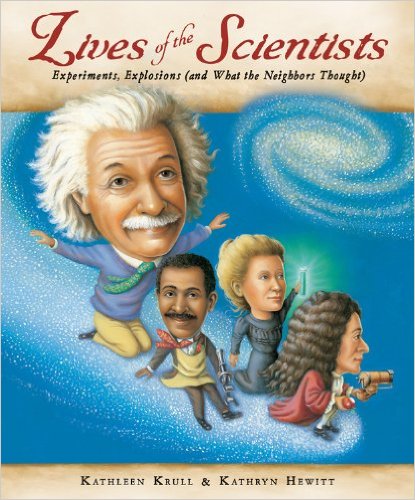
Lives of the Scientists: Experiments, Explosions (and What the Neighbors Thought), written by Kathleen Krull and illustrated by Kathryn Hewitt 


Math
During the first week we discuss how math is used in our daily lives and we jump right in and solve problems. 
Math Curse, written by Jon Scieszka and illustrated by Lane Smith

Missing Math: A Number Mystery, written and illustrated by Loreen Leedy

  
Marvelous Math: A Book of Poems, selected by Lee Bennett Hopkins and illustrated by Karen Barbour

 
Edgar Allan Poe's Pie: Math Puzzlers in Classic Poems, written by J. Patrick Lewis and illustrated by Michael Slack

The Grapes of Math, written by Greg Tan and illustrated by Harry Briggs

You can check out the other folks participating at the Picture Book 10 for 10 community.

Monday Poetry Stretch - Nonet

The nonet is a nine line poem with a diminishing number of syllables in each line. The first line containing nine syllables, the next eight, the next seven, and so on. This pattern continues until the last line (the ninth line) has only one syllable.

There is no rhyme requirement and nonets can be written about any subject.

You can read more about this form and see a few examples at Write Tribe.

I hope you'll join me this week in writing a nonet. Please share a link to your poem or the poem itself in the comments.

Friday, August 07, 2015

Poetry Seven Write Classified Ad-Haiku

Last month I believed that writing in the style of e.e. cummings was our hardest challenge. I take it back. THIS was the hardest challenge. Sometimes I find shorter forms more difficult than longer ones, and we've written to some challenging forms this year, including villanelles, sestins, raccontinos, and pantoums. So really, you'd think haiku would be a piece of cake.

But honestly, I think haiku are really hard to write. Seems ridiculous, doesn't it? But if you follow the rules (and there are lots of them), writing haiku in the spirit intended requires patience, a keen eye, and skill. Here is the formal definition of haiku and some notes about the form provided by the Haiku Society of America.
haiku is a short poem that uses imagistic language to convey the essence of an experience of nature or the season intuitively linked to the human condition. 
Most haiku in English consist of three unrhymed lines of seventeen or fewer syllables, with the middle line longest, though today's poets use a variety of line lengths and arrangements. In Japanese a typical haiku has seventeen "sounds" (on) arranged five, seven, and five. (Some translators of Japanese poetry have noted that about twelve syllables in English approximates the duration of seventeen Japanese on.) Traditional Japanese haiku include a "season word" (kigo), a word or phrase that helps identify the season of the experience recorded in the poem, and a "cutting word" (kireji), a sort of spoken punctuation that marks a pause or gives emphasis to one part of the poem. In English, season words are sometimes omitted, but the original focus on experience captured in clear images continues. The most common technique is juxtaposing two images or ideas (Japanese rensô). Punctuation, space, a line-break, or a grammatical break may substitute for a cutting word. Most haiku have no titles, and metaphors and similes are commonly avoided. (Haiku do sometimes have brief prefatory notes, usually specifying the setting or similar facts; metaphors and similes in the simple sense of these terms do sometimes occur, but not frequently. 
See, that's a lot to keep in mind for such a short poem. Perhaps that's why great haiku pack such a punch.

Never a group to do things the easy way, we added to the challenge of writing haiku by requiring that we use the form to write classified ads. And what a challenge it was! I wrote numerous pieces, most of which fell into the category of senryu.

Senryu is a Japanese poetic form similar in structure to haiku. Instead of focusing on nature and the essence of a particular moment as haiku do, senryu are concerned with human nature, political issues, and satire. While one is usually quite serious, the other is more playful. 

Here is how the Haiku Society of America defines senryu.
A senryu is a poem, structurally similar to haiku, that highlights the foibles of human nature, usually in a humorous or satiric way.
The 13th Floor Paradigm has this nice bit of history and other information on senryu.
The Senryu came into existence as an independent genre in the Edo Period (1718-1790). It is often satirical, ironical, irreverent, mundane, cynical and is about human nature, therefore about human foibles including the erotic.  It has the same form of the Haiku, but doesn’t use a seasonal word (kigo) and it doesn’t have a cutting word (keiriji)  (in reality, in English we have no direct equivalents to the keiriji, so we use what’s called a cutting phrase.) 
It would be wrong to think that Senryu is always humorous.  In fact, a Senryu could talk about divorce, sex, murder, war, jealousy, cruelty…in a word every day-to-day events in human society.
Alright, it's time to set this rambling introduction aside. I'm generally on the ball with these challenges, but this time around I wrote just over 20 poems in one day -- YESTERDAY! Here are my 3 favorite drafts.


Seasonal workers
needed - Wear boots, bring shovels
Buffalo in May

*****

Seeking teen to teach
hip old guy to surf, tweet, blog …
once the damn thing's on

*****

Kicka$$ girl seeks boy
for whirlwind romance, mating—
head loss optional

**UPDATED**
Okay, I've added one more, this written last night. I really wanted a poem that started with "Desperately seeking." Here's what I scribbled in the wee hours in the notebook I keep by my bed.

Desperately seeking
susans - my favorite daisy
sunshine on a stem

Poems ©Tricia Stohr-Hunt, 2015. All rights reserved.


You can read the poems written by my Poetry Seven compatriots at the links below. 

I do hope you'll take some time to check out all the wonderful poetic things being shared and collected today by Tabatha Yeatts at The Opposite of Indifference. Happy poetry Friday friends! 

Monday, August 03, 2015

Monday Poetry Stretch - Timeline Poem

So, this isn't really a form, but I can't think of any other way to describe this. I have a number of books I regularly use for inspiration and guidance as I write poetry. One of these books is A Note Slipped Under the Door: Teaching From Poems We Love, written by Nick Flynn and Shirley McPhillips. In the chapter on list poems (the chapter that gives the book its title) is this example.

Ducks
by Homero Aridjis

1
On cold mornings the ducks
slide across the ice
after the dry bread
thrown to them by the little girl

2
In the afternoon
the hungry ducks
cross the street
against the traffic

3
At night the ducks
nestle beside the frozen canal
they scarcely move
their green heads

4
At dawn the ducks
sleep beneath the mist
which cover the man
the dog and the stone alike


Though ostensibly a list poem, I love the arrangement of this series of moments in time, hence my term "timeline" poem. Your challenge this week is to write a poem that describes a series of events over some span of time. I hope you'll join me this week in writing a timeline poem. Please share a link to your poem or the poem itself in the comments.

Tuesday, July 28, 2015

Monday Poetry Stretch - Sedoka

Yes, I know it's Tuesday. We've had family in town since Friday and I forgot to schedule this, so I am a day late.

Continuing on the theme of Japanese poetic forms, the sedoka is an unrhymed poem made up of a pair of katauta. A katuata is a three-line poem with the syllable count of 5 / 7 / 7. Generally a sedoka addresses the same subject from different perspectives.

You can read more about the sedoka at Encyclopedia Brittanica.

I hope you'll join me this week in writing a sedoka (or two). Please share a link to your poem or the poem itself in the comments.

Monday, July 20, 2015

Monday Poetry Stretch - Dodoitsu

Dodoitsu is a Japanese poetic form. Similar to other Japanese forms, it does not rhyme and is not focused on meter, but rather on syllables. 

Dodoitsu is a 4-line poem with a syllable count of 7 / 7 / 7 / 5. Generally the subject of these poems is love or work. They also often contain a bit of humor.  

You can read more about this form and see a few examples at Poetic Asides.

I hope you'll join me this week in writing a dodoitsu (or two). Please share a link to your poem or the poem itself in the comments.

Friday, July 17, 2015

Poetry Friday - Roma Aeterna

We left last Friday to visit family in NY. Our trip up should have taken just over 5 hours by plane, but it turned into a 15+ hour odyssey. We did finally make it and had a wonderful 6 days. On our last day in Rochester, we made a short visit to Mount Hope Cemetery. I visited once in high school (many moons ago) and knew the graves of Frederick Douglass and Susan B. Anthony were there. However, on this visit I learned that someone appropriate to the Poetry Friday set was here as well.
 
In honor of Adelaide Crapsey, here is a cinquain of hers.

Roma Aeterna

The sun
Is warm to-day,
O Romulus, and on
Thine olden Palatine the birds
Still sing.


I do hope you'll take some time to check out all the wonderful poetic things being shared and collected today by Kimberley on Google+. Happy poetry Friday friends!

Monday, July 13, 2015

Monday Poetry Stretch - Ae freslighe

Ae freslighe (ay fresh lee) is an Irish poetic form. Each stanza is a quatrain with lines of seven syllables. The rhyme scheme is a b a b. In forming rhymes, the end rhyme in lines one and three is three syllables, while the end rhyme in lines two and four is two syllables. Finally, Irish poetry is cyclic, so the poem should end with the first word or entire first line.

Here's what the poem form looks like.

x x x x (x x a)
x x x x x (x b)
x x x x (x x a)
x x x x x (x b)

You can read more about this form at The Poets Garret and Creative Bloomings.

I hope you'll join me this week in writing an Ae freslighe (or two). Please share a link to your poem or the poem itself in the comments.