Friday, April 05, 2013

Poetry A-Z: V is for Visual

There were so many great V words to choose from, but I kept coming back to one word - visual. I love to read poetry aloud and listen to it, but some really clever folks have made poetry that relies on what you see as well as hear something really special. 

VISUAL - of or relating to seeing or sight 


What is a concrete poem? On his web site John Grandits says that "Concrete poems are poems that use fonts, and shape, and texture, and color, and sometimes motion." Concrete poems are truly about the marriage of words and form. Therefore, you need to SEE them to truly appreciate them. That means you'll find LOTS of links in this post to examples of the poems. Do click those links to check out the VISUAL aspects of these poems.

Let's start the ball rolling with a nod to yesterday's post on dogs and cats.
 
A CURIOUS COLLECTION OF CATS (2009) and its follow-up, A DAZZLING DISPLAY OF DOGS (2011), both written by Betsy Franco and illustrated by Michael Wertz, are collections that explore the peculiarities and absurdities of cats and dogs in wildly energetic ways. First, just look at those covers! If the use of animals in forming the letters of the titles doesn't immediately suck you in, then hopefully a few of these interior shots will. Michael Wertz has generously posted images from the books on his Flickr stream. Take a look at these images from CATS and these from DOGS.


MEOW RUFF: A STORY IN CONCRETE POETRY, written by Joyce Sidman and illustrated by Michelle Berg, is the story of a dog and cat trapped under a picnic table in a rainstorm. Since much of the verse forms the images on the page, readers will enjoy searching for the buried verses while reading the story. I can't find any good images for this one, so you'll just have to visit your library for a view!
DOODLE DANDIES, written by J. Patrick Lewis and illustrated by Lisa Desimini, uses wordplay and surprising "movement" to make the topics come alive. The 19 poems in this book cover a variety of subjects, including giraffe, weeping willow, skyscraper, baseball, basketball, the oyster family, and more. Synchronized Swim Team uses the legs of upside-down swimmers to make its point, while Creep and Slither appears in the shape of a snake, until midpoint when the bulging word bull frog announces what's been eaten. You can view some poems/images from the book at Lisa Desimini's web site.
Two books written by Joan Bransfield Graham, SPLISH SPLASH (2001) illustrated by Steve Scott, and FLICKER FLASH (2003) illustrated by Nancy Davis, are collections of concrete poems about the physical world. SPLISH SPLASH is a collection of 21 poems about water in a myriad of forms, including crocodile tears, ice cube, popsicle, snow, hail, dew and more. FLICKER FLASH is a collection of 23 poems that explores natural and man-made light sources, including the sun, birthday candles, an incubator bulb, lightning, a firefly, and more. At Google Books you can see examples from both SPLISH SPLASH and FLICKER FLASH.

LEMONADE: AND OTHER POEMS SQUEEZED FROM A SINGLE WORD, by Bob Raczka and illustrated by Nancy Doniger, might not be considered concrete poetry by some, but to really see the genius of what he's done you must LOOK closely! As the jacket flap says, "Play with your words! Part anagram, part rebus, part riddle--this brand new poetic form turns word puzzles into poetry. Using only the letters from a single word, each of the poems in this collection capture a scence from daily life and present a puzzle to solve." Check out the Macmillan Books' photostream to view a number of images from the book.

 
TECHNICALLY, IT'S NOT MY FAULT (2004) and BLUE LIPSTICK (2007), both written and designed by John Grandits, are two collections designed for older readers. The first book is written from the point of view of a young boy named Robert. The poems reveal Robert's concerns with all things adolescent. He is at turns smart then immature. Poems topics include his older sister, the school bus (dubbed TyrannosaurBus Rex), ordering pizza for dinner, mowing the lawn and more. The second book is written from the point of view of Robert's older sister, Jessie. Her concerns are those of a typical teen, but Jessie is anything but typical. She is funny, sarcastic, and totally her own person. Poem topics include a bad hair day, a pep rally, volleyball practice, Advanced English, her mother's birthday and more. Both books use graphic design in unusual and surprising ways. You can see a few of the poems from TECHNICALLY and LIPSTICK on Grandits' web site. You can see a few more images using Google Book Preview for both TECHNICALLY AND LIPSTICK. Finally, be sure to visit Grandits' concrete poetry page often, as a new concrete poem is posted each month. Right now the poem being shared is "My Stupid Day."
A POKE IN THE I: A COLLECTION OF CONCRETE POEMS, selected by Paul Janeczko and illustrated by Chris Raschka, includes a wide range of poems that are cleverly shaped and written. Eskimo Pie and Popsicle are both poems in the shape of ice cream. Swan and Shadow looks exactly like its title and is a lovely piece of work. You can view an inside spread from the book and download an activity page from the Candlewick web site. You can also get a brief preview from Google Books. Notice that the table of contents is in the form of a table!

That's it for V. See you tomorrow with some U inspired poetry ponderings.

Thursday, April 04, 2013

Poetry A-Z: W is for Warm-Blooded

Since my son's name starts with the letter W, I let him pick today's adjective from a long list. Included were words like wacky, wild, wet, and winged. Since he's crazy for animals, he chose warm-blooded.

Now, this word could go in many directions, but for today I'm focusing on warmblooded creatures of the domestic type. Settle in, because this could be a long one! There are so many wonderful books here that today you'll get some brief annotations and a few poems.

WARMBLOODED -  relating to or denoting animals (chiefly mammals and birds) that maintain a constant body temperature, typically above that of the surroundings, by metabolic means; homeothermic.


Part 1 - Dogs
"Dogs are better than human beings because they know but do not tell." --Emily Dickinson  


 A Dazzling Display of Dogs, written by Betsy Franco and illustrated by Michael Wertz, is a series of 34 concrete poems that illustrate a variety of dogs in a range of situations doing things like riding in the car, escaping from home, chasing their tails, and more. (Here's a little tip, you'll see this one again tomorrow!)

Diamond Willow, written by Helen Frost, is a verse novel told in a series of diamond-shaped poems. The story follows Diamond Willow, a young girl living in the Alaska wilderness who convinces her parents to let her take their sled dogs to her grandparents' house. Along the way tragedy strikes and Willow must do whatever she can to help her dog Roxy survive.

Dogku, written by Andrew Clements and illustrated by Tim Bowers, is the story of a stray dog told through a series of 17 haiku.

Good Dog, written by Maya Gottfried and illustrated by Robert Rahway Zakanitch, is a collection of free verse poems in which 16 breeds express their  personalities.

I Didn't Do It, written by Patricia Maclachlan and Emily Maclachlan Charest and illustrated by Katy Schneider, is the follow-up to ONCE I ATE A PIE. In it a group of adorable puppies describe what they do and see.

The Hound Dog's Haiku: and Other Poems for Dog Lovers, written by Michael J. Rosen and illustrated by Mary Azarian, introduces readers to 20 breeds of dog from bluetick coonhound to dachshund. Back matter includes information about the breeds.

It's About Dogs, written by Tony Johnston and illustrated by Ted Rand, is a collection of more than 40 poems that pay tribute to man's best friend.

Little Dog and Duncan, written by Kristine O'Connell George and illustrated by June Otani, is the follow-up to LITTLE DOG in which a very large dog named Duncan comes to visit little dog.

Little Dog Poems, written by Kristine O'Connell George and illustrated by June Otani, contains 30 poems in which a young girl describes her little dog.

Once I Ate a Pie, written by Patricia Maclachlan and Emily Maclachlan Charest and illustrated by Katy Schneider, is a collection of poems in which dogs of all types tell us how they see the world. 

Stella, Unleashed: Notes From the Doghouse, written by Linda Ashman and illustrated by Paul Meisel, is a book of poems told from Stella's point of view. They cover topics as varied as her rescue from the pound, selecting a name, the family members, other pets, eating, sleeping, the dog park, and more.

The World According to Dog: Poems and Teen Voices, written by Joyce Sidman with photographs by Doug Mindell, contains poems in a variety of forms that explore the world of the dog. Interspersed throughout are essays about dogs written by teens.

Here's one of my favorite dog poems from STELLA UNLEASHED.

TWO SCOOPS, PLEASE

Vanilla is delicious, yes.
But could I ask a favor?
Next time we're at the ice-cream store,
let's try the liver flavor.

Poem © Linda Ashman. All rights reserved.


Part 2 - Cats
"In ancient times cats were worshipped as gods; they have not forgotten this." --Terry Pratchett 

Cat Poems, written by Dave Crawley and illustrated by Tamara Petrosino - This collection contains 24 rhyming poems that describe cats and their often hilarious behaviors.

Cat, What Is That?, written by Tony Johnston and illustrated by Wendell Minor - The poet answers the question posed in the title, never using the word cat, but by describing their antics and behaviors.

Cats Vanish Slowly, written by Ruth Tiller and illustrated by Laura Seeley - This collection of 12 poems introduces readers to the cats at grandmother's farm, each one with a personality of its own.

A Curious Collection of Cats, written by Betsy Franco and illustrated by Michael Wertz - This collection of 34 concrete poems describes in words and form a variety of cats, including fat cats, princess cats, kissy cats, and more. I particularly like the poems focused on cat anatomy, like their tails and tongues. (Here's a little tip, you'll see this one again tomorrow!)

I Am the Cat, written by Alice Schertle and illustrated by Mark Buehner - Alternating between haiku and longer poems, this collection captures the essence of the cat in all it's complexity.

Old Possum's Book of Practical Cats, written by T.S. Eliot and illustrated by Edward Gorey - Forget everything you've heard about the musical and read the book! Eliot included these poems in letters to his godchildren. Though written in the 1930s, they ever get old.

So, What's It Like to Be a Cat?, written by Karla Kuskin and illustrated by Betsy Lewin - The poems in the book make up a "conversation" (perhaps interview is a better word) between a young boy and his cat.

Won Ton: A Cat Tale Told in Haiku, written by Lee Wardlaw and illustrated by Eugene Yelchin - This is the story of a shelter cat and how he acclimates in his new home, told entirely in senryu, a form focused on “the foibles of human nature--or in this case, cat nature.” Whether you call it haiku or senryu, the short verses are entirely fitting for the tale Wardlaw tells.

Here's one of my favorite cat poems. It is from the ALL THE SMALL POEMS AND FOURTEEN MORE by Valerie Worth.

cat
by Valerie Worth

The spotted cat hops
Up to a white radiator-cover
As warm as summer, and there,

Between pots of green leaves growing,
By a window of cold panes showing
Silver of snow thin across the grass,

She settles slight neat muscles
Smoothly down within
Her comfortable fur,

Slips in the ends, front paws,
Tail, until she is readied,
Arranges, shaped for sleep.


Part 3 - Dogs and Cats Together!

"If a dog jumps in your lap, it is because he is fond of you; but if a cat does the same thing, it is because your lap is warmer." -- Alfred North Whitehead

Bow Wow Meow Meow: It's Rhyming Cats and Dogs, written and illustrated by Douglas Florian - In this collection, Florian presents a series of 21 poems about domesticated and wild dogs and cats.

I Am the Dog I Am the Cat by Donald Hall - This free verse poem alternates between the voice of a rottweiler and the voice of a tabby cat.

Meow Ruff: A Story in Concrete Poetry by Joyce Sidman - A dog and cat are trapped under a picnic table in a rainstorm. Since much of the verse forms the images on the page, readers will enjoy searching for the buried verses while reading the story.

Raining Cats and Dogs, written by Jane Yolen and illustrated by, is a collection of poems that can be read from both directions. Tired of poems about dogs? Flip the book over and read about cats. (This one's out of print, so check your local library for a copy. You can also find copies online.)


Let's close today with two acrostic poems from the book A Kick in the Head: An Everyday Guide to Poetic Forms, selected by Paul Janeczko and illustrated by Chris Raschka.
Can't
Avoid
Trouble

Paul Janeczko
Does
Only
Good

Anonymous
Yup, I'm a dog lover!

That's it for W. See you tomorrow with some V inspired poetry ponderings.

Wednesday, April 03, 2013

Poetry A-Z: X is for Xeric

The letter X is the bane of alphabet book writers everywhere. There are many ways to cheat around the letter X (many of them not so eXcellent), but I'm going to take this bull by the horns I tell you! The word I've chosen may not be common, but it does give me some poetry books to play with.

XERIC - (of an environment or habitat) containing little moisture; very dry

When I browsed through my collection, I found a remarkable number of poetry books on the desert. I suppose I shouldn't be surprised. While outsiders may view deserts as harsh, barren places, they are anything but, sustaining a wide variety of flora and fauna that are amazingly adapted to their dry homes.

THIS BIG SKY, written by Pat Mora and illustrated by Steve Jenkins, is a book that beautifully captures the American southwest. The 14 poems touch upon everything from deserts and the hot sun to snakes and coyotes, with the landscape taking center stage in words and illustration. Mora also includes a glossary of Spanish words that appear in some of the poems. Here's an excerpt.

OLD SNAKE

Old Snake knows.
Sometimes you feel
you just can't breath
in you own tight skin.
Old Vibora says, "Leave
those doubts and hurts
bussing like flies in your ears.
When you feel your frowns,
like me wriggle free
from I can't , I can't.
Leave those gray words
to dry in the sand
and dare to show
your brave self,
your bright true colors."

Sadly, this one is out of print, but you can still find copies around. It's definitely worth searching out. Also worth picking up are two bilingual books Mora has written about the desert (still in print!). The Desert is My Mother/El Desierto es Mi Madre and Listen to the Desert/Oye al desierto are both beautiful book length verses.

MOJAVE, written by Diane Siebert and illustrated by Wendell Minor, is a book-length poem about the life and landscape of the Mojave desert. It begins "I am the desert./I am free./Come walk the sweeping face of me." The illustrations and text breathe life into our views of the California desert and inspire awe at the wonders found there.

DESERT VOICES, written by Byrd Baylor and illustrated by Peter Parnall, contains a series of 10 free verse poems voiced by different desert creatures. Readers hear from the buzzard, coyote, jackrabbit, rattlesnake, and more as they each tell of their lives in the desert. Here's an excerpt from one of my favorite poems. Can you guess who's voice this is?

I cross
the same arroyo
that I crossed
when I was young,
returning to
the same safe den
to sleep through
winter’s cold.
Each spring,
I warm myself
in the same sun,
search for the same
long tender blades
of green,
and taste the same
ripe juicy cactus fruit.

I know
the slow
sure way
my world
repeats itself.
I know
how I fit in.

WELCOME TO THE SEA OF SAND, written by Jane Yolen and illustrated by Laura Regan, is one in a series of 4 books Yolen wrote about different ecosystems. Sadly, this one too is out of print. A book length poem written in occasional rhyme, the text is a blend of poetry and science. In the description of the book on her web site Yolen writes "It takes a lot of research to write a poem about a place. I have been to the Sonoran desert section in Arizona several times, as well as deserts in Israel, California and Australia." In opening the pages of this book readers can travel along with Yolen and marvel at the variety of life in this very dry place. 


That's it for X. See you tomorrow with some W inspired poetry ponderings.

Tuesday, April 02, 2013

Tuesday Poetry Stretch - Zeno!

Okay, in my excitement over the launch of National Poetry Month and my poetry project, I forgot to post our stretch! *SIGH* Multi-tasking is not my forte these days.

Since my first post of the month was about Z and the zeno, and since Kate Coombs has already gotten us started, let's write a zeno! A zeno is a 10-line verse form with a repeating syllable count of 8,4,2,1,4,2,1,4,2,1. The rhyme scheme is abcdefdghd. You can read some examples Pat Lewis wrote at Poetry A-Z: Z is for Zany, Zoological, and Zeno.  

I haven't been writing round-up posts of these poems in some time, so be sure to come back (or subscribe to the comments) and see the wonderful pieces folks are sharing.

Poetry A-Z: Y is for Yolen and Youthful

Why oh why did I start at the end? Perhaps because these were some of the most challenging letters and I thought I should get them out of the way. Silly me!

When I began my research I couldn't help but think of Y as a boyish letter. After all, without that Y chromosome we'd have a world of girls. But alas, the letter Y didn't seem to lend itself to any particularly boyish adjectives or poems. It did, however, keep leading me to a woman of particular note in writing circles (poetry and otherwise). So let's start today with Yolen.

JANE YOLEN - WRITER AND POET OF SOME NOTE!

Jane Yolen has written more than 300 books in an amazing array of genres, succeeding wildly in each one. Many of her poetry books will make an appearance over the course of this month, but the ones I want to highlight today focus on one of my favorite poets.

THE EMILY SONNETS: THE LIFE OF EMILY DICKINSON is a collection of sonnets that tells Emily’s story from the points of view of Emily herself, her sister Vinnie, her niece Mattie, her friend Thomas, an unknown critic, and Yolen. Additional information and anecdotes are found throughout the pages. I savored the sonnets on my first read, lingered on the extensive end notes, then re-read the poems with renewed enthusiasm. Yolen lovingly captures and portrays Emily and shows readers quite clearly how much Emily was admired and loved by those around her.

MY UNCLE EMILY is a picture book that tells the story (part fiction, part real) of Emily Dickinson's nephew Gib. This one begins:
"One day when we were in the garden, choosing flowers for the table, my Uncle Emily gave me a dead bee and a poem for my teacher. Sometimes Uncle Emily is like that, as if she wants me to see the world one small bee and one small poem at a time."
Gib worries about the reaction of his classmates (rightly so!) to the poem. At recess a boy makes fun of his Uncle Emily, so Gib defends her and slugs him. When Gib goes home with a limp, he doesn't tell his family the whole truth about the day's events. This is a wonderful little story about honesty that may just interest readers in learning more about Dickinson.

YOUTHFUL - typical or characteristic of young people

I have a fairly tattered copy of a poetry book from childhood. I can't remember what I loved so much about it, but I imagine it appealed to me the way much of poetry for the very young does today. Preschool poetry often gets trapped in the traditional (not that there's anything wrong with classic rhymes), but there are a number of recent collections that tap into the joy of childhood and the exuberance of the really young.


A LITTLE BITTY MAN AND OTHER POEMS FOR THE VERY YOUNG, written by Written by Halfdan Rasmussen, translated by Marilyn Nelson and Pamela Espeland, and illustrated by Kevin Hawkes, is a volume of poems originally written in Danish. Though a small collection (only 13 poems) is filled with whimsy and rhymes that sing like the best of Mother Goose. This volume is perfect for the littlest readers as much for the appropriateness of vocabulary as the perfectly sweet selections.

HERE'S A LITTLE POEM: A VERY FIRST BOOK OF POETRY, collected by Jane Yolen and Andrew Fusek Peters and illustrated by Polly Dunbar, is filled with sweet and silly rhymes that fairly sing. The book is oversized and heavy, but it's well worth picking up and sharing with little ones. Organized into the categories Me, Myself and IWho Lives in My House?I Go Outside, and Time for Bed, there is a poem here for most important and everyday events in a child's life. There are also nonsense poems, tongue twisters, animal poems, and more! Since the poems in this volume have been collected from across the English-speaking world, the retention of regional spelling and usage may have you needing to explain some things to young readers. In the back you'll find the contents indexed by poem and poet. Every reader, young and old alike, will find something to love here.

WEE RHYMES: BABY'S FIRST POETRY BOOK, written Jane Yolen and illustrated by Jane Dyer, is my new go-to baby shower book! While a few of the poems come from Mother Goose, most are Yolen originals. Here's an excerpt.

HUGS

Mama's hug is gentle,
Daddy's hug is long.
Grandad's hug
Is warm as a rug.
And Grandma's comes with a song.

There's a lovely blend of playfulness, sing-song treats, and happy rhymes. This one is perfect for the littlest and newest poetry lovers.


That's it for Y. See you tomorrow with some X inspired poetry ponderings.

Monday, April 01, 2013

Poetry A-Z: Z is for Zany, Zoological, and Zeno

Z is a wonderful letter. It's zippy and zig-zagged and fun! Before we begin, join me in a little song.

Zip-a-dee-doo-dah, zip-a-dee-ay
My, oh my what a wonderful day!
Plenty of sunshine heading my way
Zip-a-dee-doo-dah, zip-a-dee-ay!

While I've never been a fan of the movie this comes from (Song of the South), I've always liked this song. In fact, I could often be heard whistling or singing it while washing dishes in our first house (you know, one of those older homes with lots of charm and no dishwasher).

Now that the mood is set, let's look at today's poetic potluck inspired by Z.

ZANY - amusingly unconventional and idiosyncratic

I wouldn't normally call poetry zany, but the book ZORGAMZOO by Robert Paul Weston fits this definition nicely. Who wouldn't call a 280+ page book written entirely in rhyming couplets zany? I could also call this one zippy, as the rhythm and rhyme pull readers along at an energetic pace. Weston has created something special here. 

Katrina Katrell lives with her guardian Mrs. Krabone (whom Katrina calls Krabby). Krabby does nog appreciate Katrina's natural curiosity or propensity to explore and daydream. One day while waiting for the subway, Katrina sees a large, hairy creature walking in the underground tunnel. Convinced that Katrina is lying, Krabby decides she needs to contact her friend Doctor LeFang to complete a lobotomy. When Katrina runs away she finds Mortimer Yorgle, the creature from the subway, and the adventure truly begins.

ZORGAMAZOO is a novel in verse that begs to be read aloud. I'll admit the first time I read it I was so enthralled with the words and craft behind Weston's writing that I got a bit lost. I had to read it a second time to more thoroughly enjoy the story. Kids will love this one and so will you.

Check out this trailer. 
Intrigued? Now read the first chapter. Better yet, check out the book's web site to learn more.

ZOOLOGICAL - of or relating to animals

This is actually an impossible adjective because there are an enormous number of poetry books about animals of all kinds. I could actually write for each of the 30 days of April about animal poetry and not reach the bottom of a very large barrel. This means that zoologically oriented posts will abound in the coming days. But this begs the question, where do I start? How about this year's Claudia Lewis Poetry Award winner and Cybils poetry finalist?

THE NATIONAL GEOGRAPHIC BOOK OF ANIMAL POETRY: 200 POEMS WITH PHOTOGRAPHS THAT SQUEAK, SOAR, AND ROAR!, compiled by J. Patrick Lewis, contains the photos we've come to love from National Geographic, accompanied by one and sometimes two poems from classic (Robert Frost and Emily Dickinson) to more modern poets (Betsy Franco and Jane Yolen). The book categorizes the poems under the headings “the big ones,” “the little ones,” “the winged ones,” “the water ones,” “the strange ones,” “the noisy ones,” and “the quiet ones.” This is THE book to put in the hands of kids curious about the natural world. It's also the one book that may spark a bit of poetry interest in reluctant readers and writers.

If you are looking for idea for the classroom, download the Teacher's Guide. In the meantime, take a look at these gorgeous photos and listen to our current Children's Poet Laureate read an excerpt.

ZENO - a poetic form invented by J. Patrick Lewis

In October of 2009 I was lucky enough to debut a poetic form invented by Pat Lewis. Here's Pat's explanation.
I've invented what I had called a “hailstone," after the mathematical "hailstone sequence." It has nothing to do with Mary O'Neill's Hailstones and Halibut Bones, but it would no doubt instantly be confused with it. Hence, "hailstone" is problematic. So I call the form a "zeno," so named for Zeno, the philosopher of paradoxes, especially the dichotomy paradox, according to which getting anywhere involves first getting half way there and then again halfway there, and so on ad infinitum. I'm dividing each line in half of the previous one. Here's my description of a zeno:

A 10-line verse form with a repeating syllable count of 8,4,2,1,4,2,1,4,2,1. The rhyme scheme is abcdefdghd.
Pat was even kind enough to send along a few examples.
Sea Song
A song streaming a thousand miles
may sound like a
fairy
tale,
but it’s only
love’s bulk-
mail
coming out of
the blue...
whale. 

Why Wolves Howl
Gray wolves do not howl at the moon.
Across a vast
timber
zone,
they oboe in
mono-
tone,
Fur-face, I am
all a-
lone.

Telephooone
The great horned owl sits in the tree
answering each
local
call—
swivel-neck and
big-eye-
ball
operator
of night-
fall.

Poems © J. Patrick Lewis. All rights reserved.
There's one more Z that's not in the title, and that's Zimmer. Tracie Vaughn Zimmer is a teacher, author and poet. She has written three collections of poetry, SKETCHES FROM A SPY TREE (2005), STEADY HANDS: POEMS ABOUT WORK (2009), and COUSINS OF CLOUDS: ELEPHANT POEMS (2011). She's also written two verse novels, REACHING FOR SUN (2007) and 42 MILES (2008). REACHING FOR SUN was awarded the Schneider Family Book Award in 2008. This award "honors an author or illustrator for a book that embodies an artistic expression of the disability experience for child and adolescent audiences."

I'm quite fond of COUSINS OF CLOUDS: ELEPHANT POEMS. You can see a bit of it below.

That's it for Z. See you tomorrow with some Y inspired poetry ponderings.

Saturday, March 30, 2013

Poetry A-Z: Just Around the Corner

The kickoff of my National Poetry Month project dubbed Poetry A-Z is only 2 short days way. Each day in April I'll share books, poems, poetic forms, and other poetry-inspired topics. The posts may seem a like a potluck of poetry, but that's exactly what I'm going for. I've tossed in a little of this, a little of that, some things old, some things new, and all things fun!

Since I'm a lefty in a right-handed world, I tend to approach many things in life from a different angle. This project will be no different. What that means is that instead of starting at the beginning, you can look forward to commencing this journey with Z and winding down to A. 

I can't wait for Monday! I hope you'll stop by to see what I've thrown together.

Monday, March 25, 2013

Monday Poetry Stretch - The Unexpected

Today is March 25th and we had a snow day in Richmond, VA. Talk about unexpected! I am so ready for spring. This is the second Monday in a row that we've had snow. My son was thrilled about this turn of events, me not so much.

How about we write about the unexpected this week? The unexpected event, turn of a phrase, ending to a book or movie, etc. What have you found lately that was unexpected? Leave me a note about your poem and I'll share the results in time for Poetry Friday.

Wednesday, March 13, 2013

Pi Day is Tomorrow! But Should We Celebrate It?

All you math lovers out there should know that tomorrow is Pi Day. But should we celebrate pi or tau? Don't know what I'm talking about? Take a look at these two videos.


Learn more about Tau by reading The Tau Manifesto by Michael Hartl.

Plans for National Poetry Month

Last year my plans for National Poetry Month were put on hold by an unexpected death in the family. It was the first time I'd missed celebrating in several years of blogging. I'd like to say I have something elaborate planned this year, but I'll be traveling during two different weeks to conferences so I have scaled back a bit.

This year my theme is Poetry A-Z. For the first 26 days of the month I'll be highlighting poetic forms, specific poems, books of poetry, and poets according to letter. For the last 4 days I've created a set of "acrostic" themed posts with some additional thoughts on poetry.

I know I haven't been around much, but I do hope you'll join me.  

Wednesday Poetry Stretch - Fear

Yes, I'm two days past Monday, but in my defense I was traveling and had little time for online pursuits. I suppose I could always post early, but stretches tend to be inspired by circumstance. I'm not sure it would be much fun to post 52 stretches for the year and just let them launch on their own.

The anniversary of my sister-in-law's death is approaching and we're all facing it with more than a bit of trepidation. Suicide is such a difficult thing. We're still trying to make sense of something that just can't be understood. 

I've been writing a lot these days about darkness and fear, so I guess now is as good a time as any to tackle this topic. Are you afraid of flying? Failure? Heights? Spiders? Something more sinister? Let's write about that this week.

Tuesday, February 26, 2013

Win Some Poetry Books!

Over at my math and science blog I'm celebrating the fact that my Pinterest site has nearly 10,000 followers. I'm a bit shocked to tell you the truth. Pinterest has been a fabulous way for me materials related to elementary instruction. Where I once used Google Sites and Weebly, I now use the boards on Pinterest. I can't emphasize how important the visual aspect of this has been. Instead of reading through lists of bookmarks and site descriptions, I can actually SEE what things look like. To say this has revolutionized the way I organize ideas and resources is an understatement.

In honor of closing in on the 10,000 follower milestone, I am giving away copies of a few of my favorite science poetry books. Here they are.
  
 
Head on over to Bookish Ways in Math and Science for a chance to win.

Monday, February 25, 2013

Monday Poetry Stretch - Climbing Rhyme

It's been nearly two years since we visited climbing rhymes, so I think it's time to try again.

Climbing Rhyme is a form of Burmese poetry containing a repeated sequence of 3 internally-rhymed lines consisting of 4 syllables each. Since Burmese is monosyllabic, this works well, but in English this might be difficult. Instead of 4 syllable lines, let's try writing in lines of 4 words. (If you're feeling brave, go ahead and try four syllables!)

The rhyme scheme for climbing rhyme is internal. That means the position of the rhyming word changes. The rhyme appears in the 4th word of line one, 3rd word of line 2, and 2nd word of line 3. The pattern continues as a new rhyme appears in the 4th word of line 3, the 3rd word of line 4, and the 2nd word of line 5. This continues on, giving a stair-step feel to the poem, hence the name climbing rhyme.
For those of you who need to see this visually, here it is. Each x stands for a word. The letters stand for rhyming words. Just remember the 4-3-2 pattern.
x x x a
x x a x
x a x b
x x b x
x b x c
x x c x
x c x x
What kind of climbing rhyme will you write? Leave me a comment about your poem and I'll post the results here later this week.

Monday, February 18, 2013

Monday Poetry Stretch - Celebrations

My son was 12 on Saturday. It was a happy occasion, but these milestones make me sad when I reflect on how quickly he's growing up.

I've written him a poem every year on his birthday, though I've never read or given them to him. I'm saving them for some time in the future. I suppose I've always wanted someone to write me poems on my birthday, and that's why I write for him. Or perhaps I do it just because I'm a sentimental sap!

What do you do to celebrate birthdays an other special occasions. Do you write poems? Do you have a celebratory poem to share? What kind of poem would you like to receive on your birthday? Leave me a note about your poem and I'll share the results in time for Poetry Friday.

Thursday, February 14, 2013

Congrats to the 2012 Cybils Winners!

I'm thrilled that BookSpeak!: Poems About Books is this year's Cybils winner in the poetry category. Go Laura!

There are many other very deserving winners. Check them out at The 2012 Cybils Awards.

To see the shortlists from which the winners were selected, check out  Cybils Finalists Flyer.

Congratulations to all the finalists and winners, and thanks to all the hardworking Cybils folks for making it happen.

Tuesday, February 12, 2013

Monday Poetry Stretch - Limericks

It's Tuesday, not Monday! I've learned it's awfully hard to read a blog post when you hit save instead of publish! That's what I get for trying to do seven things at once. As I age I seem to be getting worse at multi-tasking.

I've been a little down-in-the-dumps, so I believe some limericks might cheer me up. I'm currently trying to finish this one:

There was a young woman from Bath
Who loved nothing better than math
     She ...

I am stuck at the moment, but I promise a rousing finish.

What limerick will you share this week? Leave me a note about your poem and I'll share the results in time for Poetry Friday.

Monday, February 04, 2013

Monday Poetry Stretch - Amazed and Humbled

I've been spending time reading admission files for the University. Every year I'm simply amazed at what these applicants have done and accomplished, most before the age of 18.

There are other things in this world that amaze me. Have you seen this video on underwater astonishments?

Nature amazes me, usually on a daily basis. Last week I walked out into the snow in the early morning hours to hear a woodpecker tapping away. It made me laugh and marvel at the world at the same time.

The sky still amazes me, no matter how many times I look at the moon or stars. I also find it to be quite humbling.

While I continue to read applications and wander through my week in wonderment and appreciation, I thought it might be fun to write about what amazes or humbles us. Leave me a note about your poem and I'll share the results in time for Poetry Friday.

Monday, January 28, 2013

Monday Poetry Stretch - Snow

We've had a snow day and an early dismissal in the last week due to "snow." I quote snow because as someone who grew up outside of Rochester, NY and lived, worked and went to grad school in Buffalo, I do know a bit about snow. This stuff in Virginia ain't it!

In celebration of seeing a bit of the white stuff, my son and I have been reading books about the science of snow--how it forms, it's shapes, symmetry, etc. I'm focused on hexagons and the number six. If I were insanely creative, I'd invent a poetry form related to snow crystals, but alas, I've tried and come up with nothing. So instead, let's write about snow. 

Leave me a note about your poem and I'll share the results in time for Poetry Friday.

(You can see more snowflake images like the one above at SnowCrystals.com.)

Nonfiction Monday - The Science of Snow

In the last week we've had a snow day and an early dismissal for snow. It's only been a few inches, but it has been most welcomed by the kids around me. In anticipation of and celebration of snow, we've been reading a few of our favorite books on the subject. 

The Story of Snow: The Science of Winter's Wonder, written by Mark Cassino with Jon Nelson  - Mark Cassino is a fine art and natural history photographer. Jon Nelson is a teacher and physicist who studies ice crystals and clouds. Together they have given us a stunning volume on the formation of snow. A perfect mixture of art and science, Cassino's photographs are accompanied by clearly written text that explains a very complex process in terms kids will understand. Readers will learn what snow is made from, how it forms, what shapes it takes, and more! Photos of snow crystals are included with a comparison of the enlarged images to a snow crystal of actual size. 

In the back matter you will find directions on how to catch snow crystals and examine them. For more ideas for extending the text, download a teacher's guide for this title at the Chronicle web site.

Snowflake Bentley, written by Jacqueline Briggs Martin and illustrated by Mary Azarian - This Caldecott Medal winner tells the true story of Wilson Bentley, a farmer who spent the better part of his life studying and photographing snowflakes. It begins this way.
In the days
when farmers worked with ox and sled
and cut the dark with lantern light,
there lived a boy who loved the snow
more than anything else in the world.
Willie's story is told from his childhood through his death. Accompanying the biography are a series of sidebars that contain additional facts about Bentley. The last page of the book contains a photo of Bentley at his camera (the same one at the top of the Wilson Snowflake Bentley home page), a quote about his love for photography, and three of his renowned snowflake images.

This is the story of a remarkable man who pushed the limits of science and technology to create groundbreaking images of snowflakes. If the book inspires an interest in further study, you can view a number of his amazing photographs at The Bentley Snow Crystal Collection.


The Secret Life of a Snowflake: An Up Close Look at the Art and Science of Snowflakes, written by Kenneth Libbrecht  - The author of this book is a physicist at Caltech known for his passion for snow crystals. In this book aimed at 9-12 year olds, but appropriate for a much broader (and older) audience,  Libbrecht teaches readers what snow crystals and snowflakes are, where they come from, and how these amazing structures are created out of thin air. His own photographs beautifully complement the text.

All snowflakes begin with water vapor in air, but as they begin their journey toward the ground, changes in temperature and humidity determine their exact and unique shape. Libbrecht answers questions that many children (and adults) are apt to ask, such as "Why is snow white when the crystals that comprise snow are clear?" 

Libbrecht's web site, SnowCyrstals.com, provides a wealth of images and even more information for those readers who finish the book and want to learn more. I recommend starting with the Snowflake Primer and the Snow Crystal FAQs.

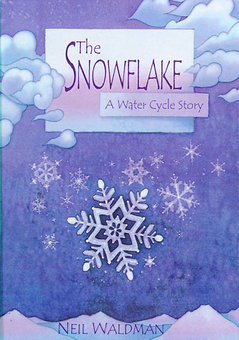
The Snowflake: A Water Cycle Story, written by Neil Waldman - While ostensibly not a book about snowflakes, this water cycle book does begin and end with a snowflake. I like this book because it makes understandable the idea that resources on Earth are finite. Kids have a hard time with this notion, but Waldman makes this message clear as readers learn that the water we drink, wash in, and play in is part of an amazing cycle that repeats itself over and over and over again. 

Water takes many different forms, but it's the form of snow in which this journey begins. In January a snowflake lands on the peak of a mountain. Over the course of year the snowflake changes both location and form. In February it's blown into a mountain pond, where it melts in March. This tiny droplet sinks into an underground stream where it continues its journey. That water drop travels to a farm and evaporates into the clouds before it comes back down to the ground to travel even further. Eventually it becomes a snowflake once more.

This post was written for Nonfiction Monday. The round up is being hosted by Laura Salas. Do stop by and check out all the wonderful books being shared today.

Sunday, January 27, 2013

100th Day Booklist

I looked at the calendar late last week and realized I missed Monday's poetry stretch and a whole host of other things I meant to do.

As I work back into book reviews, I have posted a new thematic list on the 100th day of school over at my teaching blog, Bookish Ways in Math and Science.

For some ideas on books to read and activities to try, check out the post 100th Day Books and Ideas.

Monday, January 14, 2013

Monday Poetry Stretch - Firsts

Today is the first day of the spring semester. As I wonder what this term will bring, I've started thinking a lot about firsts--first day of school, first kiss, first time on a plane, first time jumping out of one, etc. I've had a lot of firsts in my life, so this seems like a fine time to write about them. What first do you remember fondly? Or with great horror? Let's write about firsts. 

 Leave me a note about your poem and I'll share the results in time for Poetry Friday.

Monday, January 07, 2013

Monday Poetry Stretch - Homes and Habitats

Hello All! Remember me? It's been five weeks. Where did the time go? I'll admit that I checked out with the end of semester work and holidays. 

I am back at work now and happily ensconced in the work of getting ready for a new semester. I did a lot of reading and reviewing over the break. One of the books I read was Marilyn Singer's A STRANGE PLACE TO CALL HOME. The poet in me loved the use of varied forms (free verse, triolet, villanelle, terza rima and more), while the scientist in me was thrilled with a text that introduced readers to oddities in the natural world. Here's an excerpt from one of my favorite poems. 

DOWN IN THE DEPTHS 
tube worms

Life is hard--it gets intense
          by deep-sea hydrothermal vents.
Superheated water rising,
          spouting out from tall, surprising
chimneys built on the ocean floor.
Yet there live giant worms galore
          in tubes that shield them from the heat.

Since reading this I've been thinking a lot about the places where we live. A recent trip to Manhattan had me thinking about living in cities and teeny tiny apartments that cost outrageous amounts of money, but I digress. Let's write about homes, habitats, or other places humans or animals might live. Leave me a note about your poem and I'll share the results in time for Poetry Friday.

Monday, December 03, 2012

Monday Poetry Stretch - Opposites

I picked up a couple of books  by Richard Wilbur at our fabulous used bookstore last week. One was THE POEMS OF RICHARD WILBUR (1947), and the other was MORE OPPOSITES (1991). Here's a bit of info from the jacket flap of the latter.
"Richard Wilbur, his wife, and their four children used to play a rather unusual game around the dinner table. One member of the family would suggest a word, and then everyone would join in a lively quarrel about its proper opposite." 
Wilbur's first book based on this game, OPPOSITES, was published in 1973. The poems in both volumes are a bit nutty, thoroughly entertaining, and downright clever. Here's one from MORE OPPOSITES.

The opposite of kite, I'd say,
Is yo-yo. On a breezy day
You take your kite and let it rise
Upon its string into the skies,
And then you pull it down with ease
(Unless it crashes in the trees).
yo-yo, though, drops down, and then
You quickly bring it up again
By pulling deftly on the string
(If you can work the blasted thing).

Here's a nice video of Wilbur reading a number of opposite poems.
So, your challenge for the week is to write on opposites. Leave me a note about your poem and I'll share the results in time for Poetry Friday.

Monday, November 26, 2012

Monday Poetry Stretch - Alexandrine Verse

Last weekend I saw Molieré's play The Learned Ladies performed by the University Players. I was surprised to learn that poet Richard Wilbur had translated/adapted the play. I was quite caught up in the meter and rhyme, and loved the turn of many of the phrases. In some cases I found myself trying to anticipate how the verses would finish. The play opens with two sisters discussing the younger sister's intent to marry the man cast off by the older sister. Here's an excerpt.
ARMANDE.
What, Sister! Are you truly of a mind
To leave your precious maidenhood behind,
And give yourself in marriage to a man?
Can you be harboring such a vulgar plan?
HENRIETTE.
Yes, Sister.
ARMANDE.
Yes, you say! When have I heard
So odious and sickening a word?
The rhyme scheme used by Wilbur was based on Alexandrine (Alexandrian) verse. In English this is usually a 12-syllable iambic line, though you can see Wilbur often used 10. 

I do love to write in iambs, and since I've just seen a play about love and marriage and contemplated both a lot while hosting my in-laws this holiday (she writes with a smile), let's write about the virtues (or vices) of love and marriage! There is no requirement for length here, just to write to the topic in iambic pentameter or hexameter.  Leave me a note about your poem and I'll share the results in time for Poetry Friday.