Monday, January 28, 2013

Monday Poetry Stretch - Snow

We've had a snow day and an early dismissal in the last week due to "snow." I quote snow because as someone who grew up outside of Rochester, NY and lived, worked and went to grad school in Buffalo, I do know a bit about snow. This stuff in Virginia ain't it!

In celebration of seeing a bit of the white stuff, my son and I have been reading books about the science of snow--how it forms, it's shapes, symmetry, etc. I'm focused on hexagons and the number six. If I were insanely creative, I'd invent a poetry form related to snow crystals, but alas, I've tried and come up with nothing. So instead, let's write about snow. 

Leave me a note about your poem and I'll share the results in time for Poetry Friday.

(You can see more snowflake images like the one above at SnowCrystals.com.)

Nonfiction Monday - The Science of Snow

In the last week we've had a snow day and an early dismissal for snow. It's only been a few inches, but it has been most welcomed by the kids around me. In anticipation of and celebration of snow, we've been reading a few of our favorite books on the subject. 

The Story of Snow: The Science of Winter's Wonder, written by Mark Cassino with Jon Nelson  - Mark Cassino is a fine art and natural history photographer. Jon Nelson is a teacher and physicist who studies ice crystals and clouds. Together they have given us a stunning volume on the formation of snow. A perfect mixture of art and science, Cassino's photographs are accompanied by clearly written text that explains a very complex process in terms kids will understand. Readers will learn what snow is made from, how it forms, what shapes it takes, and more! Photos of snow crystals are included with a comparison of the enlarged images to a snow crystal of actual size. 

In the back matter you will find directions on how to catch snow crystals and examine them. For more ideas for extending the text, download a teacher's guide for this title at the Chronicle web site.

Snowflake Bentley, written by Jacqueline Briggs Martin and illustrated by Mary Azarian - This Caldecott Medal winner tells the true story of Wilson Bentley, a farmer who spent the better part of his life studying and photographing snowflakes. It begins this way.
In the days
when farmers worked with ox and sled
and cut the dark with lantern light,
there lived a boy who loved the snow
more than anything else in the world.
Willie's story is told from his childhood through his death. Accompanying the biography are a series of sidebars that contain additional facts about Bentley. The last page of the book contains a photo of Bentley at his camera (the same one at the top of the Wilson Snowflake Bentley home page), a quote about his love for photography, and three of his renowned snowflake images.

This is the story of a remarkable man who pushed the limits of science and technology to create groundbreaking images of snowflakes. If the book inspires an interest in further study, you can view a number of his amazing photographs at The Bentley Snow Crystal Collection.


The Secret Life of a Snowflake: An Up Close Look at the Art and Science of Snowflakes, written by Kenneth Libbrecht  - The author of this book is a physicist at Caltech known for his passion for snow crystals. In this book aimed at 9-12 year olds, but appropriate for a much broader (and older) audience,  Libbrecht teaches readers what snow crystals and snowflakes are, where they come from, and how these amazing structures are created out of thin air. His own photographs beautifully complement the text.

All snowflakes begin with water vapor in air, but as they begin their journey toward the ground, changes in temperature and humidity determine their exact and unique shape. Libbrecht answers questions that many children (and adults) are apt to ask, such as "Why is snow white when the crystals that comprise snow are clear?" 

Libbrecht's web site, SnowCyrstals.com, provides a wealth of images and even more information for those readers who finish the book and want to learn more. I recommend starting with the Snowflake Primer and the Snow Crystal FAQs.

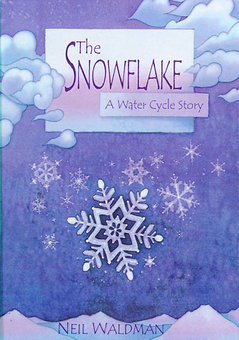
The Snowflake: A Water Cycle Story, written by Neil Waldman - While ostensibly not a book about snowflakes, this water cycle book does begin and end with a snowflake. I like this book because it makes understandable the idea that resources on Earth are finite. Kids have a hard time with this notion, but Waldman makes this message clear as readers learn that the water we drink, wash in, and play in is part of an amazing cycle that repeats itself over and over and over again. 

Water takes many different forms, but it's the form of snow in which this journey begins. In January a snowflake lands on the peak of a mountain. Over the course of year the snowflake changes both location and form. In February it's blown into a mountain pond, where it melts in March. This tiny droplet sinks into an underground stream where it continues its journey. That water drop travels to a farm and evaporates into the clouds before it comes back down to the ground to travel even further. Eventually it becomes a snowflake once more.

This post was written for Nonfiction Monday. The round up is being hosted by Laura Salas. Do stop by and check out all the wonderful books being shared today.

Sunday, January 27, 2013

100th Day Booklist

I looked at the calendar late last week and realized I missed Monday's poetry stretch and a whole host of other things I meant to do.

As I work back into book reviews, I have posted a new thematic list on the 100th day of school over at my teaching blog, Bookish Ways in Math and Science.

For some ideas on books to read and activities to try, check out the post 100th Day Books and Ideas.

Monday, January 14, 2013

Monday Poetry Stretch - Firsts

Today is the first day of the spring semester. As I wonder what this term will bring, I've started thinking a lot about firsts--first day of school, first kiss, first time on a plane, first time jumping out of one, etc. I've had a lot of firsts in my life, so this seems like a fine time to write about them. What first do you remember fondly? Or with great horror? Let's write about firsts. 

 Leave me a note about your poem and I'll share the results in time for Poetry Friday.

Monday, January 07, 2013

Monday Poetry Stretch - Homes and Habitats

Hello All! Remember me? It's been five weeks. Where did the time go? I'll admit that I checked out with the end of semester work and holidays. 

I am back at work now and happily ensconced in the work of getting ready for a new semester. I did a lot of reading and reviewing over the break. One of the books I read was Marilyn Singer's A STRANGE PLACE TO CALL HOME. The poet in me loved the use of varied forms (free verse, triolet, villanelle, terza rima and more), while the scientist in me was thrilled with a text that introduced readers to oddities in the natural world. Here's an excerpt from one of my favorite poems. 

DOWN IN THE DEPTHS 
tube worms

Life is hard--it gets intense
          by deep-sea hydrothermal vents.
Superheated water rising,
          spouting out from tall, surprising
chimneys built on the ocean floor.
Yet there live giant worms galore
          in tubes that shield them from the heat.

Since reading this I've been thinking a lot about the places where we live. A recent trip to Manhattan had me thinking about living in cities and teeny tiny apartments that cost outrageous amounts of money, but I digress. Let's write about homes, habitats, or other places humans or animals might live. Leave me a note about your poem and I'll share the results in time for Poetry Friday.

Monday, December 03, 2012

Monday Poetry Stretch - Opposites

I picked up a couple of books  by Richard Wilbur at our fabulous used bookstore last week. One was THE POEMS OF RICHARD WILBUR (1947), and the other was MORE OPPOSITES (1991). Here's a bit of info from the jacket flap of the latter.
"Richard Wilbur, his wife, and their four children used to play a rather unusual game around the dinner table. One member of the family would suggest a word, and then everyone would join in a lively quarrel about its proper opposite." 
Wilbur's first book based on this game, OPPOSITES, was published in 1973. The poems in both volumes are a bit nutty, thoroughly entertaining, and downright clever. Here's one from MORE OPPOSITES.

The opposite of kite, I'd say,
Is yo-yo. On a breezy day
You take your kite and let it rise
Upon its string into the skies,
And then you pull it down with ease
(Unless it crashes in the trees).
yo-yo, though, drops down, and then
You quickly bring it up again
By pulling deftly on the string
(If you can work the blasted thing).

Here's a nice video of Wilbur reading a number of opposite poems.
So, your challenge for the week is to write on opposites. Leave me a note about your poem and I'll share the results in time for Poetry Friday.

Monday, November 26, 2012

Monday Poetry Stretch - Alexandrine Verse

Last weekend I saw Molieré's play The Learned Ladies performed by the University Players. I was surprised to learn that poet Richard Wilbur had translated/adapted the play. I was quite caught up in the meter and rhyme, and loved the turn of many of the phrases. In some cases I found myself trying to anticipate how the verses would finish. The play opens with two sisters discussing the younger sister's intent to marry the man cast off by the older sister. Here's an excerpt.
ARMANDE.
What, Sister! Are you truly of a mind
To leave your precious maidenhood behind,
And give yourself in marriage to a man?
Can you be harboring such a vulgar plan?
HENRIETTE.
Yes, Sister.
ARMANDE.
Yes, you say! When have I heard
So odious and sickening a word?
The rhyme scheme used by Wilbur was based on Alexandrine (Alexandrian) verse. In English this is usually a 12-syllable iambic line, though you can see Wilbur often used 10. 

I do love to write in iambs, and since I've just seen a play about love and marriage and contemplated both a lot while hosting my in-laws this holiday (she writes with a smile), let's write about the virtues (or vices) of love and marriage! There is no requirement for length here, just to write to the topic in iambic pentameter or hexameter.  Leave me a note about your poem and I'll share the results in time for Poetry Friday.

Sunday, November 25, 2012

Nonfiction Monday is Here!

Hi Folks! Welcome to Nonfiction Monday. I'm offering up a review of a book about autumn, as well as rounding up today's posts. Read on!

Author/Illustrator: Bruce Goldstone
Publisher: Henry Holt and Co.
Publication Date: August, 2012
Pages: 48 pages
Grades: K-4
ISBN: 978-0805092103
Source of Book: Borrowed from my local library

Inspired by Thanksgiving, the mounds of leaves in my yard, the rising of Orion in the sky, and the chill in the air, fall is still very much on my mind. As classrooms prepare to head into winter, I hope they'll hold onto to fall for just a bit longer and delve into Bruce Goldstone's book AWESOME AUTUMN. One of the most comprehensive books on fall I've seen in a long time, the text opens with the heading "AUTUMN IS A SEASON OF AWESOME CHANGES." In text and bright photographs Goldstone explains how these changes affect plants, animals, and humans. Readers learn how days get colder and clothes get heavier, days get shorter and nights get longer, leaves change color, frost forms, crops are harvested, animals migrate and hibernate, and so much more. In addition to a cause/effect approach to some of the double page spreads, there are pages about the feel, tastes, shapes, and sounds of autumn. There are also nods to Halloween, Thanksgiving, and what people do in autumn.

The scientist in me is particularly thrilled with the treatment of leaves changing color, how leaves "know" when to fall off the tree, what happens to fallen leaves (decomposition, anyone?), and how frost forms. The text is straightforward and highly accessible for kids. Here's an excerpt.
Leaves that fall can help keep the environment healthy. As they break down, they give food to the earth and to tiny living things in the soil. Fallen leaves also act as sponges. They mix with the soil to help it hold rainwater.
The book ends with pictures of autumn activities and then directions on how to do them.

Overall, this is an engaging and wide-ranging book about fall. Highly recommended.
**********
And now, on to the round up!

Myra from Gathering Books shares a review of Queen of the Falls by Chris Van Allsburg.

Tara from A Teaching Life tells us about a number of books she's been reading including Count on Us: American Women in the Military, Spirit Seeker: John  Coltrane's Musical Journey, and Hand in Hand: Ten Black Men Who Changed America. Check out these Monday reads and more.

Jean from True Tales & A Cherry On Top features the picture book biography Helen's Big World - The Life of Helen Keller.

Jeff from NC Teacher Stuff has a review of Apples A to Z by Margaret McNamara.

Sarah Albee shares an interview and review of Michaela Muntean's book Stay: The True Story of Ten Dogs.

Louise from A Strong Belief in Wicker shares Alison Lester's book about Macquarie Island (a remote subantarctic island), One Small Island.

At Booktalking, Anastasia Suen is reading A Christmas Cookbook: Simple Recipes for Kids by Sarah L. Schuette.

Alice from Supratentorial is sharing three picture book biographies on the likes of Thomas Edison, Julia Child, and Abraham Lincoln.

Jennifer from Jean Little Library also has a picture book biography. See her review of Annie and Helen by Deborah Hopkinson.

Roberta from Wrapped in Foil shares a review of the picture book biography I, Galileo by Bonnie Christensen.

Wendie Old from Wendie's Wanderings writes about the Common Core Standards and encourages us to read the NYTimes article about why kids should read nonfiction.

Ami from A Mom's Spare Time reviews From Peanut to Peanut Butter and Circles, Stars, and Squares: Looking for Shapes. Be sure to leave a comment and your ideas for pairing the books with gifts for a chance to win these titles!

Cindy from Bookends is digging up a hoax with a post about Jim Murphy's book The Giant and How He Humbugged America.

Margo from The Fourth Musketeer shares a review of The Fantastic Jungles of Henri Rousseau by Michelle Markel.

Tammy from Apples with Many Seeds writes about The Ruins of Detroit by Yves Marchand and Romain Meffre.


Keep those links coming and check back frequently as I round up today's posts. Happy Nonfiction Monday all!

Monday, November 19, 2012

Monday Poetry Stretch - Prayers and Morning Rituals

Don't ask me where I was last week because I surely won't remember! Work has been crazy busy and I'm feeling like the hole I've dug myself is getting bigger. Perhaps this holiday will afford me some time to catch up.

Even thought I'm going slightly crazy, I still have time to read poetry. These days it's Mary Oliver's work that graces my nightstand. I've been thinking a lot about the poem "I Happen to Be Standing," in which Oliver meditates on her morning ritual with a notebook. The poem begins this way:

I Happened to be Standing

I don't know where prayers go,
   or what they do.
Do cats pray, while they sleep
   half-asleep in the sun?
Does the opossum pray as it 
   crosses the street?
The sunflowers? The old black oak
   growing older every year?


You can hear Oliver talk about this poem and others in this NPR interview.

Do you have a morning ritual? Do you say prayers at night,  in the morning, or whenever the urge hits you? These are the things I'm thinking of and want to write about. Won't you join me? Leave me a note about your poem and I'll share the results in time for Poetry Friday.

Monday, November 05, 2012

Monday Poetry Stretch - To the Dogs

My pound puppy turned 15 on Saturday. She's had a rough year but seems to be doing much better these days. It makes me a bit sad to know her days are numbered. She's been a loyal and constant companion and a good friend. In her honor I'd love to see some dog poems this week. (Sorry all you cat lovers. You'll get a turn one of these days!)

Leave me a note about your poem and I'll share the results in time for Poetry Friday.

Friday, November 02, 2012

Poetry Friday - O Captain! My Captain!

Election day is around the corner. All eyes are on the presidential election. When I think of presidents and poetry I can't help but think of Whitman.

O Captain! My Captain! 
by Walt Whitman

O Captain! my Captain! our fearful trip is done;
The ship has weather’d every rack, the prize we sought is won;
The port is near, the bells I hear, the people all exulting,
While follow eyes the steady keel, the vessel grim and daring:
    But O heart! heart! heart!        
      O the bleeding drops of red,
        Where on the deck my Captain lies,
          Fallen cold and dead.

Read the poem in its entirety.


The roundup this week is being hosted by Donna at Mainely Write. Do stop by and check out all the great poetry being shared. Before you go, do take a minute to see the wonderful poems written for this week's poetry stretch on weather. Happy poetry Friday all!

Blog the Vote - Why Every Citizen Matters

When I was visiting my mother a few weeks ago she told me that the "seniors" she knew weren't going to vote this year. She asked, "What's the point?" Since then I've heard many people suggest that their votes don't count, their voices aren't heard, and that they just don't matter. You know what? THEY'RE ALL WRONG. Before I explain why, here's a bit of a history lesson. Forgive me please, I'm a teacher.

Question - What does the Constitution say about voting rights?
Answer - Actually, there is no right to vote in the United States Constitution. However, a number of amendments to the Constitution have made provision for this right in circumstances where it had been denied.
Fifteenth Amendment (Ratified on February 3, 1870) - The right of citizens of the United States to vote shall not be denied or abridged by the United States or by any State on account of race, color, or previous condition of servitude.
Even though the 15th amendment was ratified in 1870, it took passage of the Voting Rights Act of 1965 before the majority of African Americans in the South were actually registered to vote. For years states in the south used literacy tests, poll taxes, and other means to prohibit and disenfranchise large numbers of African American voters.

Nineteenth Amendment (Ratified on August 18, 1920) - The right of citizens of the United States to vote shall not be denied or abridged by the United States or by any State on account of sex.
It took decades in which suffragettes marched, wrote, picketed, lobbied, spoke, and protested before they were granted the right to vote. At the time, many in America considered this amendment to be a radical change to the Constitution.

Twenty-fourth Amendment (Ratified on January 23, 1964) - The right of citizens of the United States to vote in any primary or other election for President or Vice President, for electors for President or Vice President, or for Senator or Representative in Congress, shall not be denied or abridged by the United States or any State by reason of failure to pay any poll tax or other tax.
Should your financial circumstances determine your eligibility to vote? At the time this amendment was passed the states of Alabama, Arkansas, Mississippi, Texas, and Virginia were still using poll taxes as a means to exclude African American voters and extend the practice of segregation.

Twenty-sixth Amendment
 (Ratified on July 1, 1971) - The right of citizens of the United States, who are eighteen years of age or older, to vote shall not be denied or abridged by the United States or by any State on account of age.
Imagine you live in a world where you can be drafted to fight for your country, yet aren't afforded the opportunity to vote. That's the position young people found themselves in during the Vietnam War when the voting age was 21. This amendment has the distinction of being ratified in the shortest period of time, only 107 days after its proposal.

It took people from all walks of life many long years of fighting for what was right to ensure that all Americans are entitled to vote. I cannot and will not take for granted the privilege their hard work won for me. The law of this land can only take us so far. If we wish for our "government of the people, by the people, for the people" to serve us well, we MUST exercise this right and see it for the solemn responsibility it is.

It is easy to become complacent and believe that one vote, one voice doesn't matter. But when those missed votes and voices are added up, important and diverse groups in our society are left out. For many, many years voting was a right afforded to privileged white men. We have a come a long way since those days, but we still have a long way to go. Every voice, every opinion matters. We cannot move this country forward without the thoughtful participation of ALL our citizens, young and old, male and female, partisan and non-partisan.

On November 6th I will fulfill my civic responsibility. I will wait in line, no matter how long, and cast my ballot. I will wear my "I Voted" sticker to work. At the end of the day I will come home and spend the evening watching history unfold. No matter the outcome, I will be proud that I participated.  Won't you join me?

You can read what others have to say about the importance of voting at Blog the Vote 2012.

Monday, October 29, 2012

Monday Poetry Stretch - Weathering the Storm

I'm home from school today as we wait to see what Sandy will bring. The forecast is calling for rain, wind, and even snow. Folks around here have doing quite a bit of storm tracking. We're as ready as we can be. So, today I'm thinking about weather. Will you write a weather poem with me this week? Leave me a note about your poem and I'll share the results in time for Poetry Friday.

Before you go, check out the fabulous collection of fairy tale poems written for last week's stretch.

Monday, October 22, 2012

Monday Poetry Stretch - Fairy Tale Poetry

Friday I shared this poem in honor of the upcoming holiday. 
Apple
by Eve Merriam

Apple,
sweet apple,
what do you hide?
Wormy and
squirmy,
rotten inside.

Apple,
sweet apple,
so shiny and red,
taste it,
don't waste it,
come and be fed.

Delicious,
malicious;
one bite and
you're dead.
I've always liked this poem, in part because I love fairy tale poetry. Here's another poem I love.
Locks
by Neil Gaiman

We owe it to each other to tell stories,
as people simply, not as father and daughter.
I tell it to you for the hundredth time:

"There was a little girl, called Goldilocks,
for her hair was long and golden,
and she was walking in the Wood and she saw — "
"— cows." You say it with certainty,

remembering the strayed heifers we saw in the woods
behind the house, last month.

"Well, yes, perhaps she saw cows,
but also she saw a house."
Read the poem in its entirety.
You can read more poems like this at The Journal of Mythic Arts: Fairy Tale Poems.

This week I'm heading down the fairy tale path. Right now I'm writing poems about magical objects, having been inspired by the apple poem. Perhaps I'll write about a pumpkin coach. Who knows?! I hope you'll join me in writing some fairy tale poetry this week. Leave me a note about your poem and I'll share the results in time for Poetry Friday.

Friday, October 19, 2012

Poetry Friday - Apple

My son asked me last night if he was too old to dress up for Halloween. I've never liked the holiday so I should have said yes, but it seems we'll be making a costume in the coming week. Hoping for a little inspiration today, I pulled a few beloved Halloween poetry books off the shelf.

I actually have two Halloween books by Eve Merriam. One is Halloween ABC, published in 1987 and illustrated by Lane Smith. However, I must say that I am even fonder of the 2002 revised edition retitled Spooky ABC. Besides the absolutely pitch-perfect poems and illustrations, one of the most interesting things about the book is the section at the end entitled "The Awful Truth Behind The Making Of Spooky ABC." In it, Lane Smith describes how the first book and revised edition came about. This section also includes images that were created for the first book, but ultimately dropped because Merriam's poems suggested other illustrations. For example, vampire was lost to viper, tree to trap, and cat to crawler. (I do LOVE the cat illustration, as well as the one for invisible. I wish you could see them!) There is just so much to love in these words and illustrations. Today I'm sharing the poem for the letter A. In the book it is accompanied by an image of a red apple held in a hand with long, slim fingers tipped with long fingernails.
Apple
by Eve Merriam

Apple,
sweet apple,
what do you hide?
Wormy and
squirmy,
rotten inside.

Apple,
sweet apple,
so shiny and red,
taste it,
don't waste it,
come and be fed.

Delicious,
malicious;
one bite and
you're dead.
The round up this week is being hosted by Irene Latham at Live Your Poem. Do stop by and take in all the great poetry being shared. Before you go, be sure to check out this week's poetry stretch results on the topic of home. Happy poetry Friday, all!

Monday, October 15, 2012

Monday Poetry Stretch - Home

First, I want to thank everyone who wrote for last week's challenge. While I did not have access the internet while I was away, my smartphone and your poems kept me going. A few of these poems even had me laughing in the face of airline delays and bumpy plane rides. So again, I thank you! Please check out the poems written for the topic On the Road.

I went home last week, but it really isn't home anymore. It happens to be where I grew up. It's where my mother still lives. On the flight back to Richmond I realized that more than half my life now has been spent somewhere outside of the place I still call home. When people ask where I'm from, I still think New York, not Virginia. That response always makes me wonder how people define home. Can you have two homes, not the brick and mortar type, but homes of the heart?

Maybe our poems this week can answer that question. Let's write about home.  Leave me a note about your poem and I'll share the results in time for Poetry Friday.

Monday, October 08, 2012

Monday Poetry Stretch - On the Road

Do you like to travel? I've been doing a lot of obligatory travel lately and it's not nearly as much fun as long-planned and awaited trip. It's also not as much fun as an impromptu day trip. 

I was at a conference last week and I'm leaving again this week to visit my Mom. The former will be much more enjoyable than the later. In any case, travel is on my mind. Whether by car, train, plane, boat, or any other form, hitting the road can be exciting. No matter what happens, travel is always bound to be interesting.

So while this is on my mind, let's write about hitting the road this week. I may even write my own poem while making my way home. Leave me a note about your poem and I'll share the results in time for Poetry Friday.

By the way, last week the challenge was to write personal ad poetry. The results were a lot of fun, so do stop by and check them out.

Monday, October 01, 2012

Cybils Nominations Open Today!

Nominations have opened for the 7th annual Cybils award! Anyone may nominate one book per genre during the public nomination period. If you try to nominate more than one book per genre, or if the book's already been nominated by someone else, you'll get kicked back to the main page. That's okay though, just go with your second or third choice!

Here's the nomination form. I'm off myself to nominate a few favorites.

Monday Poetry Stretch - Personal Ad Poetry

When my issue of The Horn Book arrives in the mail I first turn to the last page. I know I should save it for last, but it's one of my favorite things about the magazine. In the January/February 2008 issue is an  Ad Hoc page by Alicia Potter that reads like the want ads. There are sections on Services Rendered, For Sale, Real Estate, and Personals. These are all perfect little puzzles that beg the reader to determine the books and characters alluded to by the writer. Here's an example.
FRENCH TWIST. Me, you, Paris? Contact Madeline at (011) 33-494-55-87-24.
Now just imagine how much fun this would be if it were written as poetry. 

I gave it a try and here's what I came up with. 
NOT LOOKING FOR A TOAD
Winter sleeper, spring peeper.
Champion hopper, eyes copper.
Log squatter, loves water.
Eats flies, swimming prize
WINNER. 
It needs work, but you get the picture. I tried to write it like the example above, but the lack of line breaks bothered me.

So, there's your challenge, to write a little personal ad poetry. Extra points to you if you can write about a character from children's literature. Leave me a note about your poem and I'll share the results in time for Poetry Friday. Have fun!

Friday, September 28, 2012

Poetry Friday - Reading the Brothers Grimm to Jenny

This week's poetry stretch was to write about school supplies. Folks contributed some really wonderful  poems. You can read the results at Monday Poetry Stretch - School Supplies

I'm still reading poetry about fairy tales. Here's one by Lisel Mueller.
Reading the Brothers Grimm to Jenny
Dead means somebody has to kiss you.
Jenny, your mind commands
kingdoms of black and white:
you shoulder the crow on your left
the snowbird on your right;
for you the cinders part
and let the lentils through,
and noise falls into place
as screech or sweet roo-coo,
while in my own, real world
gray foxes and gray wolves
bargain eye to eye,
and the amazing dove
takes shelter under the wing
of the raven to keep dry. 
Read the poem in its entirety.
The round up today is being hosted by Marjorie at Paper Tigers. Be sure to visit and take in all the great poetry being shared this week.