Friday, April 09, 2021

Poetry Friday and NPM 2021 - Found Poem 9

Welcome Poetry Friday friends! This year for National Poetry Month I'm writing and sharing found poems, most of which are science- or nature-themed. You can learn more about this form and my plans in this post describing the project. I'm also sharing these found poems as images on my Instagram in case you want to see them all in one place. 

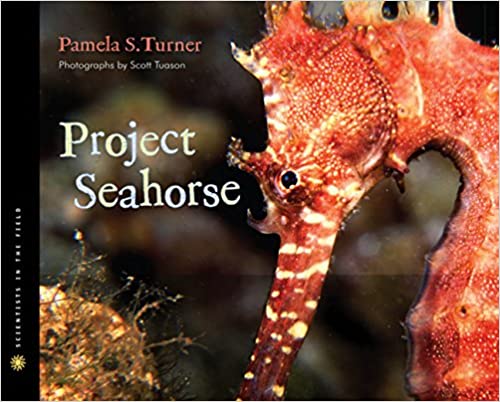
Today's poem comes from pages 7, 20, and 48 of Project Seahorse, written by Pamela S. Turner with photographs by Scott Tuason.

Night on the Reef

pony-faced fish
hover and flutter
reach out with
monkey-like tails

beautiful and vulnerable
the only fish
that holds your hand

Poem ©Tricia Stohr-Hunt, 2021. All rights reserved.

I hope you'll come back tomorrow and see what new poem I've found. Until then, you may want to read previous poems in this series.
April 1 - Flotsam
April 2 - A Warm Wind
April 3 - Zentangle Poem
April 4 - Soap Bubbles
April 6 - Mount St. Helens

I do hope you'll take some time to check out all the wonderful poetic things being shared and collected today by Tabatha Yeatts at The Opposite of Indifference. Happy Poetry Friday all!

Thursday, April 08, 2021

NPM 2021 - Found Poem 8

Today's poem comes from Chapter 5 of John Muir: America's First Environmentalist, written by Kathryn Lasky and illustrated by Stan Fellows. 

Muir in California

he boarded a ship
for San Francisco
didn't like the city
but did notice
flowers 
on windowsills

pointed in the direction 
of the mountains
he set off
swept up in the thrill
of the wilderness
drawn as if by 
magnetic force

found music in 
everything
water, wind
vibrations of pine needles
crescendos of a thunderstorm

entranced by 
snow and ice
secrets of nature
wild places
he cherished beauty

Poem ©Tricia Stohr-Hunt, 2021. All rights reserved.

I hope you'll come back tomorrow and see what new poem I've found. Until then, you may want to read previous poems in this series.
April 1 - Flotsam
April 2 - A Warm Wind
April 3 - Zentangle Poem
April 4 - Soap Bubbles
April 6 - Mount St. Helens

Wednesday, April 07, 2021

For the Love of Spiders and Spi-ku

I've been a fan of spiders for ages, long before I became a faculty member at the only college in the country with a spider mascot. As a classroom teacher I had a tarantula in my classroom and often shared spider-related humor with my students. A particular favorite was this Calvin and Hobbes strip. 
If you can't quite make out the text, here's what Calvin opines.
Like delicate lace,
so the threads intertwine,
Oh, gossamer web
of wondrous design!
Such beauty and grace
wild nature produces … 
UGHH, look at the spider
suck out that bug’s juices! 

While many folks focus on the "yuck factor," spiders are truly fascinating creatures. Leslie Bulion has fully captured how amazing they are in both verse and prose in Spi-ku: A Clutter of Short Verse on Eight Legs. Add in the incredible illustrations by Robert Meganck and you have a masterpiece that even arachnophobes will love.

Bulion is a master of informational texts that marry engaging, kid-friendly poetry with science. I wish her books had been around 33 years ago when I settled into my first classroom, eager to put science books in kids hands that would neither put them to sleep with their didactic approach to content, nor turn them away with the complexity of the writing. Not only were truly exceptional nonfiction science books hard to find back then, but poetry was almost nonexistent. As someone who encourages teachers to integrate poetry and children's literature into content area instruction, Leslie's books are a gift.

Let's start this review by exploring from the back. My students know how much I love back matter. It's one of the components that I believe separates good nonfiction texts from great ones. The back matter in Spi-ku consists of a glossary of 24 terms, notes on poetics forms, spider identification that includes common and scientific names (genus and species) for the 53 spiders illustrated so carefully by Meganck, ideas for going on a spider hunt, an annotated bibliography with resources for further study, the author's acknowledgements (yes, she consulted with experts!), a double-page spread showing spiders' relative sizes, and a page of close-up illustrations of the spiders that appear on the cover. Phew! See what I mean about back matter? This information adds a welcome layer of depth to the text.

While many of the poems in the text use Japanese or Japanese-inspired forms, such as haiku, tanka, dodoitsu, and cinquain, there are other forms, including limerick, double dactyl, free verse, concrete, and many more. The first poem, "Araneae All Around" provides a nice introduction to the humble spider and the volume. The poems are all accompanied by illustrations of spiders, their silks, and webs. I found myself constantly flipping between the pages and the spider identification in the back to try and determine exactly what spiders I was looking at. After the introductory poem, Bulion introduces arachnids, or the class of invertebrates that spiders belong to.

(Click to enlarge.)

I adore the word play in using mite in this poem. This is the kind of thing that students will remember. I know this one turn of phrase is a great way to remember at least one other type of organism found in the arachnid class. As pictured above, each double-page spread includes one or more verses and a block of informational text. The spiders highlighted in the text blocks appear in boldface to make them stand out. The information unfolds in a thoughtfully organized fashion, taking readers on a journey that has them learning about spider silk, spider movement, how they catch and eat their meals, their webs, how some spiders capture prey without the use of a web or snare, how spiders fool both prey and predators, spider senses, and so much more. 

I learned as much from the poems in the book as I did the nonfiction excerpts. The 3 different spreads on spider enemies all include poems for two voices and are particularly engaging when read aloud. The text ends with a final poem entitled "Appreciate Araneae!" After learning so much about them, it's hard not to appreciate all they contribute to "Our Spiderful World," which just so happens to be the heading for the last block of nonfiction text. (Go ahead, see for yourself!)

(Click to enlarge.)

There is so much to love in this volume. I encourage all you folks who are fearful or disdainful of spiders to be brave and take a peak. I guarantee that by the end of it, even the biggest spider-haters will be converts. 

For all you teachers out there, Leslie has developed a particularly useful Educator's Guide. Don't miss it!

Thanks to PeachTree for sending me a copy of the book and including me on the blog tour. You can check out the other stops this week to learn more.
You can learn more about Leslie Bulion and her books at her web site. You can also find her on social media at:
You can learn more about Robert Meganck and his art on his web site. (Turns out, he's my neighbor here in Virginia. Hi Robert!) You can also find him on social media at:
Finally, keep up with PeachTree Publishing and see what's new in their world of books at:
NPM 2021 - Found Poem 7

Today's poem comes from The Shape of the World: A Portrait of Frank Lloyd Wright, written by K.L. Going and illustrated by Lauren Stringer.

Beautiful Buildings

he would learn
cubes, spheres,
cones, pyramids
cylinders
shapes built up
tall or wide
flat or round

he marveled at
the world
saw shapes
everywhere he looked
loved the shape
of the world

he never forgot
hills and prairies
chose windows
set buildings
one with the world
and the wide expanse
of sky

Poem ©Tricia Stohr-Hunt, 2021. All rights reserved.

I hope you'll come back tomorrow and see what new poem I've found. Until then, you may want to read previous poems in this series.
April 1 - Flotsam
April 2 - A Warm Wind
April 3 - Zentangle Poem
April 4 - Soap Bubbles

Tuesday, April 06, 2021

NPM 2021 - Found Poem 6

Today's poem comes from p. 10-11 of Will It Blow? Become a Volcano Detective At Mount St. Helens, written by Elizabeth Rusch and illustrated by K.E. Lewis.

Mount St. Helens (May 18, 1980)

Earthquake!

WHOOSH!
landslide buried miles
under earth and rocks
POP!
"stone wind" blasted
ash, rocks, boulders
BANG!
erupting upward
ash-cloud
circled the globe
HISS!
gas, ash, pumice
rolled down
SPLAT!
heat melted ice
and snow
mud flowed

pristine mountain
transformed into
steaming moonscape

Poem ©Tricia Stohr-Hunt, 2021. All rights reserved.

I hope you'll come back tomorrow and see what new poem I've found. Until then, you may want to read previous poems in this series.
April 1 - Flotsam
April 2 - A Warm Wind
April 3 - Zentangle Poem
April 4 - Soap Bubbles

Monday, April 05, 2021

NPM 2020 - Found Poem 5

Today's found poem comes from p. 6-14 of Girls Who Looked Under Rocks: The Lives of Six Pioneering Naturalists, written by Jeannine Atkins and illustrated by Paula Conner.

Following Butterflies

insects were Maria's favorites
she searched for butterflies
and spiders
brought home caterpillars
moved by
God's attention to
small beings
she painted
extraordinary patterns
nature's beauty
was wide

egg
  caterpillar
    cocoon
      emerging butterfly
metamorphosis
admired

Poem ©Tricia Stohr-Hunt, 2021. All rights reserved.

I hope you'll come back tomorrow and see what new poem I've found. Until then, you may want to read previous poems in this series.
April 1 - Flotsam
April 2 - A Warm Wind
April 3 - Zentangle Poem
April 4 - Soap Bubbles

Sunday, April 04, 2021

NPM 2021 - Found Poem 4

Today's found poem comes from p. 15 of A Drop of Water, by Walter Wick.

Soap Bubbles

dazzling beauty
delicate precision
nearly perfect 
shimmering liquid

soapy water
stretches
without breaking
shrinks to form 
a sphere

Poem ©Tricia Stohr-Hunt, 2021. All rights reserved.

I hope you'll come back tomorrow and see what new poem I've found. Until then, you may want to read previous poems in this series.
April 1 - Flotsam
April 2 - A Warm Wind
April 3 - Zentangle Poem

Saturday, April 03, 2021

NPM 2021 - Found Poem 3

Today's found poem is a zentangle poem. Kat Apel does a really nice job describing them on her site. This is similar to blackout poetry, though doodles and lines are used to block and frame the words.

This poem was made from a page (p. 197) in the story "William the Conqueror," found in Maugham's Choice of Kipling's Best, published by Doubleday & Company in 1953. I found this at a thrift shop, so even though it set my teeth on edge to destroy a used book, I did enjoy creating this poem about things I actually love, save one. Can you guess which one is NOT true?

Here's a closeup of the page.
Found List Poem

I like
   teaching
   beauty
   books and poetry
   big gatherings
   dinners
   throwing a stone
   the desert
   the Himalayan foothills
   evening lights
   the daily paper
   sleep
   telegrams

Poem ©Tricia Stohr-Hunt, 2021. All rights reserved.

I hope you'll come back tomorrow and see what new poem I've found. Until then, you may want to read previous poems in this series.
April 1 - Flotsam
April 2 - A Warm Wind

Friday, April 02, 2021

Poetry Friday and NPM 2021 - Found Poem 2

Welcome Poetry Friday friends! This year for National Poetry Month I'm writing and sharing found poems. You can learn more about this form and my plans in this post describing the project.

Today's found poem comes from p. 176-180 of Charlotte's Web Signature Edition, written by E.B. White and illustrated by Garth Williams.

A Warm Wind

winter ended at last
from the pond
in shrill chorus
hundreds of 
little frogs

snows melted, ran away
streams bubbled
with rushing water
sparrow arrived
and sang

light strengthened
mornings came sooner
another new lamb
goose sitting on eggs
sky wider
damp earth
sweet springtime

the moment for
setting forth
is here
go out
into the world
wherever the wind
takes you

Poem ©Tricia Stohr-Hunt, 2021. All rights reserved.

I hope you'll come back tomorrow and see what new poem I've found. You can also read previous poems in this series.
April 1 - Flotsam

In the meantime, be sure to check out all the wonderful poetic things being shared and collected today by Mary Lee at A Year of Reading.

Thursday, April 01, 2021

NPM 2021 - Found Poem 1

Today's found poem comes from p. 26-28 of Tracking Trash: Flotsam, Jetsam, and the Science of Ocean Motion by Loree Griffin Burns.

Flotsam

beachcombers gather
their finds
hints of serendipity
baskets of toys
a gold mine
washed ashore
 a duck
 a frog
managed a
treacherous journey

floating trash
goes on and on

Poem ©Tricia Stohr-Hunt, 2021. All rights reserved.

I hope you'll come back tomorrow and see what new poem I've found.

National Poetry Month Project 2021 - Found Poems

I started writing centos a few weeks ago, thinking this would be the focus of my National Poetry Month Project. I even shared this at the Sunday writing session with my Poetry Sisters. However, after a bit of thought, I decided to expand the project and focus on a variety of found poem types.

At the most basic level, found poems are poems composed from words and phrases found in another text. Here is a more comprehensive description from the folks at Poets.org.

Found poems take existing texts and refashion them, reorder them, and present them as poems. The literary equivalent of a collage, found poetry is often made from newspaper articles, street signs, graffiti, speeches, letters, or even other poems.

A pure found poem consists exclusively of outside texts: the words of the poem remain as they were found, with few additions or omissions. Decisions of form, such as where to break a line, are left to the poet.
And here is what is written on the "About" page at The Found Poetry Review.
“Happy poets who write found poetry go pawing through popular culture like sculptors on trash heaps. They hold and wave aloft usable artifacts and fragments: jingles and ad copy, menus and broadcasts — all objet trouvés, the literary equivalents of Warhol’s Campbell’s soup cans and Duchamp’s bicycle. By entering a found text as a poem, the poet doubles its context. The original meaning remains intact, but now it swings between two poles. The poet adds, or at any rate increases, the element of delight. This is an urban, youthful, ironic, cruising kind of poetry. It serves up whole texts, or interrupted fragments of texts.” — Annie Dillard

Put another way, found poetry is the literary version of a collage. Poets select a source text or texts — anything from traditional texts like books, magazines and newspapers to more nontraditional sources like product packaging, junk mail or court transcripts — then excerpt words and phrases from the text(s) to create a new piece.
What I love about the Found Poetry site is that they describe different types of found poetry and where possible, provide examples. You can learn about erasure, free-form excerpting and remixing, cento, and cut-up. They also provide a quick but very helpful introduction to issues of fair use.

In an NCTE article on found and headline poems I found this most useful and inspiring language for thinking about found poetry.
Plenty of strong and beautiful poems are made from plain language. You sometimes hear such language in conversation, when people are talking their best. Listen. Sometimes you yourself say wonderful things. Admit it. You can find moving, rich language in books, on walls, even in junk mail. (From such sources you’ll probably find better poems, or better beginnings for poems, than from dictionaries and other word books.) 
So, poems hide in things you and others say and write. They lie buried in places where language isn’t so self-conscious as “real poetry” often is.
So found poetry is inspired by every little thing, you just need to keep your eyes, ears, and heart open to the possibilities.
If you would like to try writing found poems yourself or with your students, here are some helpful resources.
Now that you are inspired, go out and find yourself a poem! I'll be sharing my own found poems all month, so please come back and see what I've been working on.

If you are interested in other National Poetry Month happenings, Susan at Soul Blossom Living has an ever growing list of blogs and projects for you to check out. Happy National Poetry Month all!

Friday, March 26, 2021

Poetry Sisters Write Dizains

This month's challenge was to write a "Dizzying" Dizain. This form consists of one 10-line stanza with 10 syllables per line. The rhyme scheme is a/b/a/b/b/c/c/d/c/d. You can read more about the form at Robert Lee Brewer's site at the Writer's Digest. 

I'm not sure what dizzying means, but I toyed with writing about vertigo and dizzying love. (Does love make one dizzy?) In the end, I settled on my favorite adrenaline-filled pastime, riding roller coasters. I do feel like I needed another line or two to really describe the ride, but this will have to do. I wrote nearly all of this during our Zoom time on Sunday, so I am pleased that I was able to pull these ideas together.

A Dizzying Ride
This topsy-turvy coaster calls my name
I take a seat, lock in, and close my eyes
you’d think that every ride would be the same
but with each trip I’m daunted by its size
yet thrilled by chains click-clacking as we rise
It dizzies me to look down at the ground
instead I watch the track where we are bound
we rise and fall, turn upside down, suspend
and for those moments, how my heart does pound
too soon we’re speeding breakneck to the end

I went back to writing later that day after spending some time wading through boxes of mementos. I find parting with things difficult to do. (Under different circumstances I might have become a hoarder!) Do I really need the high school graduation cards that have been in a box in the attic since I moved to Virginia nearly 27 years ago? Why is it so hard to part with them? As a mom, why have I saved every piece of artwork my son did? As well as concert programs, notes from teachers, and so much more! There is a part of me that says "SAVE EVERYTHING!" This is the teacher in me that uses my father's old photos, letters, and newspaper clippings to teach about primary sources. But there is another part of me that says "He's a boy, he won't care about these things." I found the internal tug-of-war over these tokens to be dizzying, and just like that, I had an idea for another poem. I broke the rules here because this one has two stanzas, and a dizain is only supposed to have one.

The Dizzying Stress of Tidying Up 
   (with apologies to Marie Kondo)

The moving van held boxes from my past
things my mother saved throughout the years
childhood was not designed to last
reminders of my youth that disappeared
sentimental treasures prompting tears
A mother now myself I’ve kept things too
our son’s first tooth, a lock of hair, a shoe
report cards, photos, ticket stubs and more
so many keepsakes, none of them on view
what good are they all locked up in a drawer?

Will my son even want these for his own?
Am I a lousy mom for wanting less?
Why keep a blanket tattered, worn, and sewn?
Old homework, letters, cards, notes from recess
certificates that celebrate success
I cannot seem to part with any thing
despite the good intentions that I bring
to the task of holding each in hand
Marie's my guide, as I clean house in spring
Does it bring joy? I hope you understand.

Poems ©Tricia Stohr-Hunt, 2021. All rights reserved.

You can read the pieces written by my Poetry Sisters at the links below. 
Would you like to try the next challenge? Next month we are writing in the style of Linda Hogan’s poem "Innocence.” Share your poem on April 30th in a post and/or on social media with the tag #PoetryPals. We look forward to reading your poems!

I do hope you'll take some time to check out all the wonderful poetic things being shared and collected today by Susan Bruck at Soul Blossom Living. Happy poetry Friday friends!

Friday, February 26, 2021

Poetry Sisters Write Metaphor Poems

This month's challenge was to write a metaphor poem using metaphor dice. 

This year we are meeting once a month on Zoom to write together. It's a lovely way to spend a Sunday afternoon. This time around, Laura rolled metaphor dice for each of us. For me she rolled "the mind is a silent sideshow."

Before we met I decided I wanted to write a triolet. I like the form and find the repetition challenging. Once I had my metaphor, I generated rhyming words for show and then wrote the last two lines of the triolet. (I always begin at the end because I feel it makes the poem more cohesive.) Once I had the A line, I generated rhyming words for head. I usually begin with words off the top of my head, then I do a quick search at RhymeZone. When we were discussing process at the end of the session, Kelly shared the site Rhymer, which was new to me. It generated a really nice list of words, so I'll be trying it our for sure.

A triolet is an 8-line poem that uses only two rhymes used throughout. Additionally, the first line is repeated in the fourth and seventh lines, while the second line is repeated in the final line. Because of this, only five different poetic lines are written.  The rhyme scheme for a triolet is ABaAabAB (where capital letters stand for repeated lines). Here's my triolet.

Hearing Voices
Voices inside your head
are a personal, silent sideshow
fill you with wonder and dread
the voices inside your head
demand to be coddled and fed
poke holes in the truth that you know
Damn voices inside your head
the mind is a silent sideshow

After I wrote this I tried a free verse poem, but it didn't really go anywhere. I couldn't get away from the idea of the unquiet mind and was reminded of a meme a friend shared on Twitter from the webcomic Are You Going to Sleep? 

In this exploitable comic, users insert their own thoughts about what is keeping them awake. All these thoughts led me to write a poem with rhyming couplets about my brain at night.

Sideshow Mind
dark grows
brain knows
no lows
sideshow overthrows
sleep

internal chatter
thoughts scatter
subject matter?
     stomach flatter
     paint splatter
     cake batter
     mad hatter
wake up!

Poems ©Tricia Stohr-Hunt, 2021. All rights reserved.

You can read the pieces written by my Poetry Sisters at the links below. 
Would you like to try the next challenge? Next month we are writing Dizains. This form consists of one 10-line stanza with 10 syllables per line. The rhyme scheme is a/b/a/b/b/c/c/d/c/d. You can read more about the form at Robert Lee Brewer's site at the Writer's Digest. Share your poem on March 26th in a post and/or on social media with the tag #PoetryPals. We look forward to reading your poems!

I do hope you'll take some time to check out all the wonderful poetic things being shared and collected today by Karen Edmisten. Happy poetry Friday friends!

Friday, January 29, 2021

It's a New Year With My Poetry Sisters!

It's a new year with a new set of writing challenges with my poetry sisters. Even better than continuing on this writing journey is our commitment to writing together, over Zoom! I nearly wept when I saw their faces and heard their voices. We chatted about the challenge, wrote on our own, but together in virtual time, and then chatted about process and writing. We didn't share our poems, so I can't wait to read what they've written.

This month's challenge was to select words from a particular year in Merriam Webster’s Time Traveler. This site highlights when a word was first used in print. I was born in 1965 and had some interesting words to choose from. 


I ended up with two remarkably different poems, though both are focused on childhood memories. Neither one feels particularly finished, but I'm glad to have gotten something down. (Note that the words from Time Traveler that I used are highlighted.)

Not by Definition
Dork
a moniker casually tossed
but hand-me down clothes
fittingly unstylish, outdated
gave it legs
a tendency to choose books
over social interaction
made it stick

My game face was nerd
my lived experience more
smart than odd, more
curious than awkward

stoked not just by math, science,
Dr. Who, and Star Trek
but also the give-and-go,
alley-oop, and leg out

Driveway hoops, backyard ball,
winter hockey on a frozen pond
all precious moments when
there was acceptance
hard won in sweat, pumping legs,
and flying elbows

But there is little wiggle room
in a label that
damns us from the start
restricts how others see us
how we see ourselves
unless we take it back
embrace it, proclaim it
wave its banner high

Today my name tag reads
“Hello my name is  __.
I am a dork.


Diamond Days

We lived for the home stands
clutched knothole passes 
in clammy hands
excitedly took seats in
hard, hot bleachers

We cheered as batters legged out
hoped for theirs to ground out
held a collective breath
at the top of the 9th with
two outs, full count, bases loaded
watched our hurler
full-on game face
wait for a sign

Time slowed before the nod,
the wind up, the pitch
the crack of the bat
the agony of defeat

We left burned
in more ways than one
but more than ready
to return the next day
for another round
another glorious day
in the sun

Poems ©Tricia Stohr-Hunt, 2021. All rights reserved.

You can read the pieces written by my Poetry Sisters at the links below. 
Would you like to try the next challenge? Roll a set of metaphor dice and write a poem inspired by the metaphor. If you don’t have a set, try this online generator: https://perchance.org/ve4axzbkx4. Share your poem on February 26th in a post and/or on social media with the tag #PoetryPals. We look forward to reading your poems!

I do hope you'll take some time to check out all the wonderful poetic things being shared and collected today by Jan Annino at Bookseedstudio. Happy poetry Friday friends!

Friday, December 25, 2020

Capping the Year With My Poetry Sisters - Wistful Poetry

It's our last challenge for 2020, which this time around  was to write to the theme of "Wish I'd Been There," or to an historical event that incites wistfulness. I'm not sure the event I've chosen incites wistfulness, but this event reminds me of something my mother often said, "Oh, to be a fly on the wall." Or as Burr proclaims in Hamilton, "I wanna be in the room where it happens." 

Let me take you back to 1872 in Rochester, NY. 

Clipped from the Brooklyn Union newspaper, 5 Nov 1872

I'm not sure this poem is finished yet, but it's a start.

November 5th, 1872 - Election Day

I've always admired 
those resolute women
corset wearing
bustled and ruffled
     risk takers
     rule breakers
     history makers
who cast their votes
for Ulysses S. Grant
pushed the boundaries
of the 14th amendment
determined to be heard
who embraced fully
the word citizen
with all the rights
it implied
who broke the law
then marched on

Poem ©Tricia Stohr-Hunt, 2020. All rights reserved.

You can read the pieces written by my Poetry Sisters at the links below. We're missing a sister or two, but they'll be back for other challenges. 
I do hope you'll take some time to check out all the wonderful poetic things being shared and collected today by Irene Latham at Live Your Poem. Happy poetry Friday friends! Sending you all wishes for a happy holiday season and much awaited new year. 

Friday, November 27, 2020

Poetry Sisters Look Back

It's another looking back month in our year of hindsight/foresight. I chose to revisit a poem from April 2019.  While I didn't revise or talk back to that poem, I did take another stab at the form. In that challenge, we wrote anagram poems. The challenge was inspired by the poem A Garden to Gander, written by Linda Baie of Teacher Dance. Linda's poem included two anagrams in each line. I wanted to play with this idea a bit more. Instead of using words as I did the first time around, my new poem largely uses phrases.

Thoughts on a Sleepless Night 
I went to bed dreaming of 
poems, words, anagrams  
I woke with questions ...
   Is the astronomer just a moon starer? 
   In a cat's dream, are there rats and mice? 
   Is a gentleman always an elegant man? 
   Will asteroid threats be a disaster to Earth? 
   When the eyes are closed, what do they see? 
   When voices rant on in conversation, 
        must you be silent and listen? 
  Are election results lies? (Let's recount!)

Poem ©Tricia Stohr-Hunt, 2020. All rights reserved.

You can read the pieces written by my Poetry Sisters at the links below. As usual, life has gotten in the way for some folks, but they'll be back for other challenges. 
I do hope you'll take some time to check out all the wonderful poetic things being shared and collected today by Carol of Carol's Corner. Happy poetry Friday friends!

Friday, October 30, 2020

Poetry Sisters Write Naani

This month's challenge was to write a naani with an autumn theme. A naani is a 4-line poem containing between 20-25 syllables. I had a lot of trouble with this one, but then I generally have difficulty with short forms that are rather open-ended, so I shouldn't have been surprised. In the end, I ended up with a longer poem composed of several naani strung together.

An Autumn Naani Story

my favorite maple tree
blushes brilliant red
with immodesty
celebrating fall 

oak stands quietly nearby
cloaked in orange and gold
dropping scads of acorns
for every passing squirrel

both silent witnesses to
a world in upheaval
sentinels of change
outlasting generations

Poem ©Tricia Stohr-Hunt, 2020. All rights reserved.

You can read the pieces written by my Poetry Sisters at the links below. As usual, life has gotten in the way for some folks, but they'll be back for other challenges. 
If you’d like to write with us next month, the challenge is to pick one of your old poems to revise and/or write a new poem in conversation with it. We will be posting on the last Friday of the month (November 27th, the day after Thanksgiving) and would love to have you join us.

I do hope you'll take some time to check out all the wonderful poetic things being shared and collected today by Linda Baie of Teacher Dance. Happy poetry Friday friends!

Friday, September 25, 2020

Poetry Sisters Ponder the Hippo

The challenge this month was to write to the word ponderous or the image of a hippo. I decided to play around with an old quick write prompt issued by Nikki Grimes at Kate Messner's blog way back in 2014. Based on the examples she shared, I decided I wanted to begin a poem with "Hippo is a __ word." Here's where my poem  went.


Image courtesy of Wallpaper Flare

Hippo is a ponderous word
a barrel-shaped word
a semi-aquatic,
unable to swim word
a yawning, wide open word
a gregarious, booming word
an aggressive and unpredictable word
Keep your hands in the boat
while you float downriver,
observing a bloat of
hippopotamuses and hippopotami
half-submerged
ears twitching, eyes watching
keeping the crocodiles at bay.

Poem ©Tricia Stohr-Hunt, 2020. All rights reserved.

You can read the pieces written by my Poetry Sisters at the links below. As usual, life has gotten in the way for some folks, but they'll be back for other challenges. 
If you’d like to write with us next month, the challenge is to write a naani poem with the theme of foresight, or autumn, or both. We will be posting on the last Friday of the month (October 30th) and would love to have you join us.

I do hope you'll take some time to check out all the wonderful poetic things being shared and collected today by Jone MacCulloch. Happy poetry Friday friends!

Friday, August 28, 2020

Poetry Sisters Look Back

This month's challenge was to pick one of our old poems to revise and/or write a new poem in conversation with it. I went back to a post from May of 2016. Here's how that challenge was defined.

This month the Poetry Seven crew wrote in the form of the tritina. The tritina is composed of 3 tercets and a final line (envoi) that stands alone. Similar to a sestina, though shorter, it uses a set of 3 alternating end words instead of six. The form is: ABC / CAB / BCA / A, B, and C (final line/envoi).

The words we chose from were selected by Tanita. They were: 
     sweet, cold, stone, hope, mouth, thread

I wrote 2 poems back then, one for my father and one for sheer fun. 

Looking back on these old challenges to find a poem to revisit, I was inspired by the words Tanita selected and decided to have another go at this one. Here's my new poem. It was written to this photo.
Stonewall Jackson's plinth, photo by Ryan Patterson

Running Monument Ave
I hold a spark of hope
as I pass by stone
bases, empty and cold

I know this route cold
run it with hope
I won't trip on the stones

In this city, hearts made of stone
send messages cold
quash seeds of hope

But cold stone statues fall, and hope still rises.

Poem ©Tricia Stohr-Hunt, 2020. All rights reserved.

You can read the pieces written by my Poetry Sisters at the links below. As usual, life has gotten in the way for some folks, but they'll be back for other challenges. 
If you’d like to write with us next month, the theme is ponderous, or an image of a hippo. You may use any form you like. We will be posting on the last Friday of the month (September 25th) and would love to have you join us.

I do hope you'll take some time to check out all the wonderful poetic things being shared and collected today by Heidi Mordhorst at my juicy little universe. Happy poetry Friday friends!

Friday, August 21, 2020

#MTBoSBLaugust - Moo-ve It Multiplication

Today I'm sharing another multiplication game. This is a variation on a bump game. It has a cow on it, so that's where Moo-ve it comes from.

In the game, players roll 2 dice and finds the product. They find that product on the board and cover it. If the product is already covered, the player may "bump" their opponent's piece off the board. The first player to get 3 in a row, horizontally, vertically, or diagonally, is the winner.

Here is what the print version looks like.

This is the digital version.

If you would like to try this with your students, you can download the PDF or the Google slides version.

That's it for day 21 of #MTBoSBlaugust. I hope you'll come back tomorrow to see what else I have to share.

Thursday, August 20, 2020

#MTBoSBLaugust - Multiplication Four-in-a-Row

I have a number of multiplication games that students can play to practice basic facts. I really like Multiplication Four-in-a-Row. Students are give a number strip or table and begin by placing markers on any two numbers. The first player finds the product and covers that number. The second player moves one of the markers on the number table to create a new number sentence, finds that product, and covers the number. Play continues until one player gets 4 in a row, either horizontally, vertically, or diagonally.

I've been using this paper and pencil version for some time.

If you want to try this with your students, you can download a PDF.

I've also just created a digital version.


If you would like to try this with your students, you can download a copy.

That's it for day 20 of #MTBoSBlaugust. I hope you'll come back tomorrow to see what else I have to share.

Wednesday, August 19, 2020

#MTBoSBLaugust - Digital Shut the Box

Have you every played Shut the Box? When my son was young, we used to eat at a little hole-in-the-wall restaurant/bar for breakfast. There was a Shut the Box game behind the bar and the owner would hand it to us when we walked in so we could play while we waited for our food. 

Eventually, I made a portable version that fit in my purse. I took small poker chips and wrote the numbers 1-10 on them. I stuck them in a snack size baggie with two dice and we had a game we could play any time, anywhere.

I also made a paper and pencil version for use in class. We laminated some of these and placed additional copies inside sheet protectors for reuse.

If you would like a copy, you can download a PDF.

Kids really enjoy this game, so I've created a digital version too.


If you want to try this with your students, you can download a copy.

That's it for day 19 of #MTBoSBlaugust. I hope you'll come back tomorrow to see what else I have to share.

Tuesday, August 18, 2020

#MTBoSBLaugust - Subitizing and Recognizing Number Combinations

In working to develop number sense in our second grade students, we spent time on activities that encouraged students to visualize numbers and think about number combinations. We did quick image activities with ten frames, solved Splat! questions (thank you Steve Wyborney!), played Shake and Spill, and conducted other related activities. 

For quick images with ten frames we used both horizontal and vertical sets of ten frame cards. Cards were flashed for 2-3 seconds and then hidden. Students were asked:

  • What number did you see?
  • How did you see it?
  • How many more to 10?
Here's an example of the cards we used.
If you want to try this with your students, you can download a copy of each set of ten frame cards. Click here for the horizontal version. Click here for the vertical version.

Shake and spill is a game we played with two-color counters. Students would take a number of counters (6, for example) in their hands, shake them, and spill them on the desktop. Students then looked at the counters and determined how many of each color without counting. Eventually, the same combinations would keep coming up and students began to recognize that 6 could be made of 0+6. and 1+5, and 2+4, and 3+3, and so on. Once students were familiar with the game, we added in recording sheets. Here's the sheet for 6.
I first learned about Shake and Spill many years ago in an old video series (80s hair and clothes) created by Marilyn Burns. The videos focused on how different manipulatives could be used to teach a range of mathematical ideas. You can read about an updated version of this activity at the Math Solutions site. 

If you want to try this with your students, you can download a PDF file with Shake and Spill for numbers 5-10.

That's it for day 18 of #MTBoSBlaugust. I hope you'll come back tomorrow to see what else I have to share.

Monday, August 17, 2020

#MTBoSBLaugust - Race for a Flat

I think every elementary teacher has played Race for a Flat, that game where students learn to regroup and exchange 10 ones for 1 ten, and 10 tens for 1 hundred, or a flat.

In the past, my students played on a legal-sized place value mat that looked like this.

Some of my students had difficulty with this, so I created this mat for them to use instead. 

The blocks on this mat are composed of centimeter squares, so base-ten blocks fit perfectly. For whatever reason, students found it easier to make trades from ones to tens with the blocks in this format, which surprised me because we tried hard to get them to use ten frames to visualize numbers.

If you want to use this new Race for a Flat mat with your students, you can download a PDF version.
If you want to try the more traditional place value mat, you can download a PDF version of that as well.

That's it for day 17 of #MTBoSBlaugust. I hope you'll come back tomorrow to see what else I have to share.

Sunday, August 16, 2020

#MTBoSBLaugust - Three-to-Win Games

 I like games that allow students to practice basic facts in a strategic way. Three to Win is a simple, quick game where students practice basic facts in addition and subtraction (and sometimes multiplication) while using problem solving strategies. The first player rolls two dice and says the numbers. They look at the empty spaces on the board and decide whether to ADD or SUBTRACT the numbers (or sometimes MULTIPLY). Once a choice is made, the player says the number sentence aloud and places their marker over the answer. If a player rolls doubles, they can cover one of the images on the board. Play alternates until one player gets three markers in a row, vertically, horizontally or diagonally.

Below are images of the digital version, which focuses on addition and subtraction.


Below are the images of the print version, which focuses on addition, subtraction, and multiplication.


If you would like to try this with your students, you can download a copy of the Google slides or the PDF version.

That's it for day 16 of #MTBoSBlaugust. I hope you'll come back tomorrow to see what else I have to share.