Friday, January 02, 2015

Ringing in the New Year with Poetry Friday

I'm pleased to host the first Poetry Friday round-up of the new year, but even more excited to share some work the Poetry Seven have been working on.

Last year for my birthday in late August I suggested that writing poems together would be an amazing gift. Kelly Fineman picked up on that, Liz Garton Scanlon made some suggestions, and we were off writing triolets on the topic of beginnings and endings. Our goal was to share with each other some time in October. During that time my life was in a bit of an upheaval and I was dealing with the approaching death of a beloved colleague. The poems that came out of that time were all dark and depressing. I lost my friend and mentor just 43 days after he was diagnosed with cancer. He'd probably be mortified that I was writing about him, but the poems helped me get through those days. Here are the first and current drafts of my triolet.
First Draft (untitled) 
I dreamt of you last night
Knowing nothing ever stays
Past wrongs not yet made right
I dreamt of you last night
Saw you loosed and taking flight
Slipping towards the end of days
I dreamt of you last night
Knowing nothing ever stays
37th Draft ... or something ridiculous like that. After all, "A poem is never finished; it is only abandoned." (A paraphrase of Paul Valéry by W. H. Auden)
Letting Go 
I dream of you each night
knowing nothing ever stays
glimpse that smile despite your plight
I dream of you each night
watch you loosed and taking flight
slipping towards the end of days 
I dream of you each night
knowing nothing ever stays 
Poem ©Tricia Stohr-Hunt, 2015. All rights reserved.

You can read the poems written by my Poetry Seven compatriots at the links below.

I am happy to be free of 2014 and ready to embrace 2015 and all it will bring. I hope you'll help me ring in the new year by celebrating all the amazing poetry folks are sharing this week. I'm and old-school style host, so please leave a note with a link to your offering in the comments. Happy new year and happy poetry Friday all!

--------------------
Celebrations
As the hostess today I'm taking the liberty of sharing this one. A Year of Reading celebrated its 9th birthday yesterday with a look back at their nine most popular posts. Congratulations to Mary Lee and Franki! We hope you'll be with us for another nine years.


The Cybils
Linda Baie of Teacher Dance shares a bit about the Cybils finalists in poetry and also shares a poem by Michael Chitwood entitled Accomplishments.

Sylvia Vardell of Poetry for Children shares the book blurbs for the Cybils shortlist and reminds us of all the terrific books nominated in the 2014 poetry category.

Margaret Simon, a round one judge, also shares the Cybils finalists for poetry.

Jone MacCulloch of Check It Out, our fearless leader in the round one judging for Cybils poetry, also shares the Cybils poetry shortlist.


Original Poetry 
Robyn Hood Black of Life on the Deckle Edge shares an original haiku for the new year.

Sally Murphy also shares an original poem for the new year.

Greg Pincus of GottaBook started my morning with a laugh with his poem My New Year's Resolutions Are Making Me Loopy.

Amy Ludwig VanDerwater shares her wish poem entitled A Box of Snow.

Matt Forrest Esenwine shares an original poem entitled Night Light.

Diane Mayr of Random Noodling has been participating in an annual New Year's haiku postcard exchange, called a Nengajo, for quite some time. She shares this year's postcard with us.

Mary Lee Hahn of A Year of Reading shares her one little word for 2015 and a poem entitled Expectantly.

Donna Smith of Mainely Write shares a poem inspired by her dog, Gingersnap. (What a great name for a dog!)

Jan Godown Annino of Book Seed Studio shares an original poem inspired by a marsh visit. She's also sharing an excerpt of the poem Purple by Alexis Rotella.

Carlie of Twinkling along shares her poem entitled The First Month.

Ramona of Pleasures from the Page shares her OLW for 2015 and her poem entitled Moving On.


Poetry of Others
Julie Larios of The Drift Record shares the poem Apples by Laurie Lee.

Catherine of Reading to the Core shares the poem I Dwell in Possibility by Emily Dickinson.

Michelle Haseltine of One Grateful Teacher joins us for the first time (welcome Michelle!) and shares a little gem by Emily Dickinson.

Myra Garces Bascal of Gathering Books shares a bit of T.S. Eliot.

Doraine Bennett of Dori Reads shares an excerpt from The Prelude by William Wordsworth.

Irene Latham of Live Your Poem shares her word for the year (wild) and some poetry on that theme. Included are poems by Mary Oliver and Wendell Berry.

Tabatha Yeatts of The Opposite of Indifference shares the poem Ode to the Hotel Near the Children's Hospital by Kevin Young.

Diane Mayr of Kurious Kitty's Kurio Kabinet shares the poem Acceptance by Robert Frost.

Michelle Heidenrich Barnes of Today's Little Ditty shares the poem Sea Glass by Donna JT Smith.

Keri of Keri Recommends shares a poem from the winter poetry swap entitled Winter's Cooking by Linda Baie.

Carol of Carol's Corner shares the poem by Walkers With the Dawn by Langston Hughes.

Tara Smith of A Teaching Life shares the poem To the New Year by W.S. Merwin.

Karen Edmisten shares an excerpt from the poem Journey of the Magi by T.S. Eliot.

Ruth of There is no such thing as a God-forsaken town shares her OLW for 2015 and the poem God Knows by Minnie Louise Haskins.

Little Willow of Bildungsroman shares the poem Entrance by Rainer Maria Rilke.

Colette Bennett of 100 Words a Day shares thoughts on loss and the poem One Art by Elizabeth Bishop.


Meditations
Kim Doele of Flukeprints shares some thoughts on writing poetry for children.

Heidi Mordhorst of my juicy little universe shares how she selected her one word for the year.


Invitations
Carol Varsalona of Beyond Literacy Link shares a link to the Finding Fall gallery of poems and images and invites readers to participate in the 5th gallery of artistic expressions, to be titled Winter Whisperings. You'll also find an original poem here!

Thursday, January 01, 2015

Cybils Poetry Finalists

It was hard keeping quiet about this amazing list of books. Here's what the round 1 judges, a lovely group of women to work with, chose to send along to the round 2 judges.

by Jacqueline Woodson

Brown Girl Dreaming is many things in one rich collection – memoir, history, biography – and lyrical, exquisite poetry. Events of the author’s personal and family history provide the framework for a series of individual poems. Woven throughout are key events of the Civil Rights journey and also personal effects of racism and discrimination. In this beautiful and powerful tapestry of verse, one hears the poignant reflections of Jacqueline Woodson, one of today’s finest writers, who kept on dreaming through tough times and good times and who keeps on writing in mesmerizing verse.

Blurb written by Nancy Bo Flood, The Pirate Tree: Social Justice and Children’s Literature

written by Irene Latham and illustrated by Anna Wadham

Dear Wandering Wildebeest’s poetry bounces with the impala and peeps like the meerkat. With childlike illustrations by Anna Wadham, Irene Latham takes us on a journey to the water hole of the African grasslands. Each poem is accompanied with factual information that will inform even the oldest readers.

To All the Beasts who Enter Here, there is word play with “Saw-scaled viper/ rubs, shrugs,/ sizzzzzzzzzzzzzzzzzzzzzles,” form experiments in Triptych for a Thirsty Giraffe, humor with “Dung Beetle lays eggs/ in elephant poop,” and even danger, “Siren-howls/ foul the air./ Vultures stick to task.” Children and adults alike will love the language and learning that wanders in this book along with the animals of the watering hole.

Blurb written by Margaret Simon, Reflections on the Teche

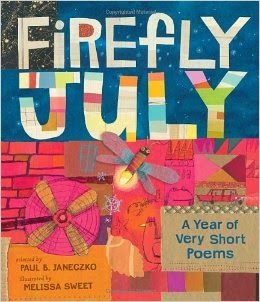
written by Paul B. Janeczko and illustrated by Melissa Sweet

Prolific anthologist Paul B. Janeczko brings the old and the new together in Firefly July: A Year of Very Short Poems. The collection of 36 poems contains poems by classic poets such as Emily Dickinson and Robert Frost. Intermingled with these are poems by well known children’s poets including J. Patrick Lewis and X. J. Kennedy. Firefly July takes readers through the seasons beginning in spring and ending with winter. The poems take readers to different locations as well. Both city and country settings appear in the poems. As the subtitle states, the poems are short, but the images they evoke are almost tangible. Melissa Sweet’s mixed media illustrations are colorful, playful, imaginative, and whimsical. They draw readers into the poems. Firefly July is a stellar collection that will likely be a family favorite for years to come.

Blurb written by Bridget R. Wilson, What Is Bridget Reading?

written and illustrate by Jon J Muth

Inspired by his twins, Muth wrote a haiku book that doesn’t followe the often used three line, 5-7-5 syllable form. This made this title a stand out among other haiku books.
Readers take a seasonal journey from summer through spring by Koo the panda. (Thus the pun in the title: Hi Koo!) Beginning with a simple observation about the wind: /found!/ in my Coat pocket a missing button/ the wind’s surprise, to the last haiku: becoming quiet/ Zero sound/ only breath/ Muth offers to young readers a new way to experience haiku.The watercolor and ink drawings complement the text. The subtle alphabet theme adds another dimension to the book.
The author’s note at the book’s beginning sets the tone: “…haiku is like an instant captured in words–using sensory images. At its best, a haiku embodies a moment of emotion that reminds us that our own human nature is not separate from all of nature.”
This book of poetry will help readers to slow down to appreciate the small moments of nature and daily happenings.

Blurb written by Jone Rush MacCulloch, Check It Out

written by Bob Raczka and illustrated by Chuck Groenink

Who knew that among his many talents, Santa was an expert at writing haiku? In this collection of 25 poems using the 5-7-5 format, Raczka brings us Santa’s many observations, some about his job: “Wishes blowing in/from my overfilled mailbox–/December’s first storm” and others about the weather, the time of year, and Christmas preparations: “Clouds of reindeer breath/in the barn, steam rising from/my hot chocolate”. A fun read all at once, or one per day in anticipation of Christmas, some of the haiku work for winter in general as well: “Just after moonrise/I meet my tall, skinny twin–/’Good evening, shadow.'”

Blurb written by Kelly Ramsdell Fineman, Writing and Ruminating

written by J. Patrick Lewis and George Ella Lyon

Voices from the March is a historical novel in verse that focuses specifically on the momentous march on Washington, D.C. on August 28, 1963, where Dr. Martin Luther King, Jr. gave his landmark “I Have a Dream” speech. Six fictional characters (young and old, black and white) tell their tales on this historic day in cycles of linked poems alongside the perspectives of historic figures and other march participants for a rich tapestry of multiple points of view. It’s been 50 years since the signing of the Civil Rights Act in 1964, when discrimination on the basis of race, color, religion, sex, or national origin became against the law. In this powerful work, Lewis and Lyon tackle issues of racial and social justice in 70 lyrical poems that reflect the perspectives of young people and adults struggling with taking action for positive change in peaceful ways. In addition, extensive and helpful back matter includes a guide to the fictional and historical voices, bibliography, index, and list of websites and related books.

Blurb written by Sylvia Vardell, Poetry for Children

written by Pat Mora and illustrated by Meilo So

In a series of free verse poems in English and Spanish, our most precious natural resource takes center stage. Water rolls, rises, slithers, hums, twists, plunges, slumbers and moves across the Earth in varied forms and places. Mora’s three-line poems are filled with imagery and emotion. “Water rises/ into soft fog,/ weaves down the street, strokes and old cat.” (In Spanish: “El agua sube/ formando suave neblina/ que ondula pro la calle, acacia a un gate viejo.”) The lyrical movement of water described in verse is accompanied by Meilo So’s gorgeous mixed-media illustrations highlighting 16 landscapes from Iceland, to China, to Mexico, the United States and more. Back matter includes an author’s note and information about the images in the book. A joyous, bilingual celebration, this collection brings water to life.

Blurb written by Tricia Stohr-Hunt, The Miss Rumphius Effect

Learn more about the Cybils and check out the other books send forward at 2014 Finalists.

Monday, December 29, 2014

Monday Poetry Stretch - Looking Forward, Looking Back

Another year is ending and a new one beginning. It seems the perfect time to try our hand at writing a reverso.

The form, invented by Marilyn Singer, is described by the poet in this way.
A reverso is two poems in one. Read the first down and it says one thing. Read it back up, with changes just in punctuation and capitalization, and it's a different poem. 
Here's an example Singer provides in her note about the form.

A cat
without
a chair:
incomplete
Incomplete:
a chair
without
a cat.

The coolest thing about these is that whether you are reading them forwards or backwards, they work! You can learn more about the reverso and the book that started it all by checking out this post at Seven Imp and this post at Writing and Ruminating.

So, what do you think? It seems an impossible task, but perhaps we could try writing some short poems similar to Marilyn's example. That, my friends, is the challenge. Please share a link to your poem or the poem itself in the comments.

Friday, December 12, 2014

Poetry Friday - Snowy Owl Near Ocean Shores

If you know OWL MOON by Jane Yolen, you'll want to follow along with Owl Count 2014, which begins at midnight on December 14th. Heidi Stemple will be live tweeting (perhaps on this occasion it should be called hooting) @heidieys and reporting on the Facebook page. In honor of the count, I'm sharing this lovely poem.

Snowy Owl Near Ocean Shores
by Duane Niatum

A castaway blown south from the arctic tundra
sits on a stump in an abandoned farmer’s field.
Beyond the dunes cattails toss and bend as snappy
as the surf, rushing and crashing down the jetty.

His head a swivel of round glances,
his eyes a deeper yellow than the winter sun,
he wonders if the spot two hundred feet away
is a mouse on the crawl from mud hole
to deer-grass patch.

Read the poem in its entirety.


Visit the Audubon Society to learn more about the Christmas bird count.

I do hope you'll take some time to check out all the wonderful poetic things being shared and collected today by Paul at These 4 Corners. Happy poetry Friday friends!

Monday, December 08, 2014

Monday Poetry Stretch - 13 Ways of Looking at Winter

This weekend I was savoring Wallace Steven's wonderful poem, Thirteen Ways of Looking at a Blackbird. I began to think that looking at winter in this way might be an interesting thing to do. Now, you don't need to come up with 13 stanzas of your own. Perhaps we could write this as a modified renga, each contributing a verse or two.

Here is the stanza I'm starting with (I think).

I
Short days
long nights
the coldest of seasons
heralds the approaching light

However you want to approach it, the challenge this week is to write a few stanzas (or more!) about winter. I hope you'll join me. Please share a link to your poem or the poem itself in the comments.

Friday, December 05, 2014

Poetry Friday - Winter Nights

Mother nature hasn't decided what the weather will be, with 70 degree days followed by 40 degree days. I'm enjoying advent and the slow approach of winter. Here's an old poem (late 16th to early 17th century) for the season.

Winter Nights
by Thomas Campion

Now winter nights enlarge
      The number of their hours,
    And clouds their storms discharge
      Upon the airy towers.
    Let now the chimneys blaze        
      And cups o'erflow with wine;
    Let well-tuned words amaze
      With harmony divine.
    Now yellow waxen lights
      Shall wait on honey love,
While youthful revels, masques, and courtly sights
      Sleep's leaden spells remove.

    This time doth well dispense
      With lovers' long discourse;
    Much speech hath some defence,
      Though beauty no remorse.
    All do not all things well;
      Some measures comely tread,
    Some knotted riddles tell,
      Some poems smoothly read.
    The summer hath his joys,
      And winter his delights;
Though love and all his pleasures are but toys,
      They shorten tedious nights.


I do hope you'll take some time to check out all the wonderful poetic things being shared and collected today by Anastasia Suen at Booktalking #kidlit. Happy poetry Friday friends!

Monday, December 01, 2014

Monday Poetry Stretch - Pleiades

Invented by Craig Tigerman, the editor for the online poetry journal SOL Magazine, the pleiades is a 7-line poem in which each line begins with same letter as the first letter in the one-word title. There are no rhyme or meter requirements for a pleiades, though some have suggested the lines be limited to six syllables.

You can read more about this form at Super Forty and The Poets Garret.

I hope you'll join me this week in writing a pleiades. Please share a link to your poem or the poem itself in the comments.

Monday, November 24, 2014

Monday Poetry Stretch - Etheree

An etheree is a poem of ten lines in which each line contains one more syllable than the last. Beginning with one syllable and ending with ten, this unrhymed form is named for its creator, 20th century American poet Etheree Taylor Armstrong.

Variant forms of the etheree include the reverse form, which begins with 10 syllables and ends with one. The double etheree is twenty lines, moving from one syllable to 10, and then from 10 back to one. (I suppose a double etheree could also move from 10 syllables to one, and then from one back to 10.)

You can learn more about the etheree at The Poets Garret and Shadow Poetry.

I hope you'll join me this week in writing an etheree. Please share a link to your poem or the poem itself in the comments.

Monday, November 17, 2014

Monday Poetry Stretch - Septolet

A septolet is a 14-word poem written in two stanzas and connected by the same idea.

I've not seen any consistency regarding number of lines (I've seen 5, 6, and 7) or where the break between stanzas should be (some recommend between lines 4 and 5 if the poem is 7 lines long).

You can read more about the septolet at The Poets Collective and Super Forty.

I hope you'll join me this week in writing a septolet. Please share a link to your poem or the poem itself in the comments.

Tuesday, November 11, 2014

Thank You, Veterans

I've been privileged to know many veterans over the years, and I am eternally grateful to them for their service to our country.

Today I'm honoring a veteran close to my heart, my dad. Here are some pictures from when he was stationed at Kaneohe in Hawaii.


Here's a little something I found packed away with a letter to my grandparents saying that my dad was being discharged and would be coming home soon.

And here's a form letter from Truman.
Thanks to my dad and all the other veterans who have served. We owe you more than we can ever repay.

Monday, November 10, 2014

Monday Poetry Stretch - Epiphora

Early this year we wrote poems that used the device anaphora. Anaphora is the repetition of a word or phrase at the beginning of successive sentences or clauses. Epiphora (or epistrophe) is the exact opposite, where this repetition occurs at the end of successive sentences or clauses.

Here are a few examples.

The Gettysburg Address
“… that government of the people, by the people, for the people, shall not perish from the earth.“


From "Song of Myself" by Walt Whitman
And am not stuck up, and am in my place.

(The moth and the fish-eggs are in their place,
The bright suns I see and the dark suns I cannot see are in
     their place,
The palpable is in its place and the impalpable is in its place.)


From THE MERCHANT OF VENICE by William Shakespeare
Bassanio: Sweet Portia,
If you did know to whom I gave the ring,
If you did know for whom I gave the ring
And would conceive for what I gave the ring
And how unwillingly I left the ring,
When nought would be accepted but the ring,
You would abate the strength of your displeasure.

Portia: If you had known the virtue of the ring,
Or half her worthiness that gave the ring,
Or your own honor to contain the ring,
You would not then have parted with the ring.


So, your challenge for the week is to write a poem that uses epiphora. Please share a link to your poem or the poem itself in the comments.

Friday, November 07, 2014

Poetry Friday - Acquainted with the Night

Last week for Halloween I was persuaded to post the rap from the song Thriller. What I really wanted to post was this.

Acquainted with the Night
by Robert Frost

I have been one acquainted with the night.
I have walked out in rain—and back in rain.
I have outwalked the furthest city light.

I have looked down the saddest city lane.
I have passed by the watchman on his beat
And dropped my eyes, unwilling to explain.

Read the poem in its entirety.


I do hope you'll take some time to check out all the wonderful poetic things being shared and collected today by Diane at Random Noodling. Happy poetry Friday friends!

Monday, November 03, 2014

Monday Poetry Stretch - Rondelet

I've been inconsistent in posting stretches this semester, so I'm trying to get back on track with a new form.

The rondelet is a 7-line French poetic form that contains a refrain, strict rhyme scheme, and distinct syllable pattern. The structure is:
Line 1 : A—4 syllables (refrain)
Line 2 : b—8 syllables
Line 3 : A—repeat of Line 1 (refrain)
Line 4 : a—8 syllables
Line 5 : b—8 syllables
Line 6 : b—8 syllables
Line 7 : A—repeat of Line 1 (refrain)
You can read more about this form at Shadow Poetry and LOTR Rondelets.

I hope you'll join me this week in writing a rondelet. Please share a link to your poem or the poem itself in the comments.

Friday, October 31, 2014

Poetry Friday - Thriller Rap

As if I could post anything else today ...

Rap from Thriller
by Rod Temperton

Darkness falls across the land
The midnight hour is close at hand
Creatures crawl in search of blood
To terrorize y'all's neighborhood
And whosoever shall be found
Without the soul for getting down
Must stand and face the hounds of hell
And rot inside a corpse's shell

The foulest stench is in the air
The funk of forty thousand years
And grizzly ghouls from every tomb
Are closing in to seal your doom
And though you fight to stay alive
Your body starts to shiver
For no mere mortal can resist
The evil of the thriller


If you have some time, here's the video of the song. (You can hear Vincent Price around the 6:30 mark.)

I do hope you'll take some time to check out all the wonderful poetic things being shared and collected today by Linda Baie at Teacher Dance. Happy poetry Friday friends! And Happy Halloween!

Monday, October 20, 2014

Monday Poetry Stretch - Kodachrome

Over the last few weeks I have been scanning slides and revisiting old family photos. My uber-cute brother and sister are in the picture below! Don't you just love those Easter basket sunglasses?
While immersed in this project I've been reminded me of a story NPR ran a few years ago about a photo historian who found an archive of more than 14,000 photos taken by Charles W. Cushman. Cushman began using Kodachrome soon after it came out and used it to capture the world in ways it had never been seen before. 

You can hear the story at The Found Archive of Charles W. Cushman. Better yet, you can see some of the photos at Lost and Found: Discover a Black-and-White Era in Full Color.

Our family slides are not great works of art, but they contain an awful lot of history. I'm amazed that this array of images has captured the evolution of the television, clothing, hairstyles, and cars. So, today I'm thinking about old kodachrome and photographs. I hope you'll join me this week in writing about them. Please share a link to your poem or the poem itself in the comments.

Tuesday, October 14, 2014

Tuesday Poetry Stretch - Lipogram

I looked back over the last month and realized I have failed to post a stretch for several weeks now. Mea culpa, mea culpa. If you only knew about all the crazy things happening in my life! Please forgive my absence here. I've missed writing with you! I have been working on a project with the Poetry Princesses that I hope will be unveiled in a few short weeks.

That said, today I'm thinking about the lipogram. A lipogram is a piece of writing that avoids one or more letters of the alphabet. You can read more about lipograms at A.Word.A.Day.

Here is an example of a lipogram. It comes from Gadsby, the 1939 story (more than 50,000 words!) by Ernest Vincent Wright that does not contain the letter E.
"Now, any author, from history's dawn, always had that most important aid to writing: an ability to call upon any word in his dictionary in building up his story. That is, our strict laws as to word construction did not block his path. But in my story that mighty obstruction will constantly stand in my path; for many an important, common word I cannot adopt, owing to its orthography."
Here's another form of lipogram favored by JonArno Lawson in A VOWELLER'S BESTIARY. This alphabet book is based on vowel combinations rather than initial letters. The lipograms in this book exclude certain vowels from each set and include each of the vowels in the word. Here's an example.
Excerpt from  "Moose"
(p. 30) 
Yellow-toothed wolves
lope somewhere close, rove homeless over broken slopes,
overwhelm moose's forest home.
Moose seldom welcome wolves.

So, which letter or letters will you slight? Write a poem this week omitting one or more letters. I Please share a link to your poem or the poem itself in the comments.

Friday, October 10, 2014

Poetry Friday Is On!

Welcome friends to Poetry Friday! I'm thrilled to be your host this week. Today I'm sharing a bit of Robert Frost. He's the one poet I revisit every fall. Whether it's Gathering Leaves, Nothing Gold Can Stay, or After Apple Picking, Frost puts me in the mood for my favorite season.

October
by Robert Frost

O hushed October morning mild,
Thy leaves have ripened to the fall;
Tomorrow’s wind, if it be wild,
Should waste them all.
The crows above the forest call;
Tomorrow they may form and go.

Read the poem in its entirety.


I'm rounding this one up old-school style, so please leave a note with a link to your offering in the comments. Happy poetry Friday all!

*************************
Amy Ludwig VanDerwater shares an original poem entitled Each Seed.

Robyn Hood Black shares the work of Grace Futral, the haiku student poet of the month.

Bridget Magee shares an original poem about election season.

Carol Varsalona shares the poem Pretty Words by Elinor Wylie and some thoughts on crafting a poem.

Violet Nesdoly shares an original poem on the allure of fall.

Donna Smith shares an original poem written for a poetry prompt, as well as a found poem created from the lines of other challenge-takers!

Julie Larios shares all kinds of good stuff, including her thoughts the connection between creativity and home, her month-long trip to Oaxaca, and a poem by Nelson Bentley.

Heidi Mordhorst shares a poem by Valerie Worth and her thoughts on using the poem for instruction.

Laura Shovan shares an original poem inspired by the recent eclipse of the full moon.

Michelle Heinrich Barnes shares a poem by Keri Collins Lewis on the season.

Mary Lee Hahn shares a poem by Walt Whitman and some thoughts on science and creativity.

Tara Smith is still thinking of summer and shares the poem Summer Tomatoes by Karina Borowicz.

Laura Purdie Salas shares an original riddle-ku.

Margaret Simon shares the results of students writing zenos.

Jama Rattigan shares excerpts from the rhyming picture book BAKING DAY AT GRANDMA'S by Anika and Christopher Denise and a recipe for chocolate cake! Yum! (Notice which part of the Friday Feast description I've chosen as the link!)

Diane Mayr has lots of goodies today. At Random Noodling she shares some Edgar Allan Poe. At Kurious Kitty she shares a bit of Billy Collins.

Matt Forest Esenwine shares an original zeno.

Tabatha Yeatts shares day a poem by Hong Kong poet Leung Ping-kwan.

Ruth shares several versions of the Pangur Ban poem in honor of their new kitten of the same name.

Linda Baie shares some early Naomi Shihab Nye.

Catherine Johnson shares two original zombie poems.

Joy Acey shares a skeleton poem and a poetry prompt.

Jone MacCulloch shares some thoughts on poetry books and reminds us to NOMINATE BOOKS FOR THE CYBILS!

Charles Waters updates on the good things happening in his life since moving to the Big Apple and shares an original poem.

Tanita Davis stopped in to wave hello from Kidlitcon. She has a poem, and as soon as I have a link I'll post it! Have fun all you folks participating in Kidlitcon this weekend. I wish I was there.

Jeannine Atkins shares some thoughts on writing and a quote from Frost.

Doraine Bennett shares the poem Invitation From a Mole by Alice Schertle.

Little Willow shares the poem For Women Who Are Difficult to Love by Warsan Shire.

Karen Edmisten shares an original poem on Lemony Snicket.

Catherine Flynn shares Poem Without End by Yehuda Aichai.

Andi Sibley shares a review of the book JOSEPHINE: THE DAZZLING LIFE OF JOSEPHINE BAKER by Patricia Hruby Powell.

Ramona shares her experiences promoting the Poetry Storybox project.

Sherry shares the poem October's Bright Blue Weather by Helen Hunt Jackson.

Joyce Ray highlights a new journal of ekphrastic poetry.

Friday, September 26, 2014

Poetry Friday - Zombie Poetry

Yesterday at lunch my son and I were having a major discussion (that included math) over the check and tip. As I was explaining my thinking, the conversation took an unexpected turn.

Son: Mom, did you just do all that math in your head?
Me: Yes, I did.
Son: Wow. If I were a zombie I'd totally eat your brain first.

A strange compliment if I ever heard one, but I know exactly what his 13 year old mind was thinking!

That conversation got me thinking about zombies and poetry. (Yes, I know my mind works in strange ways!) Did you know there was a book of zombie poetry?
You can download a free sample. You can also listen to the poem Rebirth is Always Painful.

In 2012 The New York Times ran an article on zombie poetry.

Finally, while doing a bit of searching, I came across this little gem.

Midnight Snack
by David Piper

The sound of plates and glasses clinking
Woke me up quite late last night.
And from the kitchen something stinking
Gave me, well, a nasty fright.

Read the poem in its entirety. (It also contains a lovely bit of artwork.)


I do hope you'll take some time to check out all the wonderful poetic things being shared and collected today by Laura Purdie Salas at Writing the World for Kids. Happy poetry Friday friends!

Friday, September 19, 2014

Poetry Friday - Saved From the Discard Pile

I've frequented some library sales and second hand bookstores recently and have added some lovely titles to my poetry collection. Today I'm sharing two poems from the book Sweet Corn: Poems by James Stevenson.

Screen Door

When fog blurs the morning,
Porches glisten, shingles drip.
Droplets gather on the green screen door.
"Look," they say to one another.
"Look how dry it is inside."


Ladder

The ladder leaning against the barn
Is like the man who used to use it:
Strong at the beginning,
Okay in the middle,
A few rungs missing at the end.


Poem ©James Stevenson. All rights reserved.


I do hope you'll take some time to check out all the wonderful poetic things being shared and collected today by Amy Ludwig VanDerwater at The Poem Farm. Happy poetry Friday friends!

Friday, September 12, 2014

Poetry Friday - The Gray of Day

I've been reading some terrific new poetry books this week, so today I'm sharing a lovely poem from the book EVERYTHING IS A POEM: THE BEST OF J. PATRICK LEWIS.

The Gray of Day

Shy Evening paints all heaven gray,
Erasing blue from balmy Day,

Uncolors brute box elders, oaks,
And elms with even, gentle strokes,

Then finds the houses, whereupon
She dabs her brush ... their lights come on

As if two dozen stars fell down
To twinkle life into the town.

But Evening's easel leaves undone
One mischief streak of western Sun

To grace the masterpiece she drew—
Still Live: An Evening's Point of View

Till he robs her of fading light,
That thief of art, black-hearted Night.

Poem ©J. Patrick Lewis. All rights reserved.


I do hope you'll take some time to check out all the wonderful poetic things being shared and collected today by Renée LaTulippe at No Water River. Happy poetry Friday friends!

Monday, September 08, 2014

Monday Poetry Stretch - Polysemantic words

I'm always inspired and a bit in awe when I read a poem that uses the same word in multiple ways. I often wish I were this clever. However, I've begun to think that like many things, getting better is a matter of practice.

Polysemantic words are words that have multiple, diverse meanings. I often share these words in math and science to highlight just how confusing content vocabulary can be for students. Think about the word scale. Scale can be:
  • an instrument used to measure weight or mass
  • the outer covering on a reptile or fish
  • a proportion between two sets of dimensions
  • a series of musical tones in ascending or descending order
  • the act of climbing 
I'm sure you can think of many words that have multiple meanings. Your challenge this week is to pick a polysemantic word and use it in multiple ways in a poem of any form. I hope you will join me. Please share a link to your poem or the poem itself in the comments.

Elementary School Homework and Reading in Math and Science

Yesterday I read a post by Donalyn Miller entitled No More Language Arts and Crafts. It struck a chord with me as I thought about how we try to motivate kids to read, and all the ways we get it wrong.

First, let me respond to this by telling you about a little rant I usually end up making during the first weeks of the semester. It generally occurs when I teach students how to write lesson plans and we get to the section labeled homework. I've seen a lot of bad homework over the years, as a parent and a teacher educator reading lesson plans. It seems that no one really thinks about why we give homework. What purpose does it serve? How does it advance what you're doing in the classroom? Is it absolutely necessary? Homework should be given because it is beneficial to student learning, and not because it's "school policy."

There has been a lot of research done on the effects of homework. One of the best introductions to this is the Educational Leadership piece The Case For and Against Homework.

I do tell my students (future teachers) that I think a worksheet with 25 problems is a terrible idea for math homework. I would rather see students solve one good problem and explain how they did it than use rote skills to complete a series of problems that doesn't do much to engage their brains. Also, too many teachers assign homework as practice long before students are ready to tackle the problems on their own.

Ultimately, my suggestion for elementary school homework is "Read, play, and puzzle."
Read - Reading for homework is a no-brainer, and EVERYTHING and ANYTHING should count. How can we ever hope to build stamina if kids don't sit and read? Kids should be read to and read on their own. Please don't tell me that wordless picture books and graphic novels don't count. You won't convince me that reading David Wiesner's wordless book Flotsam is any less challenging or engaging than a "traditional" picture book with words. Or that the graphic novel The Great American Dust Bowl by Don Brown isn't a masterpiece of history and science, weaving together sourced facts in an accurate historical narrative. 
Play - Kids weren't meant to sit in a chair all day long. They need time to run, play, imagine, create, and do all kinds of things the curriculum doesn't allow them to do. When kids get home from school the first order of business shouldn't be homework. They should be allowed to run and play outside, ride a bike, walk the dog, catch frogs (if they do that sort of thing), climb trees, and more. They should build with LEGO and GoldiBlox, draw pictures, build train track, topple dominoes, play board games, and more. Play is just as important as structured learning, and kids don't get enough of it today.  
Puzzle - When was the last time you sat down to solve a puzzle and did it for fun? I do this all the time. Sudoku, crossword puzzles, jigsaw puzzles, logic problems, tangrams ... I could go on. Puzzles are good for the brain. They develop critical thinking and problem solving skills. They teach kids to persevere, guess and check, collaborate with others, and try a whole host of new strategies. Can you think of a better training ground for mathematical thinking than puzzling? Now imagine if your teacher encouraged you to do this for homework. 

Let me bring this back to reading and how we document what kids do. When I taught middle school science I had a large classroom library. Most of the books were nonfiction of the Eyewitness variety, though I had a lot of books by Patricia Lauber and Seymour Simon. Every Friday one class of kids went home with a book from my library. EVERY KID. There were no reading logs, no book report forms, no AR tests. The books came back on Thursday and each child gave a quick book talk. These were informal. We sat in a circle, they held up their books, gave the title and author, and then gave a general overview and one cool thing they learned. Each student was given one minute. The hardest part of the assignment? Cutting kids off at the one-minute mark so everyone had a chance to speak. I only lost two books in the three years I did this. Kids didn't forget to bring them back. They often wanted to keep books longer than the week. And you know what? THEY WANTED TO READ. The bonus for me was that they were learning a lot of science on their own and from their peers. During the week they had their books there were lots of side conversations about what they were reading.

Isn't this what we want? Kids excited about reading and what they are learning? Yes, I think so.

I've been working on a series of "homework" bags to share with my classes. The math bags contain a book and a game (with all the materials and directions to play). Homework is reading and play. The beauty is that the play is mathematically oriented, so kids are practicing and reinforcing basic skills. The science bags contain a pair of linked books, usually a nonfiction or poetry title with a picture book. For example, one bag pairs a copy of the book An Island Grows by Lola Schaefer with the book Volcano Rising by Elizabeth Rusch. Where I can include cheap materials and activity ideas, I may just do that. 

Ultimately, I don't want reading or homework to be a chore. I want kids to be engaged and thinking. I don't believe homework should be given out per some classroom policy, but should be thoughtfully devised and intentionally planned. If we do this, it will make a difference.

Monday, September 01, 2014

Monday Poetry Stretch - Labor

Sorry I missed you last week, but with the start of the semester here, things got a bit crazy.

Yesterday during morning mass and the Prayers of the Faithful we prayed for those who labor and wish to do so. I thought a lot about that over the course of the day and realized how very lucky I am to not only be employed, but to be engaged in work that (for the most part!) love to do.

So, this is not very inspired on this day, but I want to write about work and labors of love. I hope you will join me. Please share a link to your poem or the poem itself in the comments.

Monday, August 18, 2014

Monday Poetry Stretch - Joy

This weekend I watched my niece get married. I'm a bit shocked that time has passed so quickly and that we've all aged (some more gracefully than others). There were lots of smiles this weekend, a great deal of happiness, and a whole lot of joy.

What makes you happy or joyful? Let's write about that this week. I hope you will join me. Please share a link to your poem or the poem itself in the comments.

Monday, August 11, 2014

Monday Poetry Stretch - The Kitchen

I had planned to write to form again this week, but I found myself thinking quite a lot of my mother this weekend, and nearly every memory was of her in the kitchen.

As a child I hated chores in the kitchen, particularly drying the dishes, but these are some of the times with my mom I remember most fondly. She always washed. I dried and put dishes away. I can still see her the ceramic elephant on the windowsill, trunk raised and holding her rings while she plunged her hands into very hot soapy water to scrub the pots and pans. That elephant sits on my kitchen windowsill now.

Perhaps my fondest memory of my mom standing with her back against the oven, waiting for it to warm her in the cold of winter. I wasn't tall enough to reap such benefits, but can remember putting my hand on her back and feeling just how toasty she'd gotten.

So, your challenge for this week is to write a poem set in the kitchen. I hope you will join me. Please share a link to your poem or the poem itself in the comments.

Friday, August 08, 2014

Poetry Friday - Of Modern Books

I'm especially fond of the pantoum as a poetic form. Here is a lovely example.

Of Modern Books
by Carolyn Wells

               (A Pantoum)

Of making many books there is no end,
   Though myriads have to deep oblivion gone;
Each day new manuscripts are being penned,
   And still the ceaseless tide of ink flows on.

Though myriads have to deep oblivion gone,
   New volumes daily issue from the press;
And still the ceaseless tide of ink flows on—
   The prospect is disheartening, I confess.

Read the poem in its entirety.


I do hope you'll take some time to check out all the wonderful poetic things being shared and collected today by by Mary Lee at A Year of Reading. Happy poetry Friday friends!

Monday, July 28, 2014

Monday Poetry Stretch - Macaronic Verse

Back in 2011 we wrote poems in the form of macaronic verse. It's been a long time, so this seems like a good time to revisit the form. The Handbook of Poetic Forms defines macaronic verse in this fashion.
Macaronic verse is a peculiar, rare and often comic form of poetry that sometimes borders on nonsense. It is a mixture of two (or more) languages in a poem, in which the poet usually subjects one language to the grammatical laws of another to make people laugh.
Poetry Base describes macaronic verse this way.
The definition is a poem in a mixture of two languages, one of them preferably Latin. Usually the mixture of languages is a bit absurd. The word of one language may be terminated with common endings in the other.
So, your challenge for this week is to write a poem that uses more than one language. I hope you will join me this week in writing macaronic verse. Please share a link to your poem or the poem itself in the comments.

Friday, July 25, 2014

Poetry Friday - The Tide Rises, the Tide Falls

It's been one week since posting a poem about the sand, and I'm still dreaming of the sea.

The Tide Rises, the Tide Falls
by Henry Wadsworth Longfellow

The tide rises, the tide falls,
The twilight darkens, the curlew calls;
Along the sea-sands damp and brown
The traveller hastens toward the town,
      And the tide rises, the tide falls.

Darkness settles on roofs and walls,
But the sea, the sea in the darkness calls;
The little waves, with their soft, white hands,
Efface the footprints in the sands,
      And the tide rises, the tide falls.

The morning breaks; the steeds in their stalls
Stamp and neigh, as the hostler calls;
The day returns, but nevermore
Returns the traveller to the shore,
      And the tide rises, the tide falls.


I do hope you'll take some time to check out all the wonderful poetic things being shared and collected today by Sylvia Vardell and Janet Wong at Poetry for Children. Happy poetry Friday friends!

Monday, July 21, 2014

Monday Poetry Stretch - Mask/Persona Poem

In my Poetry Friday post I shared a poem from the book DOGS AND DRAGONS, TREES AND DREAMS by Karla Kuskin.
Published in 1980, Kuskin wrote:
An Introduction Children May Feel Free To Ignore 
The double purpose of this introduction is to bring together poems I wrote for children between 1958 and 1975 and to discuss the process of introducing poetry to children.
Throughout the book the poems are prefaced with insights into the nature of reading, writing, and appreciating poetry. Here's an example.
As you read a poem aloud listen to the sounds of the words. They have infinite variety. There are short, brittle sounds, soft rolling sounds, stuttering sounds and the sibilance of many s's, long liquid sounds flowing with o's. In some poems there is not so much sense as sound.
Near the end of the book Kuskin shares a number of mask or persona poems. The preface to this collection reads:
The following five poems do not have titles. As you read each poem you will figure out what it is describing. Each one tells how it would feel to be something other than yourself.
I've read a lot of descriptions of mask poems. I think I like this one best. Here's one of the poems she shared.

If you,
Like me,
Were made of fur
And sun warmed you,
Like me,
You'd purr.

You can read more about persona poems (and teaching them) at the Poetry Foundation.

I hope you will join me this week in writing a mask/persona poem. Please share a link to your poem or the poem itself in the comments.

Friday, July 18, 2014

Poetry Friday - Sitting in the Sand

Last week I left Virginia and made the long road trip to NY. Ten+ hours in a car is not my idea of fun. However, getting home is always lovely. I had a nice visit with my mother, who happens to be celebrating her 85th birthday today, and my brother and his family. I drove home earlier this week in what at times were torrential downpours.

My trips to western NY always include a trip to Lake Ontario to walk on the pier. I take my mother with me and push her in her wheelchair. These walks are quite nostalgic, as she tells me all about growing up in the town of Summerville on the lake.

I'll be heading back in a month for my niece's wedding, which means I probably won't see the ocean this summer unless I take time off to make a day trip. Just like my visits to the lake, I find so much peace and comfort in the water.

Today I'm sharing a poem from a book I found last week in a library discard pile. That book is DOGS AND DRAGONS, TREES AND DREAMS by Karla Kuskin.

Sitting in the Sand
by Karla Kuskin

Sitting in the sand and the sea comes up
So you put your hands together
And you use them like a cup
And you dip them in the water
With a scooping kind of motion
And before the sea goes out again
You have a sip of ocean.

I do hope you'll take some time to check out all the wonderful poetic things being shared and collected today by Tabatha Yeatts at The Opposite of Indifference. Happy poetry Friday friends.

Monday, July 07, 2014

Monday Poetry Stretch - Faith and Hope

I love the poems that were shared as part of last week's stretch to write about America. I understand the sentiments of both pride and disappointment. What came out in some of the comments and conversations I had afterwards is that even though we are discouraged, we have not lost hope.

A few years back when I traveled to China, I decided to get a tattoo to commemorate my trip. I knew exactly what I wanted. This is my tattoo.

Traditionally, Chinese characters were read from top to bottom and right to left. However, in modern times the western approach to reading from left to right and top to bottom is often used. Read in this fashion, the characters represent faith, hope, and love. Some days it's particularly hard to keep the faith and have hope. Whenever I forget this I need only look in the mirror, my tattoo a gentle reminder to press on. 

This seems like the moment to write about faith, hope, or both.  I do hope you will join me this week. Please share a link to your poem or the poem itself in the comments.

Monday, June 30, 2014

Monday Poetry Stretch - America Is ...

Last week my Thursday class focused on using primary sources, interpreting documents and analyzing art and photographs. We also looked at the book THE ART OF FREEDOM: HOW ARTISTS SEE AMERICA, by Bob Raczka. Using very simple text and art from the likes of Georgia O'Keefe, Thomas Hart Benton, John Trumbull, Stuart Davis, and more, Raczka provides an introduction to the things that make us American. In pictures and words America is depicted as hard work, jazz, baseball, freedom, and more.

This book got me thinking about the stretch this week. Since the 4th of July is Friday, this seems like a perfect time to write about what America is.  I hope you will join me in writing about America this week. Please share a link to your poem or the poem itself in the comments.

Friday, June 27, 2014

Poetry Friday - Wildflowers

At the end of each week I head to church to practice the music I'll be singing on the weekend. I could probably lead most of these songs in my sleep, but I feel better about croaking out songs at 8:30 on Sunday morning when I've had a bit of rehearsal.

This time of year my favorite thing about visiting the church is Father George's garden. Right now it is filled with gorgeous wildflowers. Seeing them today reminded me of this poem.

Wildflowers
by Reginald Gibbons

Coleridge carefully wrote down a whole page
of them, all beginning with the letter b.
Guidebooks preserve our knowledge
of their hues and shapes, their breeding.

Read the poem in its entirety.


I do hope you'll take some time to check out all the wonderful poetic things being shared and collected today by Buffy Silverman at Buffy's Blog. Happy poetry Friday friends.

Monday, June 23, 2014

Monday Poetry Stretch - Quiet

Over the weekend I was reading excerpts from the essays of Alfred Brendel on music and came across a notion that has stuck with me.
"The word 'listen' contains the same letters as the word 'silent'."
It seems so obvious and simple really, but silence is so important. The silence in music often conveys as much as the notes. It is in the silence that I do my best thinking, best writing, and best observing. I also can't help but think this is important to convey in the classroom as I teach kids how to speak with others and to actively listen.

So, silence seems like a good topic for writing this week. I hope you will join me in writing about quiet this week. Please share a link to your poem or the poem itself in the comments.

Tuesday, June 17, 2014

Tuesday Poetry Stretch - Collections

Late again, I am. I spent the day yesterday cleaning house with my son. It's an end of the school year tradition. He goes through his books, "toys" (he's 13 now, so apparently I can't call them toys any longer) and other materials he's collected over the course of the year and offers them up for donation. A large box of books is going to teacher friends, the rest have gone to Freecycle.

I've done a lot of cleaning out over the last year, first as we downsized my mother to a 190 square foot room in a nursing home, and just recently as we've downsized my in-laws from a 3000+ square foot home to a retirement cottage of just over 1400 square feet. All this downsizing has made me realize how much "stuff" I have that I don't need. As hard as it is to let go of things, this "stuff" does not make my life. There is much I can and will gladly give away, but the collections? Now this is where I have difficulty.
  • I have a hefty stamp collection, but I have taken it to my office and now use it in my teaching. 
  • I have been collecting teapots (individual sizes) since my college days. I use one or two, but the rest sit on a shelf where I love to look at them. 
  • I have a large collection of of pottery I use in the kitchen. Most of these dishes only see the light of day a few times a year, but again, I have glass-front cabinets and love to see them.
  • My largest collection of items is books, and books I just can't bear to part with.
Do you have a collection? If it could talk, what would it say? What would you say about it? Let's write about collections this week. I hope you will join us. Please share a link to your poem or the poem itself in the comments.

Monday, June 09, 2014

Monday Poetry Stretch - Book Spine Poems

Back in April, Travis over at 100 Scope Notes sponsored a gallery of book spine poems. He's been doing this since 2010, so if you check out this year's gallery, you can also explore poems from other years. Book spine poems are the equivalent of visual centos. You take someone else's words and arrange them to make something new.

This morning while re-shelving books from last week's classes, a few titles jumped out at me. I suppose you could say my books goaded me into the stretch this week. Here are my poems.


Black stars in a white night sky
light and shadow
a million dots
tap dancing on the roof
where I live


Outside your window
a whiff of pine, a hint of skunk
one leaf rides the wind.
In November,
forest has a song

With the exception of A MILLION DOTS, all of these are poetry books.

I hope you'll join me in perusing your shelves and creating a book spine poem this week. I don't think you can leave a photo in the comments, so please share a link to your poem.

Tuesday, June 03, 2014

My Ardent Thanks

In introducing my Poetry Friday post on Sorrow, Diane Mayr wrote "Tricia at The Miss Rumphius Effect is back. She's been having a difficult month and so, she's posting a poem called "Sorrow." Since a shared sorrow is a sorrow halved, then by the end of the day, her readers should have her back on the joy track."

Many of you dropped by to offer offer words of wisdom, virtual hugs, and kind thoughts.

Diane wrote "Embrace the sadness for without it, you can't appreciate the happy times."

Tanita left me this lovely poem.
Still Morning
by W.S. Merwin

It appears now that there is only one
age and it knows
nothing of age as the flying birds know
nothing of the air they are flying through
or of the day that bears them up
through themselves
and I am a child before there are words
arms are holding me up in a shadow
voices murmur in a shadow
as I watch one patch of sunlight moving
across the green carpet
in a building
gone long ago and all the voices
silent and each word they said in that time
silent now
while I go on seeing that patch of sunlight

Mary Lee reminded me why I love Poetry Friday and the Kidlitosphere so much when she wrote "I am thankful to be part of a community where you could lay it before us (along with a poem) and allow us to gather round you, hold you up, help you move on."

Margaret Simon wrote "Sorrow is like a ceaseless rain, but when it is through, the sun shines and the flowers bloom and we see life anew. That is my hope for you."

Laura wrote "We all have seasons of loss—times of year when anniversaries and birthdays of those we've lost make us sad. Millay's poem captures that slowed-down feeling that comes with grief. Sending you a virtual hug.

There were many more lovely messages shared through e-mail, Facebook, and Twitter. Your support has broken through the clouds and allowed the sun to shine through. I can't thank you enough for that. The next time I need some cheering up, I will return to this post to soak up the kindness.

Tuesday Poetry Stretch - Ideograms

As my mother would say, I'm a day late and a dollar short, but at least I'm here.

This in one of my favorite May Swenson poems, second only to Analysis of Baseball.
Cardinal Ideograms
by May Swenson

0     A mouth.  Can blow or breathe,
       be a funnel, or Hello.

1     A grass blade or cut.

2     A question seated.  And a proud
       bird’s neck.

3     Shallow mitten for a two-fingered hand.

4     Three-cornered hut
       on one stilt.  Sometimes built
       so the roof gapes.

I love the notion of writing about the shape of things. What do you see in the number 6? Or the letter Y? What kind of ideogramatic poem can from the word S-P-R-I-N-G? (Ideogramatic? Yeah, I just made that up!)

Visit Joyce Sidman's site to see how she used the words in her name to write an ideogram poem. Now it's your turn to write an ideogram poem. Won't you join us? Please share a link to your poem or the poem itself in the comments.